R134a Replacement: R1234yf, R513A, R450A & Application-Specific Alternatives
R134a is still widely present in vehicles, chillers, medium-temperature refrigeration and legacy domestic equipment, but there is no single refrigerant that replaces it across all of those applications. The correct transition depends first on the equipment category: R1234yf dominates new passenger-vehicle A/C, R513A and R450A are important A1 routes in chillers and medium-temperature refrigeration, while R600a, R744 and other very-low-GWP platforms belong to different purpose-designed systems.
For new light-duty vehicle A/C, R1234yf is the mainstream low-GWP route and R744 is a selected high-pressure alternative. For chillers and medium-temperature refrigeration, R513A and R450A are established A1 options. Household refrigeration has largely moved to small-charge hydrocarbon platforms such as R600a. Existing R134a equipment may often continue to be serviced, subject to current rules and OEM guidance.
Start with the equipment decision, not just the refrigerant name
Replacement searches often combine several different decisions. The cards below separate the questions that must be answered before choosing a refrigerant.
Same refrigerant, different markets
R134a served multiple sectors, so the correct replacement path depends on whether the equipment is automotive, chiller, commercial refrigeration or domestic refrigeration.
Existing equipment vs new equipment
An installed R134a system is a different decision from selecting refrigerant for a new product. Do not turn a market transition into an assumed field retrofit.
Safety class and architecture matter
R134a is A1. R1234yf is A2L, R600a is A3 and R744 uses a very different high-pressure architecture. GWP alone cannot establish compatibility.
R134a replacement decision map
This decision graphic is designed to summarize the transition logic before readers enter the detailed replacement matrix and regulatory sections.
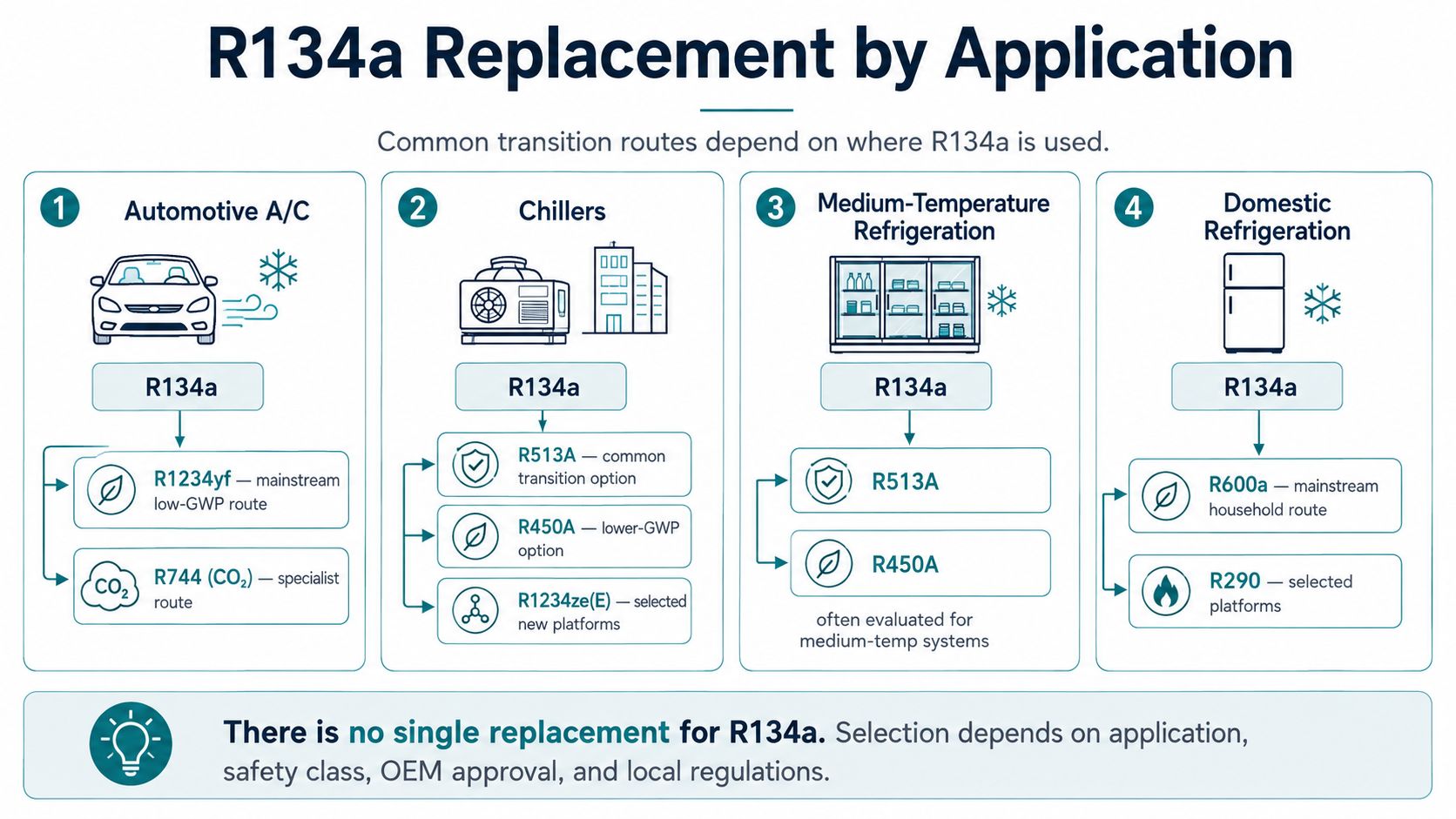
Main refrigerant routes discussed as R134a alternatives
“Replacement” can mean retrofit, new-equipment transition, or an entirely different system architecture. Read the final column carefully.
| Refrigerant | GWP | Safety | Type | Main Role | Typical Context | Replacement Meaning |
|---|---|---|---|---|---|---|
| R134a | 1,430 | A1 | HFC | Installed-base reference | MVAC, chillers, medium-temp refrigeration, legacy domestic equipment | Legacy baseline |
| R1234yf | 1 | A2L | HFO | Main automotive route | New passenger-vehicle MVAC and selected other uses | New-equipment / OEM platform |
| R513A | 630 | A1 | HFO/HFC blend | A1 R134a-class transition | Chillers, medium-temperature refrigeration, selected process AC | Retrofit/new-equipment depending OEM |
| R450A | 601 | A1 | HFO/HFC blend | A1 R134a-class alternative | Chillers and medium-temperature refrigeration | Retrofit/new-equipment depending system |
| R600a | 1 | A3 | Hydrocarbon | Domestic refrigeration platform | Household refrigerators/freezers and small sealed systems | Purpose-designed small-charge platform |
| R744 | 1 | A1 | Carbon dioxide | Specialist natural route | Selected MVAC, heat pumps and refrigeration architectures | Distinct high-pressure platform |
How the main R134a replacement routes differ
The most useful replacement answer depends on system condition, end use, safety class, GWP, regulation and the equipment manufacturer’s approved operating envelope.
R1234yf
HFO · GWP 1The most important R134a replacement route in modern passenger-vehicle air conditioning. EPA SNAP lists HFO-1234yf as acceptable with use conditions in specified newly manufactured vehicle categories, while HFC-134a is unacceptable for all newly manufactured vehicles as of MY 2026 under the cited SNAP status.
R513A
R134a / R1234yf blend · GWP 630R513A is a key nonflammable lower-GWP alternative in positive-displacement and centrifugal chillers and in selected refrigeration uses. EPA SNAP lists it as acceptable in these chiller categories.
R450A
R134a / R1234ze(E) blend · GWP 601R450A is another established A1 alternative for R134a-class chillers and medium-temperature refrigeration. EPA SNAP lists it as acceptable in centrifugal and positive-displacement chillers.
R600a
Isobutane · GWP 1R600a is the dominant modern route in many household refrigerator designs. It represents a move to purpose-designed, small-charge sealed hydrocarbon systems rather than a universal field conversion of existing R134a appliances.
R744
CO₂ · GWP 1R744 provides a very-low-GWP, nonflammable pathway in selected vehicle and refrigeration architectures. In MVAC it is a fundamentally different high-pressure system, and the European Commission identifies R744 as an emerging alternative in some vehicle applications.
Platform
Application firstThe phrase “replace R134a” has different meanings in different sectors. A low-GWP candidate can replace the market role of R134a without being approved as a drop-in refrigerant for an existing system.
Existing R134a system vs new equipment project
Keeping an installed system alive and choosing refrigerant for a new platform are different engineering decisions.
Existing R134a Equipment
Continue, repair, retrofit, or replace depending on the actual equipment categoryNew Equipment Project
Choose the refrigerant by sector, regulation and equipment architectureWhy a lower-GWP alternative is not automatically a drop-in replacement
Refrigerant transitions can change safety, pressure, capacity, oil return, temperature glide, components, controls and regulatory obligations.
Application Category
R134a served many unrelated system types; the same substitute cannot be assumed across MVAC, chillers and domestic refrigeration.
Safety Classification
R134a is A1, while important alternatives include A2L and A3 refrigerants that require different risk controls.
Pressure & Capacity
R744 is a high-pressure architecture; R513A and R450A have different capacity and thermodynamic behavior from R134a.
Regulatory Path
U.S. SNAP and Technology Transitions rules, EU F-gas rules and MVAC-specific regulations can lead to different answers by sector.
How current U.S. and EU rules affect the R134a transition
Regulation is application-specific and time-sensitive. The summaries below explain the main strategic direction without pretending every piece of equipment has the same compliance date.
United States
EPA · SNAP · Technology Transitions / ODS rulesIn the United States, R134a transition rules are sector-specific. EPA Technology Transitions sets a 150 GWP limit for light-duty passenger-vehicle A/C beginning MY2025 and a 700 GWP limit for comfort-cooling chillers from January 1, 2025. EPA SNAP separately lists substitute acceptability and use conditions.
European Union
EU refrigerant / F-gas / ODS frameworkThe EU has already moved new passenger cars away from R134a through the MAC Directive’s GWP <150 requirement, while Regulation (EU) 2024/573 tightens new stationary refrigeration and chiller categories over time.
New passenger cars using refrigerants above GWP 150 are prohibited under the MAC Directive; R1234yf became the main substitute.
Many self-contained refrigeration categories are already at GWP 150 or lower, depending on the exact equipment definition.
Chiller and other stationary categories tighten further under Regulation (EU) 2024/573, so long-term suitability must be checked by equipment class.
Use the site tools to evaluate R134a replacement options
Use these tools for screening and comparison, then confirm the final retrofit or equipment route with the applicable OEM and regulatory requirements.
Refrigerant Finder
Screen refrigerants by application, system context and project goals.
Open Finder →Comparison Tool
Compare R134a with alternative refrigerants side by side.
Compare Refrigerants →GWP Calculator
Estimate direct GWP reduction from moving away from R134a.
Calculate GWP →CO₂e Calculator
Convert refrigerant charge into direct CO₂-equivalent emissions.
Calculate CO₂e →Pressure-Temperature Chart
Review P-T behavior before comparing retrofit or service conditions.
Open P-T Chart →Common R134a replacement questions
Direct answers to common replacement, retrofit and phaseout questions.
What is the best replacement for R134a?
There is no single best replacement. R1234yf is the main new passenger-vehicle route, R513A and R450A are important A1 chiller/refrigeration routes, and R600a is common in modern domestic refrigeration.
Can R1234yf replace R134a?
It replaces R134a in the market role of new MVAC systems, but it should not be treated as a universal drop-in recharge for an older R134a vehicle.
Can R513A replace R134a?
R513A is an important lower-GWP A1 option for selected R134a-class chillers and refrigeration equipment, subject to OEM and system suitability.
Can R450A replace R134a?
R450A is another A1 lower-GWP route for selected chiller and medium-temperature refrigeration applications.
Can R600a replace R134a in a refrigerator?
Modern household refrigerators often use R600a, but an existing R134a appliance should not be converted casually because hydrocarbon safety and equipment design are fundamental.
Can CO2 replace R134a?
R744 can replace the application role of R134a in selected systems, but it requires a fundamentally different high-pressure architecture.
What is the GWP of R134a?
The EPA Technology Transitions reference table lists HFC-134a at GWP 1,430.
Is R134a banned in cars?
For U.S. newly manufactured vehicles, SNAP status and Technology Transitions rules have moved specified vehicle categories away from HFC-134a. Existing vehicles remain a separate service issue.
Is R134a still used in chillers?
It remains in the installed base, but current U.S. SNAP and Technology Transitions rules push new comfort-cooling chillers toward lower-GWP refrigerants.
Is R134a A1?
Yes. R134a is classified A1.
Does a lower GWP refrigerant always save energy?
No. GWP is a climate metric; system efficiency depends on refrigerant thermodynamics, compressor and heat-exchanger design, controls and operating conditions.
What should I compare next?
Use the refrigerant comparison tool and application guides, then confirm the final route against OEM and current regulatory requirements.
Authoritative sources used for this page
Primary regulator sources are prioritized, with technical manufacturer guidance used to explain real retrofit practice where appropriate.
Current EPA reference GWPs including HFC-134a, R513A, R450A, R744 and HFO-1234yf.
Open source →Current GWP limits and dates for MVAC, chillers, stand-alone refrigeration and other sectors.
Open source →Current substitute status and use conditions for HFC-134a, HFO-1234yf and other MVAC refrigerants.
Open source →Official EU overview of R134a transition in mobile A/C and alternatives such as R1234yf and R744.
Open source →Official listing showing R450A and R513A as acceptable alternatives in this chiller category.
Open source →Official overview of lower-GWP refrigeration alternatives and replacement relationships.
Open source →Need help comparing replacement routes?
Start with the comparison and refrigerant-finder tools, then confirm the final choice against system condition, OEM documentation, application category and current regulations.