R410A Replacement: R32, R454B, R452B & Low-GWP Alternatives
R410A remains one of the most important installed-base refrigerants in comfort air conditioning and heat pumps. But for new equipment, the market is moving toward lower-GWP refrigerants such as R32, R454B and R452B, while natural-refrigerant platforms such as R290 and R744 are also gaining relevance in selected architectures.
Existing R410A systems can generally continue to operate and be serviced, while new equipment is increasingly designed for lower-GWP refrigerants. Candidate transition routes include R32, R454B, R452B, and selected natural-refrigerant platforms such as R290 or R744 depending on the system architecture.
Read R410A replacement in two separate ways
Many searchers use “R410A replacement” for two different questions: what to do with an existing system, and what refrigerant route to choose for new equipment. Separating these paths makes the topic easier to use and less likely to be misunderstood.
Existing system working
Keep using the system in accordance with OEM service guidance. Replacement is not automatically required just because R410A is a higher-GWP refrigerant.
Existing system needs repair
Repair the legacy system through the approved service path. That is different from choosing a new refrigerant and redesigning the system around it.
New equipment selection
This is where R32, R454B, R452B and selected natural-refrigerant platforms become relevant as lower-GWP alternatives to new R410A equipment.
Existing R410A system vs new equipment project
The uploaded infographic below summarizes the central message of this page: a system role replacement is not automatically the same thing as a refrigerant retrofit.
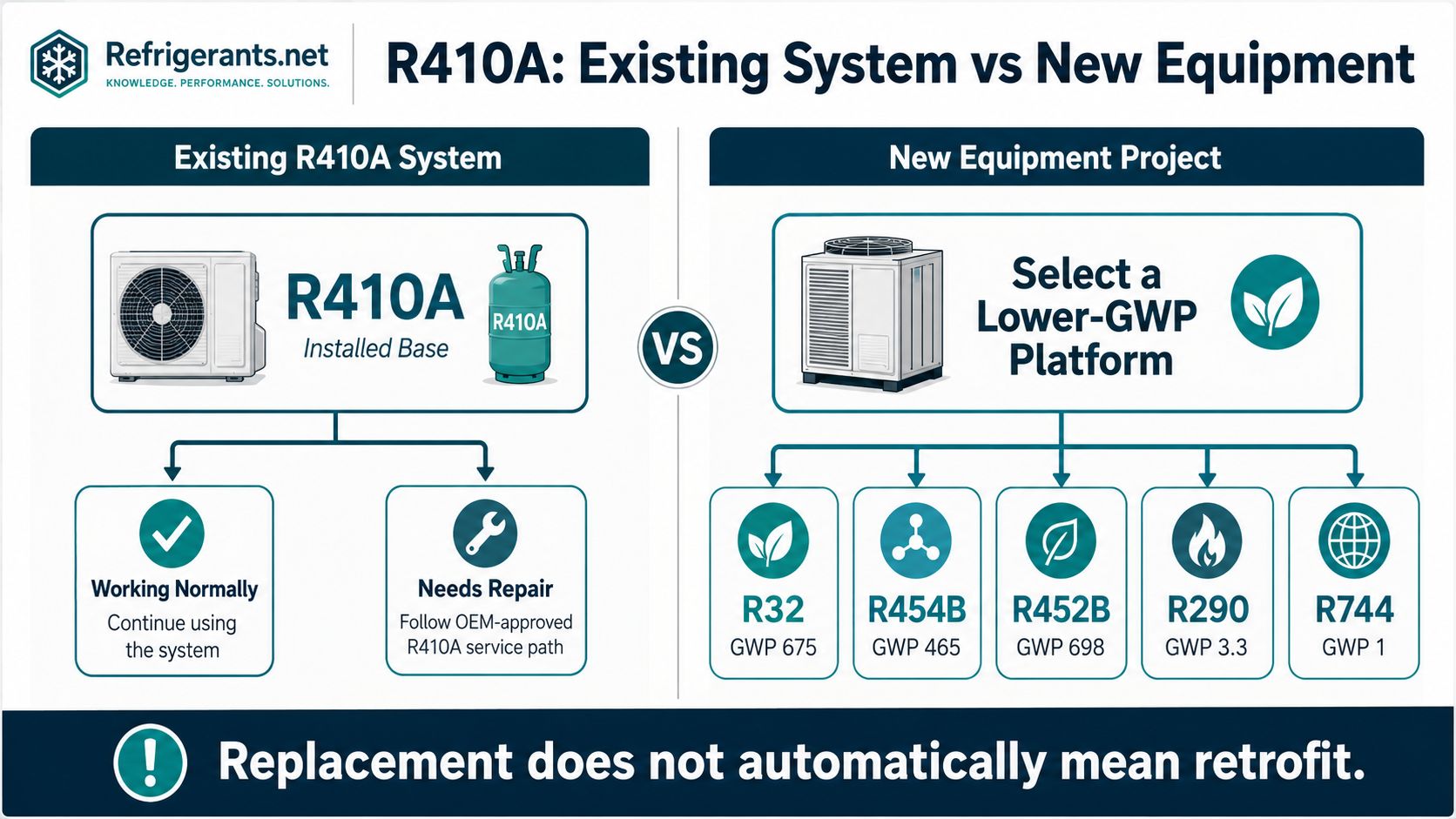
Main refrigerant routes discussed as R410A alternatives
The table below is intended for research and comparison. “Alternative” here usually means a route for a new equipment platform, not a statement of retrofit compatibility.
| Refrigerant | GWP | Safety | Type | Main Role | Typical Context | Replacement Meaning |
|---|---|---|---|---|---|---|
| R410A | 2,088 | A1 | HFC blend | Installed-base reference | Existing residential/light-commercial AC and heat pumps | Legacy baseline, not the transition target |
| R32 | 675 | A2L | Single-component HFC | Major new-equipment route | Residential and light-commercial HVAC / heat pumps | Lower-GWP new platform, not universal drop-in |
| R454B | 465 | A2L | HFO/HFC blend | Leading lower-GWP route | New equipment, especially North American transition | New-equipment route, not universal retrofit |
| R452B | 698 | A2L | HFO/HFC blend | Selected sub-700 route | Selected new HVAC/heat-pump platforms | Application-specific alternative to new R410A systems |
| R290 | 3.3 | A3 | Hydrocarbon | Natural-refrigerant platform | Purpose-designed systems in suitable architectures | Alternative system platform, not like-for-like retrofit |
| R744 | 1 | A1 | Carbon dioxide | Specialist natural route | Selected heat pump and water-heating architectures | Alternative equipment architecture |
R32, R454B, R452B, R290 and R744 as R410A alternatives
These are the main refrigerants most often discussed when people ask what is replacing R410A. They do not all solve the same problem, and they should not be treated as direct substitutes for one another.
R32
Single-component HFC · GWP 675R32 is one of the most important lower-GWP routes replacing new R410A equipment in residential and light-commercial HVAC. It sits below the U.S. 700-GWP threshold for the relevant sector table, but it remains an A2L refrigerant and must be used in equipment designed and listed for it.
R454B
R32 / R1234yf blend · GWP 465R454B is a leading lower-GWP transition route for new comfort-cooling and heat-pump equipment. It offers a materially lower GWP than R410A and is widely discussed in the North American transition, but it is still a mildly flammable A2L refrigerant and not a blanket retrofit answer.
R452B
HFO/HFC blend · GWP 698R452B is another A2L option used in selected new-equipment platforms. Because its GWP is very close to the U.S. 700-GWP limit, it is particularly important to read the current sector restrictions carefully and avoid over-generalizing future suitability across all markets.
R290 — Propane
Natural refrigerant · GWP 3.3R290 is a very-low-GWP natural-refrigerant route. It is best understood as a purpose-designed system platform rather than a simple replacement gas for legacy R410A equipment. Its A3 classification is central to system design, charge management and application suitability.
R744 — Carbon Dioxide
Natural refrigerant · GWP 1R744 is a specialist natural-refrigerant platform used in selected heat pumps, water-heating systems and other high-pressure architectures. It offers very low direct climate impact, but its pressure and equipment architecture make it fundamentally different from a conventional R410A system.
Alternative platform ≠ retrofit refrigerant
Key interpretation ruleWhen an article says R32, R454B, R452B, R290 or R744 is “replacing R410A,” that often means they are replacing the role of new R410A equipment in the market. It does not automatically mean the refrigerant can be placed into an existing R410A system.
What should you do if you already have an R410A system?
The right answer depends on whether the existing system is operating normally, needs repair, or has reached end of life.
Existing R410A System
Continue, service, or replace — depending on system conditionNew Equipment Project
Move to the appropriate lower-GWP refrigerant platformWhy R32 or R454B cannot be assumed to replace R410A in an older system
Even when a new refrigerant appears similar on paper, retrofit suitability depends on far more than whether the refrigerant is used in the same general application category.
Safety Classification
R410A is A1, while R32, R454B and R452B are A2L. R290 is A3. Safety class influences system design, installation rules and approval status.
Equipment Listing
A refrigerant must be used in equipment designed, tested and listed for that refrigerant. A market transition route is not the same as approval for retrofit.
Thermodynamic Behavior
Pressure-temperature behavior, capacity, discharge conditions, control settings and overall system performance may differ significantly across refrigerants.
System Components
Compressors, heat exchangers, controls and refrigerant-management features are selected around a specific refrigerant and its application envelope.
How current U.S. and EU rules shape the R410A transition
Regulatory language is highly specific. The main practical distinction is that rules target new equipment placement and installation, while legacy systems and servicing are treated differently.
United States
AIM Act · Technology Transitions · SNAPEPA's Technology Transitions table sets a 700 GWP limit for stationary residential and light-commercial air conditioning and heat pumps. This is why lower-GWP new-equipment routes such as R32, R454B and R452B are central to the current transition.
European Union
Regulation (EU) 2024/573The EU framework pushes many air-conditioning and heat-pump categories toward much lower-GWP refrigerants over time. Because R410A has a GWP above 2,000, it is increasingly out of step with future-facing EU placement-on-the-market rules.
Single split systems containing less than 3 kg of Annex I fluorinated greenhouse gases: GWP 750-or-more restriction.
Self-contained air-conditioning equipment and heat pumps up to 12 kW: GWP 150-or-more restriction, with stated safety exceptions. Split air-to-water systems up to 12 kW also tighten.
Further staged restrictions affect split systems and larger equipment categories, making category-specific compliance essential.
Use the site tools to evaluate R410A transition options
These tools help compare refrigerants, estimate emissions and review application fit, but none of them by itself determines retrofit legality or engineering approval.
Refrigerant Finder
Screen refrigerants by application, system context and project goals.
Open Finder →Comparison Tool
Compare R410A with lower-GWP alternatives side by side.
Compare Refrigerants →GWP Calculator
Estimate the GWP reduction from shifting away from R410A.
Calculate GWP →CO₂e Calculator
Convert refrigerant quantity into direct CO₂-equivalent emissions.
Calculate CO₂e →Pressure-Temperature Chart
Check P-T behavior to understand thermodynamic differences.
Open P-T Chart →Common R410A replacement questions
Direct answers to the most common search questions around R410A replacement, transition and retrofit interpretation.
What is replacing R410A?
For new equipment, common transition routes include R32, R454B and R452B, with R290 and R744 relevant in selected natural-refrigerant architectures.
Is there a drop-in replacement for R410A?
No universal drop-in replacement should be assumed. Replacement in the market sense is not the same as retrofit compatibility for an existing system.
Can R32 replace R410A?
R32 is a major lower-GWP new-equipment route, but it should not be assumed to be a universal retrofit refrigerant for older R410A systems.
Can R454B replace R410A?
R454B is an important lower-GWP replacement route for new equipment, especially in current HVAC transitions, but not a blanket swap for legacy systems.
Can an existing R410A system still be used?
Yes, existing systems can continue to operate and be serviced under the relevant regulatory and OEM framework.
Can an R410A system still be repaired?
Yes. Repair and servicing of legacy R410A systems are different from manufacturing or installing new higher-GWP equipment.
Why can't I just recharge an old R410A unit with R454B?
Because safety class, equipment listing, thermodynamic behavior and system design all matter. Similar application does not prove retrofit suitability.
What is the GWP of R410A?
R410A is 2,088 on the EPA Technology Transitions reference basis used on this site.
Which R410A alternative has the lowest GWP?
Natural-refrigerant platforms such as R744 and R290 have much lower direct GWP than R410A, but that does not make them universal retrofit answers.
What does the U.S. 700-GWP rule mean?
It means certain new residential and light-commercial AC and heat-pump equipment must transition away from higher-GWP refrigerants such as R410A.
Does lower GWP automatically mean better performance?
No. GWP measures direct climate impact, while efficiency and operating performance depend on thermodynamics, components and system design.
What page should I read next?
Start with the heat-pump guide, refrigerant comparison tool and U.S. regulations page if you want to move from a general overview into a more specific project decision.
Authoritative sources used for this page
Time-sensitive regulatory statements are grounded in current primary sources. Always verify the latest official text for the exact end use and jurisdiction.
EPA overview of current HFC restriction tables, including residential and light-commercial AC and heat-pump categories.
Open EPA sector table →EPA FAQ covering existing systems, servicing, components and technician questions relevant to R410A split systems.
Open EPA FAQ →End-use-specific substitute listings and use conditions for R32, R454B, R452B and other refrigerants.
Open SNAP table →EPA reference GWPs for refrigerants such as R410A, R32, R454B and R452B, alongside the current EU fluorinated-gas framework.
Open GWP table →Need help comparing lower-GWP routes after R410A?
Start with the comparison and GWP tools, then confirm the final refrigerant route against OEM documentation, the application category and the current regulations for your target market.