Commercial Refrigeration Refrigerants: CO2, R290, R454C, R455A & HFC Transition
Commercial refrigeration is not one end use. A supermarket rack, a remote condensing unit and a self-contained display case can require entirely different refrigerant strategies. Architecture is therefore the most important first step in low-GWP selection.
Major natural-refrigerant route for centralized supermarket systems and selected stand-alone equipment.
Strong route for self-contained commercial cases and other purpose-designed stand-alone equipment.
Used in selected small self-contained commercial and domestic-style appliances.
Sub-150 route listed for supermarket and remote-condensing applications subject to use conditions.
Sub-150 new-equipment route listed by EPA for multiple retail-food categories.
Sub-150 option in new supermarket and remote-condensing equipment subject to use conditions.
Important earlier R404A transition blends, now increasingly constrained for new systems by lower GWP limits.
How to choose refrigerants for commercial refrigeration
Start with the equipment architecture and duty, then screen safety classification, regional regulation, environmental metrics and OEM approval.
Stand-alone, remote condensing, centralized rack and cascade systems have different refrigerant constraints.
Large centralized systems and small cases carry very different leak and regulatory implications.
Medium-temperature and low-temperature loads may be served by one or multiple circuits.
A3 and A2L refrigerants in occupied retail spaces require equipment and charge strategies matched to standards.
U.S. stand-alone limits are already at 150, while supermarket and remote-condensing systems use staged limits through 2032.
Commercial Refrigeration refrigerant comparison
This matrix describes broad engineering and market roles. It is not an equipment approval or retrofit authorization.
| Refrigerant | EPA GWP | Safety | Stand-Alone | Supermarket / Rack | Remote Condensing |
|---|---|---|---|---|---|
| R744 | 1 | A1 | Accepted route | Strong centralized route | Selected |
| R290 | 3.3 | A3 | Strong purpose-designed route | Not a general central-rack route | Application-specific |
| R600a | 1 | A3 | Selected small equipment | Not typical | Not typical |
| R454C | 146 | A2L | End-use specific | New route with use conditions | New route with use conditions |
| R455A | 146 | A2L | End-use specific | New route with use conditions | New route with use conditions |
| R457A | 137 | A2L | End-use specific | New route with use conditions | New route with use conditions |
| R448A | 1,386 | A1 | Legacy / transition | Installed base / earlier transition | Installed base / earlier transition |
| R449A | 1,396 | A1 | Legacy / transition | Installed base / earlier transition | Installed base / earlier transition |
Major refrigerant pathways for commercial refrigeration
Different system architectures can meet the same application need with very different refrigerant strategies.
Self-contained cases
R290 · R600a · R744 and other sub-150 routesThe U.S. 150-GWP product limit makes hydrocarbon and other very-low-GWP architectures especially relevant in stand-alone commercial refrigeration.
Centralized supermarket systems
R744 transcritical / cascade + sub-150 A2L optionsCentral racks must be evaluated as complete systems. CO2 is a major natural route; EPA also lists new A2L alternatives subject to use conditions.
Remote condensing units
Sub-150 / sub-300 planningEPA’s staged 2026/2032 limits make charge size and high-side cascade configuration central to future refrigerant selection.
Legacy R404A / R507A transition
R448A · R449A and other earlier A1 alternativesR448A and R449A reduced GWP relative to R404A but now sit near or above several current U.S. interim limits, shifting them toward installed-base management.
Current U.S. and EU transition framework
Regulatory limits are application-specific. Always check the exact equipment category, compliance date and use conditions.
U.S. commercial refrigeration rules differ sharply by stand-alone, supermarket and remote-condensing architecture
EU commercial refrigeration already pushes many self-contained and centralized systems below 150 GWP
Safety class changes system design — not just the label
Flammability, toxicity, pressure and charge characteristics must be evaluated together.
R744 · R448A · R449A
CO2 is A1 but high-pressure; legacy HFC blends are A1 but carry higher direct climate impact.
R290 · R600a
Very low GWP with higher flammability; especially suited to purpose-designed small-charge stand-alone equipment.
R454C · R455A · R457A
Sub-150 fluorinated routes require charge, leak-detection and ignition-risk controls defined by equipment standards and listing conditions.
All safety classes
A refrigerant appropriate for a sealed display case is not automatically appropriate for a large supermarket rack.
Where the major refrigerant routes fit
These examples organize the application by system type and decision context rather than treating one refrigerant as universally best.
Plug-in display case
Small-charge self-contained route.
R290 · R600a · R744Supermarket transcritical rack
Centralized natural-refrigerant route.
R744Distributed / remote condensing
A2L sub-150 routes subject to use conditions.
R454C · R455A · R457ACascade supermarket
Can combine very-low-GWP low side with a separate high-stage circuit.
R744 low side + application-specific high sideLegacy HFC rack
Installed-base service / retrofit strategy.
R448A · R449A · older R404A/R507AFood processing / dispensing equipment
Do not assume the supermarket list automatically covers every retail-food product.
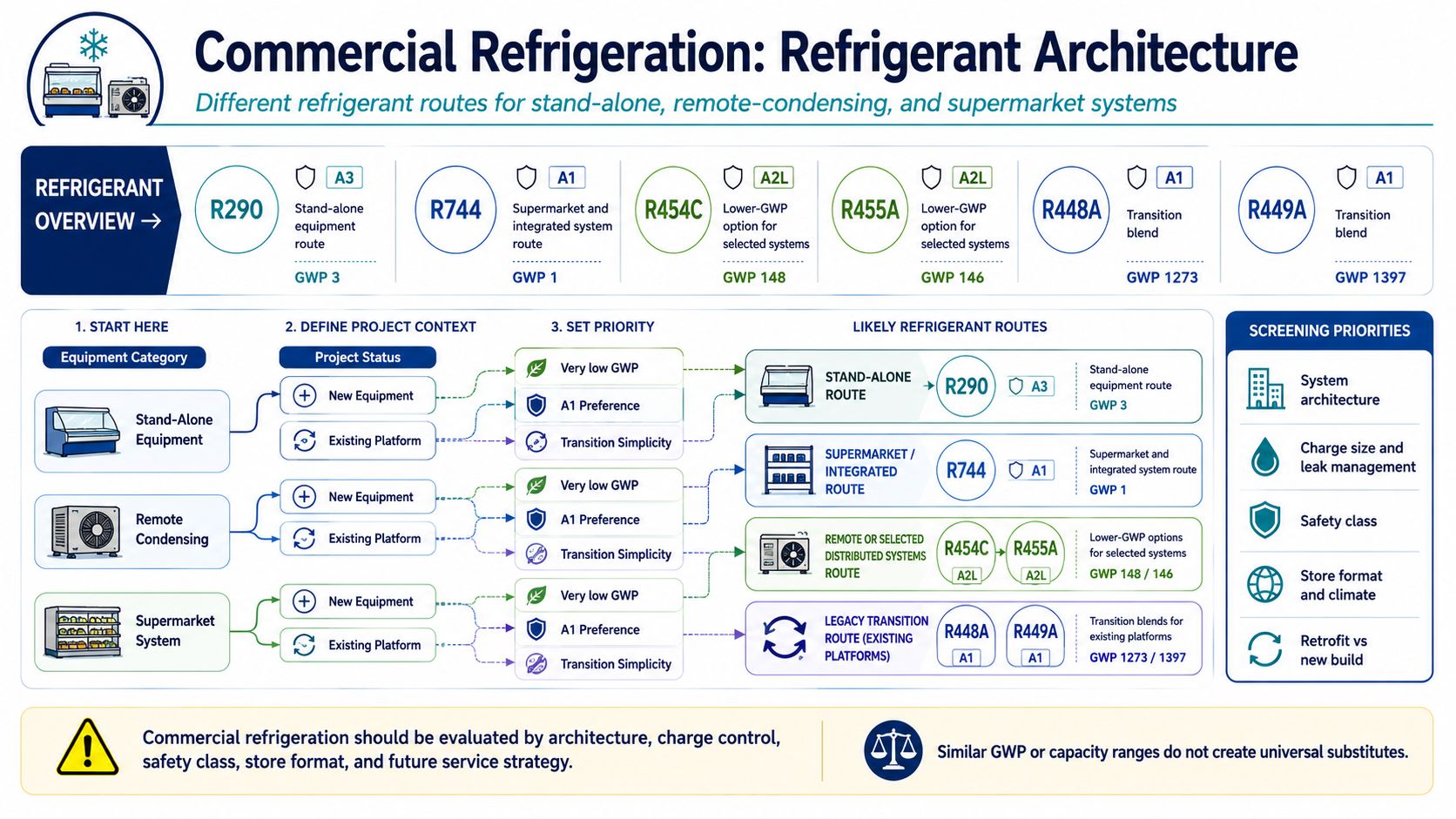
End-use-specific SNAP optionsA practical refrigerant-screening flow for commercial refrigeration
Use the system map below to move from application architecture to safety, regulatory and OEM-approved refrigerant choices.
Move from application to evidence
Use each tool for a different part of the refrigerant decision.
Refrigerant Finder
Screen by application, GWP target and safety context.
Open Finder →Comparison Tool
Compare GWP, safety and application role side by side.
Compare →GWP Calculator
Calculate refrigerant GWP reduction.
Calculate →CO₂e Calculator
Convert charge or leak mass into direct CO₂-equivalent.
Calculate CO₂e →P-T Chart
Review saturation pressure-temperature behavior.
Open P-T Chart →Commercial Refrigeration refrigerant questions
Direct answers to the most important application, safety and regulatory questions.
What refrigerants are used in commercial refrigeration?
Major routes include R744 CO2, R290 and R600a in stand-alone equipment, sub-150 A2L blends such as R454C/R455A/R457A in selected systems, and legacy R448A/R449A installations.
What is the best refrigerant for supermarkets?
There is no universal best choice.Centralized CO2, distributed A2L and other architectures can all be valid depending on store design, climate, safety and regulation.
Is R290 used in supermarkets?
Yes mainly in purpose-designed self-contained cases and other small-charge equipment, not as a generic central-rack substitute.
Is CO2 used in supermarket refrigeration?
Yes.R744 is a major natural-refrigerant route for transcritical and cascade supermarket systems.
What is the U.S. GWP limit for stand-alone commercial refrigeration?
150 from January 1, 2025 under Technology Transitions.
What is the U.S. supermarket GWP limit?
An interim 1,400 limit applies from January 1, 2027, tightening to 150 or 300 in 2032 depending on charge and configuration.
What is the U.S. remote-condensing limit?
An interim 1,400 limit applies from July 27, 2026, tightening to 150 or 300 in 2032.
Are R448A and R449A still relevant?
Yes in the installed base and earlier transition projects, but their GWPs are above the long-term 150/300 U.S.pathway for many new retail-food systems.
Are R454C and R455A acceptable in U.S. supermarket systems?
EPA lists them for new typical supermarket systems subject to use conditions.
Why can’t one commercial-refrigeration refrigerant list cover every store?
Because stand-alone equipment, remote condensing units, racks and food-processing equipment are distinct regulatory and engineering end uses.
What is the EU direction for commercial refrigeration?
Many self-contained and large centralized commercial systems already face <150-GWP pathways, with broader stationary refrigeration restrictions tightening in 2030.
How should a retailer choose a refrigerant?
Choose the store architecture first, then evaluate charge, safety, climate, regulation, maintenance capability and lifecycle emissions.
Primary references behind this guide
Time-sensitive claims prioritize current government and standards sources.
Current supermarket refrigerant listings.
Open source →Current remote-condensing refrigerant listings.
Open source →Current self-contained commercial equipment listings.
Open source →Current stand-alone, supermarket and remote-condensing limits.
Open source →EU stationary and commercial refrigeration prohibitions.
Open source →Safety-class reference.
Open source →Need help narrowing a commercial refrigeration refrigerant route?
Start with the application architecture, compare refrigerant properties, then verify the exact OEM platform and regulatory requirements.