Cold Storage Refrigerants: Ammonia, CO2, R454C, R455A & Transition Options
Cold-storage refrigerant choice is inseparable from plant architecture. Large ammonia engine rooms, low-charge ammonia packages, ammonia/CO2 cascades, transcritical CO2 systems and lower-GWP A2L direct-expansion platforms each solve different combinations of charge, temperature, safety and lifecycle requirements.
Traditional industrial cold-storage route; especially strong in large centralized systems.
CO2 used in transcritical, cascade and secondary architectures.
Sub-150 A2L option listed by EPA for new cold-storage equipment subject to use conditions.
Sub-150 A2L blend with cold-storage SNAP listing subject to use conditions.
Sub-150 A2L new-equipment option listed by EPA.
Sub-150 A2L route listed in cold storage with use conditions.
Important installed-base / earlier-transition blends, but above the current U.S. cold-storage interim 700-GWP new-system limit.
How to choose refrigerants for cold storage
Start with the equipment architecture and duty, then screen safety classification, regional regulation, environmental metrics and OEM approval.
Large distribution centers and small cold rooms can justify very different refrigerant architectures.
Frozen, chilled and multi-temperature facilities change suction pressures and system design.
Engine-room ammonia, distributed packages, cascade and DX systems change refrigerant charge and leak exposure.
Ammonia toxicity, A2L flammability and CO2 pressure must be handled within the plant design.
U.S. cold-storage limits tighten again in 2032; EU stationary refrigeration moves broadly toward <150 GWP in 2030.
Cold Storage refrigerant comparison
This matrix describes broad engineering and market roles. It is not an equipment approval or retrofit authorization.
| Refrigerant | EPA GWP | Safety | Cold Storage Role | Architecture | Long-Term Signal |
|---|---|---|---|---|---|
| R717 | 1 | B2L | Large industrial warehouses | Central / low-charge / cascade | Strong natural route |
| R744 | 1 | A1 | Frozen / chilled / cascade | Transcritical / cascade / secondary | Strong natural route |
| R454C | 146 | A2L | New lower-GWP DX | Distributed / DX | Sub-150 pathway |
| R455A | 146 | A2L | New lower-GWP DX | Distributed / DX | Sub-150 pathway |
| R457A | 137 | A2L | New lower-GWP DX | Distributed / DX | Sub-150 pathway |
| R516A | 140 | A2L | New lower-GWP DX | Distributed / DX | Sub-150 pathway |
| R448A | 1,386 | A1 | Installed base / retrofit | DX | Earlier transition, not current U.S. new-system path |
| R449A | 1,396 | A1 | Installed base / retrofit | DX | Earlier transition, not current U.S. new-system path |
Major refrigerant pathways for cold storage
Different system architectures can meet the same application need with very different refrigerant strategies.
Ammonia vapor compression
R717EPA’s refrigeration overview states that the majority of U.S. cold storage warehouses use ammonia. It remains a core large-plant route because of thermodynamic performance and industrial familiarity, but requires ammonia-specific safety and materials design.
Ammonia / CO2 cascade
R717 high stage + R744 low stageCascade systems can keep ammonia out of occupied cold spaces while using CO2 on the low-temperature side. The high-stage circuit is treated separately in some regulatory tables.
CO2 transcritical / pumped CO2
R744CO2 offers GWP 1 and A1 classification but requires high-pressure components and controls designed for CO2 operation.
Sub-150 A2L DX
R454C · R455A · R457A · R516AEPA lists these refrigerants for new cold-storage equipment subject to use conditions, creating a fluorinated sub-150 pathway for suitable equipment.
Current U.S. and EU transition framework
Regulatory limits are application-specific. Always check the exact equipment category, compliance date and use conditions.
U.S. cold-storage systems: 700 GWP now, then 150/300 in 2032
EU cold storage: most stationary refrigeration moves toward <150 GWP by 2030
Safety class changes system design — not just the label
Flammability, toxicity, pressure and charge characteristics must be evaluated together.
R717 ammonia
Higher toxicity group and lower flammability; requires ammonia-specific detection, ventilation, emergency planning and materials compatibility.
R744 CO2
Nonflammable but high-pressure; leak concentration and pressure-relief strategy are critical.
R454C · R455A · R457A · R516A
Lower flammability requires standards-compliant charge, leak mitigation and electrical / ignition controls.
R448A · R449A
Nonflammable but comparatively high GWP; increasingly an installed-base rather than new-system strategy in the U.S.
Where the major refrigerant routes fit
These examples organize the application by system type and decision context rather than treating one refrigerant as universally best.
Large frozen warehouse
Industrial central architecture remains strong.
R717 · R717/R744 cascadeLow-charge ammonia facility
Reduces ammonia inventory while keeping ammonia thermodynamic advantages.
R717CO2 transcritical warehouse
Very low GWP with dedicated high-pressure system design.
R744Distributed DX cold rooms
Sub-150 A2L routes can align with 2032 U.S. large-charge thresholds when equipment use conditions are met.
R454C · R455A · R457A · R516ALegacy HFC warehouse
Asset management and retrofit planning remain distinct from new-system rules.
R448A · R449A · R404A / R507A historyVery-low-temperature process storage
Below −50°C may follow separate regulatory treatment and often requires specialist cascade design.
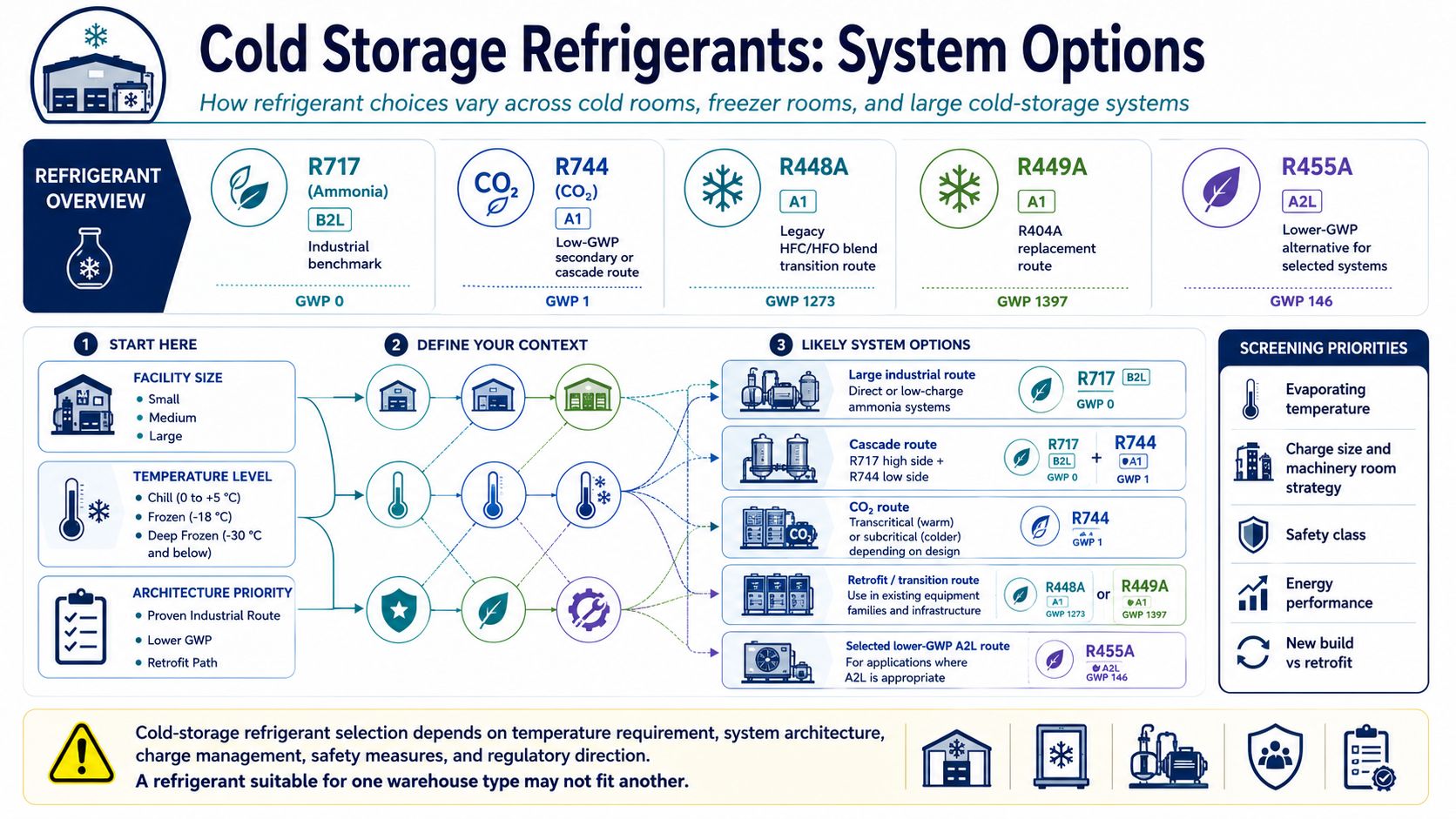
Application-specific cascadeA practical refrigerant-screening flow for cold storage
Use the system map below to move from application architecture to safety, regulatory and OEM-approved refrigerant choices.
Move from application to evidence
Use each tool for a different part of the refrigerant decision.
Refrigerant Finder
Screen by application, GWP target and safety context.
Open Finder →Comparison Tool
Compare GWP, safety and application role side by side.
Compare →GWP Calculator
Calculate refrigerant GWP reduction.
Calculate →CO₂e Calculator
Convert charge or leak mass into direct CO₂-equivalent.
Calculate CO₂e →P-T Chart
Review saturation pressure-temperature behavior.
Open P-T Chart →Cold Storage refrigerant questions
Direct answers to the most important application, safety and regulatory questions.
What refrigerant is most common in U.S. cold storage warehouses?
EPA states that the majority of U.S.cold storage warehouses use ammonia.
Why is ammonia used in cold storage?
R717 is well established in industrial refrigeration and supports large centralized systems, but requires ammonia-specific safety and materials design.
Is CO2 used in cold storage?
Yes.R744 is used in transcritical, cascade and secondary architectures and has GWP 1.
What sub-150 refrigerants are listed by EPA for new cold storage?
Examples include R454C, R455A, R457A and R516A, all listed subject to use conditions.
Can R448A or R449A be used in new U.S. cold-storage systems after July 27, 2026?
Their GWPs are above the 700 interim Technology Transitions limit, so they do not fit the general new-system pathway covered by that rule.
What is the U.S. cold-storage GWP limit in 2026?
An interim 700-GWP system limit applies from July 27, 2026.
What happens in 2032 for U.S. cold storage?
The limit tightens to 150 for systems with 200 lb or more charge, or 300 for smaller-charge systems and high-temperature cascade sides.
Does A1 make CO2 simpler than ammonia?
Not necessarily.R744 is A1 but uses much higher pressures; safety classification is only one engineering factor.
Is an ammonia/CO2 cascade system the same as a CO2 transcritical system?
No.Cascade systems use separate refrigerant circuits; transcritical CO2 uses a CO2 system operating across the critical region.
How do EU cold-storage rules differ from U.S. rules?
EU rules use placing-on-market prohibitions that broadly move stationary refrigeration toward <150 GWP by 2030, with category and safety exceptions.
Are existing HFC cold stores immediately illegal?
New-equipment restrictions and ongoing service of existing systems are different questions; service and maintenance rules must be checked separately.
How should a cold-storage refrigerant be selected?
Start with load, temperature, warehouse scale and architecture, then evaluate safety, regulation, energy use and lifecycle service strategy.
Primary references behind this guide
Time-sensitive claims prioritize current government and standards sources.
EPA overview noting ammonia prevalence in U.S. cold storage warehouses.
Open source →Current refrigerant listings and use conditions.
Open source →2026 interim and 2032 cold-storage GWP limits.
Open source →Official stationary refrigeration prohibitions.
Open source →Refrigerant designation and safety-class framework.
Open source →Internal ammonia properties and application guide.
Open source →Need help narrowing a cold storage refrigerant route?
Start with the application architecture, compare refrigerant properties, then verify the exact OEM platform and regulatory requirements.