Chiller Refrigerants: R513A, R1234ze(E), R515B & Low-GWP Options
Chiller refrigerant selection starts with compressor type, pressure level, capacity, leaving-fluid temperature, safety constraints and regional regulation. Centrifugal, screw, scroll and process chillers do not share one universal refrigerant path.
Established lower-GWP A1 route for many positive-displacement and R134a-class chiller platforms.
Very-low-GWP HFO used in selected centrifugal and positive-displacement chiller designs.
A1 blend positioned for new centrifugal and positive-displacement chillers.
Low-pressure HCFO route used in specialized chiller platforms.
Ultra-low-GWP low-pressure chiller route, including centrifugal applications.
Very-low-GWP low-pressure blend with a different toxicity classification tradeoff.
Important installed-base references; new equipment strategy increasingly moves to lower-GWP alternatives.
How to choose refrigerants for chillers
Start with the equipment architecture and duty, then screen safety classification, regional regulation, environmental metrics and OEM approval.
Centrifugal, screw, scroll and reciprocating chillers operate in different pressure and capacity ranges.
Low-pressure chiller fluids cannot be treated as direct substitutes for R134a- or R410A-class fluids.
Comfort cooling and industrial process chillers are regulated differently in the U.S.
A1, A2L and B1 classifications change machinery-room, charge and system-design considerations.
U.S. GWP limits and EU Annex IV chiller prohibitions use different thresholds and dates.
Chillers refrigerant comparison
This matrix describes broad engineering and market roles. It is not an equipment approval or retrofit authorization.
| Refrigerant | EPA GWP | Safety | Typical Chiller Role | Pressure / Architecture | Transition Position |
|---|---|---|---|---|---|
| R513A | 630 | A1 | Positive displacement / R134a-class | Medium pressure | Lower-GWP A1 route |
| R1234ze(E) | 1 | A2L | Selected centrifugal / positive displacement | Low-to-medium pressure | Very-low-GWP HFO route |
| R515B | 287 | A1 | Centrifugal / positive displacement | R1234ze(E)-class | A1 lower-GWP new equipment |
| R1233zd(E) | 4 | A1 | Low-pressure centrifugal / process | Low pressure | Ultra-low-GWP low-pressure route |
| R1224yd(Z) | 1 | A1 | Low-pressure centrifugal | Low pressure | Ultra-low-GWP A1 route |
| R514A | 3 | B1 | Low-pressure centrifugal / positive displacement | Low pressure | Very-low-GWP but B1 |
| R134a | 1,430 | A1 | Large installed base | Medium pressure | Legacy / transition reference |
| R123 | 77 | A1 | Legacy low-pressure centrifugal | Low pressure | HCFC installed-base reference |
Major refrigerant pathways for chillers
Different system architectures can meet the same application need with very different refrigerant strategies.
Low-pressure centrifugal chillers
R123 legacy → R1233zd(E), R1224yd(Z), R514A, R1336mzz(Z)Low-pressure refrigerant selection is strongly tied to compressor aerodynamics, purge design and machinery architecture. Modern routes can reach very low GWP, but safety classification and exact OEM design still differ.
R134a-class / medium-pressure chillers
R134a legacy → R513A, R515B and selected HFO routesR513A and R515B are important A1 transition options, while HFO-1234ze(E) offers a much lower GWP with A2L classification in appropriate equipment.
Positive-displacement chillers
Screw, scroll and reciprocating platformsEPA SNAP maintains separate positive-displacement chiller listings. The correct refrigerant depends on compressor envelope, heat-exchanger design, charge and safety standard.
Process chillers
Leaving-fluid temperature changes the regulatory pathwayU.S. Technology Transitions distinguishes process chillers above −30°C, −50°C to −30°C, and below −50°C. A single “chiller GWP limit” is therefore inaccurate.
Current U.S. and EU transition framework
Regulatory limits are application-specific. Always check the exact equipment category, compliance date and use conditions.
U.S. chiller transition: 700 GWP is important, but temperature band matters
EU chillers: capacity changes the 2027 and 2032 pathway
Safety class changes system design — not just the label
Flammability, toxicity, pressure and charge characteristics must be evaluated together.
R513A · R515B · R1233zd(E) · R1224yd(Z)
Nonflammability can simplify some chiller projects, but pressure, ventilation and exposure risks remain.
R1234ze(E)
Very low GWP with lower flammability; equipment and machinery-room design must match the approved platform.
R514A
Very low GWP with a different toxicity-group classification; site design and exposure management matter.
R134a · R123
Installed-base knowledge remains important even as environmental policy drives new chiller platforms.
Where the major refrigerant routes fit
These examples organize the application by system type and decision context rather than treating one refrigerant as universally best.
Large centrifugal comfort cooling
Compressor family and pressure level are the first screen.
R1233zd(E) · R1224yd(Z) · R514A · R515BScrew / scroll comfort cooling
OEM platform and safety class determine the practical route.
R513A · R515B · R1234ze(E)Industrial process chillers ≥ −30°C
U.S. 700-GWP limit is active for this temperature band.
Sub-700 options selected by process dutyProcess chillers −50 to −30°C
U.S. compliance date shifts to 2028.
Sub-700 optionsVery-low-temperature process chillers
Below −50°C is currently not covered by the U.S. Technology Transitions chiller row.
Application-specificLegacy installed base
Service and replacement planning should be separated from new-equipment rules.
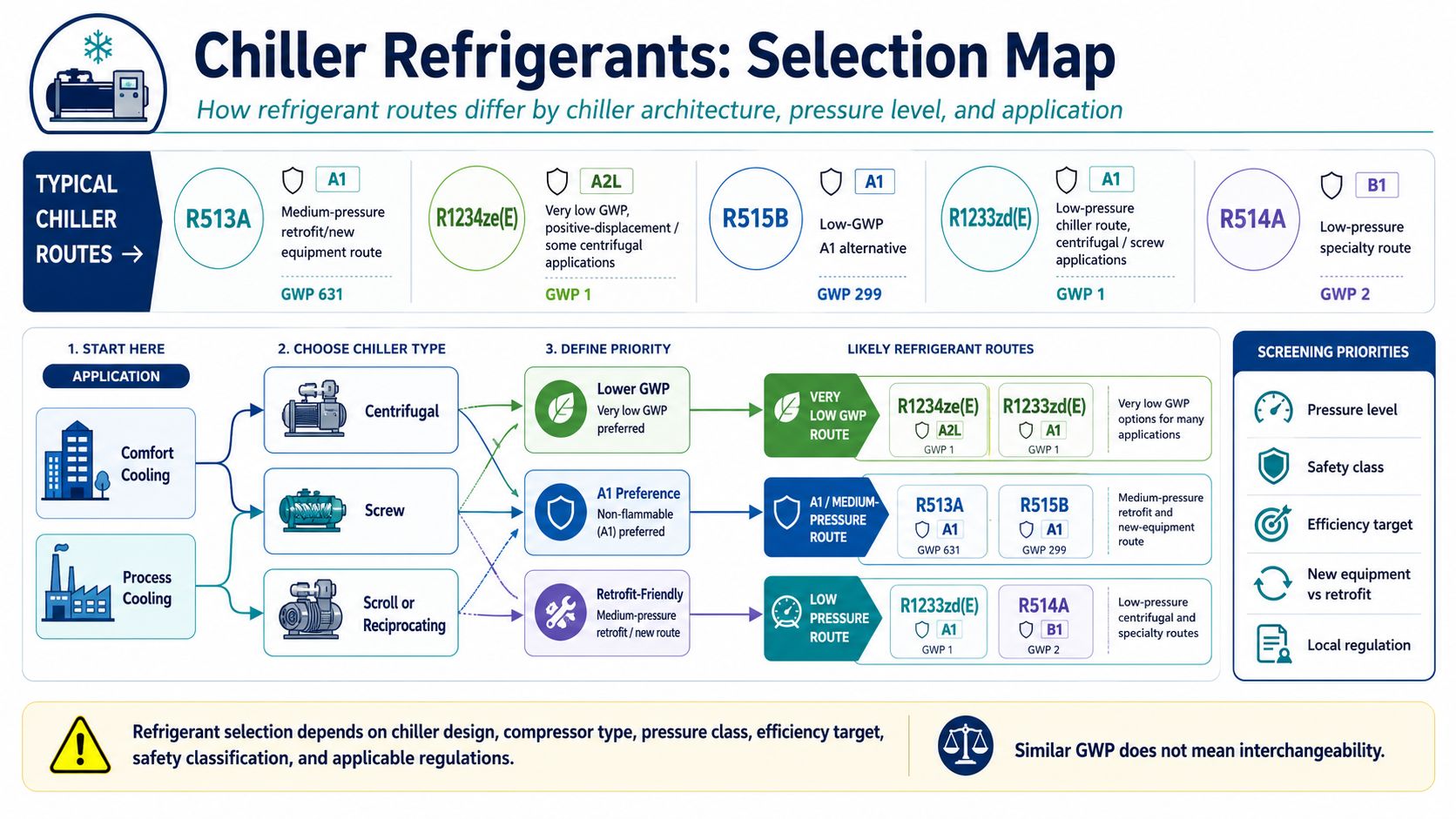
R134a · R123 · R245faA practical refrigerant-screening flow for chillers
Use the system map below to move from application architecture to safety, regulatory and OEM-approved refrigerant choices.
Move from application to evidence
Use each tool for a different part of the refrigerant decision.
Refrigerant Finder
Screen by application, GWP target and safety context.
Open Finder →Comparison Tool
Compare GWP, safety and application role side by side.
Compare →GWP Calculator
Calculate refrigerant GWP reduction.
Calculate →CO₂e Calculator
Convert charge or leak mass into direct CO₂-equivalent.
Calculate CO₂e →P-T Chart
Review saturation pressure-temperature behavior.
Open P-T Chart →Chillers refrigerant questions
Direct answers to the most important application, safety and regulatory questions.
What refrigerants are used in chillers?
Common current and transition routes include R513A, R1234ze(E), R515B, R1233zd(E), R1224yd(Z) and R514A, while R134a and R123 remain important installed-base references.
What is the best low-GWP refrigerant for chillers?
There is no universal best choice.Compressor type, pressure level, capacity, leaving-fluid temperature, safety class and OEM platform all matter.
Is R513A used in chillers?
Yes.EPA SNAP lists R513A as acceptable in positive-displacement chillers, and it is widely discussed as a lower-GWP A1 R134a-class route.
Is R1234ze(E) used in chillers?
Yes.EPA lists HFO-1234ze in centrifugal chillers, and it is used in selected low-GWP chiller designs.
Is R515B used in chillers?
Yes.EPA lists R515B as acceptable in centrifugal and positive-displacement chillers.
What is replacing R123 in chillers?
Modern low-pressure routes include R1233zd(E), R1224yd(Z), R514A and other specialized fluids, depending on the chiller platform.
Can R513A replace R134a in any chiller?
Do not assume direct interchangeability.Retrofit suitability must be verified by the chiller OEM and actual equipment design.
What is the U.S. GWP limit for chillers?
Comfort-cooling chillers use a 700-GWP limit, while industrial-process chiller dates depend on leaving-fluid temperature.
What is the EU chiller GWP limit?
From 2027, chillers ≤12 kW face a 150-GWP threshold and chillers >12 kW face a 750-GWP threshold, subject to safety exceptions; ≤12 kW tightens further in 2032.
Does A1 mean two chiller refrigerants are interchangeable?
No.Pressure level, compressor design, material compatibility and thermodynamic behavior can be completely different.
Are very-low-temperature chillers treated the same as comfort chillers?
No.U.S rules explicitly distinguish process-chiller temperature bands, and below −50°C is currently shown as not covered in the Technology Transitions table.
Should GWP be the first chiller selection criterion?
No.Start with the chiller architecture and duty, then screen regulation, safety and environmental metrics.
Primary references behind this guide
Time-sensitive claims prioritize current government and standards sources.
Current U.S. chiller GWP limits and dates.
Open source →Chiller end-use definitions and current SNAP navigation.
Open source →Centrifugal chiller refrigerant listings.
Open source →Screw, scroll and reciprocating chiller refrigerant listings.
Open source →Official EU chiller placing-on-market prohibitions.
Open source →Safety-class and refrigerant-designation reference.
Open source →Need help narrowing a chillers refrigerant route?
Start with the application architecture, compare refrigerant properties, then verify the exact OEM platform and regulatory requirements.