Refrigerants for Heat Pumps: R290, R32, R454B & Low-GWP Options
Heat pump refrigerant selection depends on system architecture, capacity, required temperature lift, safety classification, regional regulation and equipment design. Common current and emerging routes include R290, R32, R454B, R452B, R744 and, in industrial applications, R717.
Very-low-GWP natural route with strong relevance in purpose-designed heat-pump platforms.
Single-component HFC used in residential and light-commercial heat-pump platforms.
Lower-GWP blend used in new HVAC and heat-pump equipment platforms.
Sub-700 A2L blend used in selected new HVAC and heat-pump designs.
Natural-refrigerant route for specialist water-heating, commercial and high-temperature architectures.
Industrial heat-pump route for process heat, heat recovery and large systems.
Large installed base and transition reference. Higher direct GWP makes it a key legacy platform in current refrigerant-transition planning.
How to choose a refrigerant for a heat pump
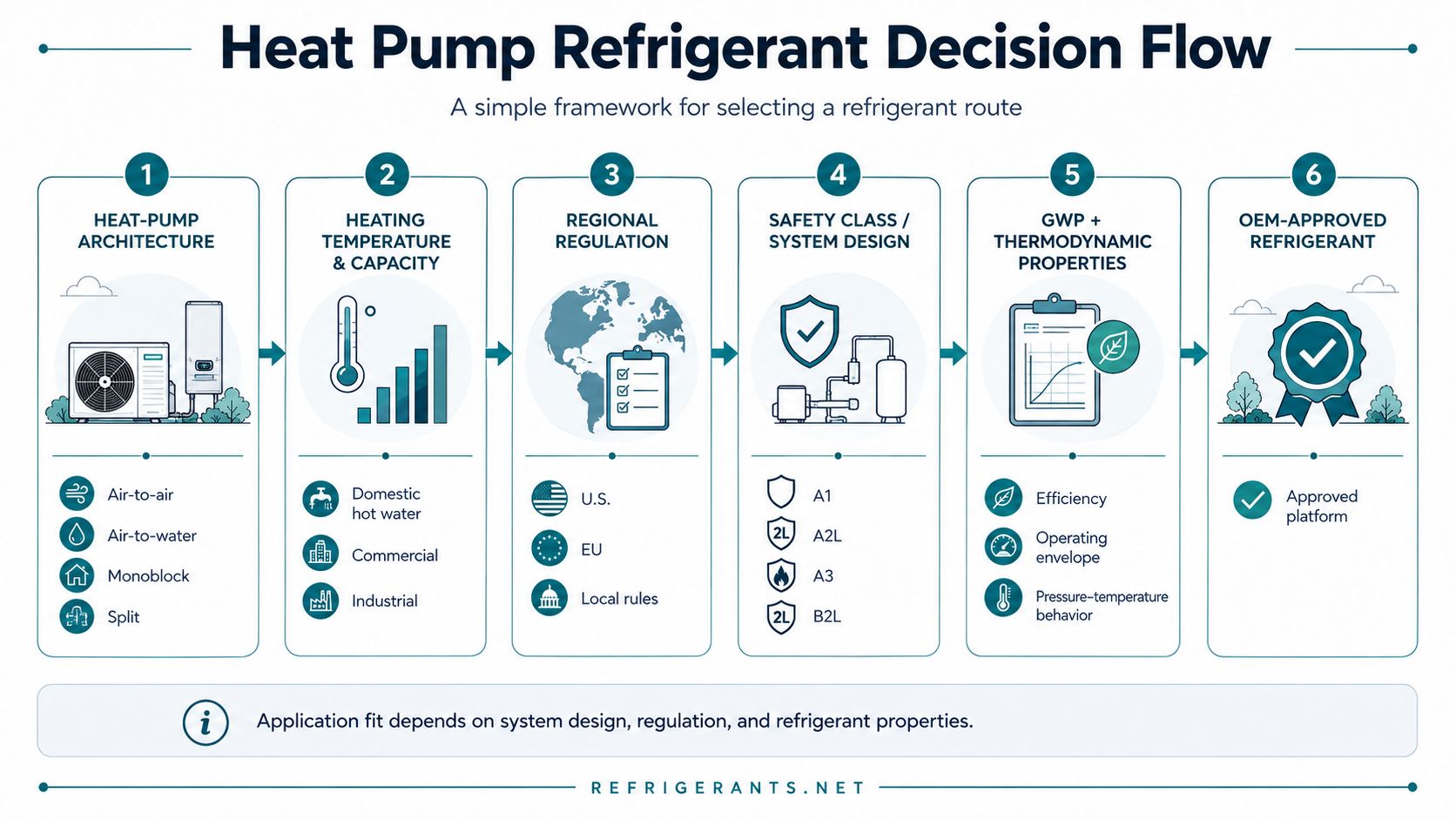
Start with the heat-pump architecture and operating requirements, then narrow the refrigerant route using regulation, safety constraints and equipment design. A low GWP number alone is not a selection decision.
1. Heat Pump Architecture
Air-to-air, air-to-water, split, monoblock, water-source, commercial and industrial platforms create different refrigerant constraints.
2. Heating Temperature
Space heating, domestic hot water and higher-temperature process heat can favor different refrigerant and compressor architectures.
3. Regional Regulation
U.S. Technology Transitions, EPA SNAP, EU F-gas rules and local codes affect refrigerant availability and equipment design differently.
4. Safety & System Design
A1, A2L, A3 and B2L classifications influence allowable equipment configurations, mitigation measures, standards and installation constraints.
5. Thermodynamic Fit
Pressure-temperature behavior, operating envelope, compressor design and system efficiency must be assessed independently from GWP.
Heat pump refrigerant comparison by application role
This matrix describes broad market and application roles. “Selected” or “common” does not mean every product, jurisdiction or installation permits the refrigerant.
| Refrigerant | GWP | Safety | Residential | Air-to-Water | Commercial | High-Temp / Industrial | Transition Role |
|---|---|---|---|---|---|---|---|
| R290 | 3.3 | A3 | Strong presence | Strong presence | Selected | Selected / application-specific | Very-low-GWP natural route |
| R32 | 675 | A2L | Common | Common / market-specific | Common | Application-specific | Current lower-GWP HFC route |
| R454B | 465 | A2L | Growing in new equipment | Selected | Growing | Application-specific | New-equipment transition route |
| R452B | 698 | A2L | Selected | Selected | Selected | Application-specific | Sub-700 new-equipment route |
| R744 | 1 | A1 | Selected / specialist | Selected | Selected | Specialist strong route | Natural, high-pressure architecture |
| R717 | 1 | B2L | Not typical | Not typical | Industrial / specialist | Strong industrial route | Industrial natural-refrigerant route |
| R410A | 2,088 | A1 | Installed base | Installed base | Installed base | Limited relevance | Higher-GWP legacy platform |
R290, R32, R454B, R452B, R744 and R717 in heat pumps
Each route solves a different combination of GWP, safety, pressure, temperature and market requirements. None is a universal answer.
R290 — Propane
Natural refrigerant · GWP 3.3R290 has become an important very-low-GWP heat-pump route, particularly in purpose-designed air-to-water and self-contained/monoblock architectures in markets where standards and product rules permit it. Its A3 classification materially affects equipment architecture, refrigerant quantity and risk controls.
R32
Single-component HFC · GWP 675R32 is widely used in residential and light-commercial HVAC and heat-pump platforms. It is below the U.S. Technology Transitions 700-GWP threshold, but its A2L classification and equipment-specific design requirements still matter. In the EU, later heat-pump restrictions can be substantially tighter than 700 GWP.
R454B
R32/R1234yf blend · GWP 465R454B is a major lower-GWP new-equipment transition route in North American residential and light-commercial HVAC. It is an A2L blend and appears on EPA's SNAP list for residential/light-commercial AC and heat-pump new equipment subject to use conditions.
R452B
HFO/HFC blend · GWP 698R452B is another sub-700 A2L route used in selected new HVAC and heat-pump platforms. EPA lists it as acceptable with use conditions for the relevant new-equipment end use. Its GWP is very close to the 700 Technology Transitions threshold, so exact regulatory basis and equipment category should be checked.
R744 — Carbon Dioxide
Natural refrigerant · GWP 1R744 is relevant to domestic hot-water heat pumps, selected commercial applications and specialist high-temperature systems. Its low direct GWP and A1 classification do not make it interchangeable with conventional HFC systems: R744 uses substantially different pressure architecture and system components.
R717 — Ammonia
Natural refrigerant · GWP 1R717 is primarily an industrial heat-pump refrigerant route, with relevance to process-heat recovery, district heating and large systems. Its B2L classification, materials compatibility and site-design requirements make it fundamentally different from residential heat-pump platforms.
What is replacing R410A in heat pumps?
There is no universal R410A replacement for heat pumps. The transition is primarily a move to new equipment platforms designed around lower-GWP A2L or natural refrigerants.
Think in platform routes, not drop-in substitutes
R410A's installed base remains important, but new-equipment refrigerant pathways vary by market, heat-pump architecture, safety rules and required performance.
Useful next comparisons
Use the dedicated comparison and replacement pages to separate climate metrics from compatibility and system-design questions.
Heat pump refrigerant transition in the United States and European Union
Heat-pump refrigerant rules are increasingly application-specific. The U.S. Technology Transitions program and EPA SNAP answer different questions, while the EU F-gas Regulation sets staged prohibitions by equipment type, capacity and date.
United States
EPA Technology Transitions + SNAPEPA's current Technology Transitions system table applies a 700 GWP limit to stationary residential and light-commercial AC and heat-pump systems, with a general installation compliance date of January 1, 2025 and transition provisions for specified pre-2025 components.
European Union
Regulation (EU) 2024/573 · Annex IVEU heat-pump restrictions become progressively tighter by equipment type and capacity. This is why a refrigerant that fits a U.S. 700-GWP pathway should not be described as universally “future-proof” in Europe.
Single split systems with less than 3 kg of Annex I F-gases: GWP 750-or-more restriction applies from January 1, 2025.
Split air-to-water systems ≤12 kW: F-gases with GWP 150 or more are restricted, subject to the regulation's site-safety exception. Key self-contained heat-pump categories also tighten to a 150 threshold.
Split air-to-air systems ≤12 kW: GWP 150-or-more restriction. Split systems >12 kW: GWP 750-or-more restriction, with stated safety exceptions.
Split systems >12 kW: GWP 150-or-more restriction, subject to the regulation's site-safety exception.
Split systems ≤12 kW: fluorinated greenhouse gases are restricted, except where required to meet site safety requirements.
A1, A2L, A3 and B2L heat-pump refrigerant routes
Safety class is one input to system design. It is not a simple ranking from “safe” to “unsafe,” and it does not establish equipment approval.
R410A · R744
These two refrigerants share an A1 classification but have very different pressure, materials and equipment architectures.
- R410A — installed-base HFC blend
- R744 — high-pressure natural route
R32 · R454B · R452B
A2L refrigerants require equipment and installation approaches designed around their flammability characteristics and applicable standards.
- R32 — GWP 675
- R454B — GWP 465
- R452B — GWP 698
R290
R290's very low GWP comes with A3 design constraints that can materially affect refrigerant quantity, equipment layout and allowed application.
- Natural hydrocarbon
- GWP 3.3
R717
R717 is primarily an industrial route requiring site and system design appropriate to ammonia's safety and materials characteristics.
- Industrial heat pumps
- GWP 1
Which refrigerants appear in different heat-pump architectures?
The examples below describe market and engineering routes, not equipment approvals. The exact refrigerant must be verified against the specific product and jurisdiction.
Residential Split Heat Pumps
Current and emerging fluorinated platforms vary by market and regulation.
Common / Emerging RoutesR32 · R454B · R452BResidential Air-to-Water
Low-GWP transition is especially important in Europe because later F-gas thresholds tighten sharply.
Routes Seen in MarketR290 · R32 · application-specific A2L platformsMonoblock / Self-Contained
Purpose-designed systems can enable refrigerant routes that would not map directly to split-system architectures.
Relevant RoutesR290 · market-specific fluorinated optionsDomestic Hot Water
R290 and R744 can both appear, but they represent fundamentally different system-pressure and safety architectures.
Relevant RoutesR290 · R744Commercial Heat Pumps
Capacity, temperature lift, system location and code constraints broaden the refrigerant decision space.
Possible RoutesR32 · R454B · R290 · R744 · application-specific optionsIndustrial / High-Temperature
Large heat-recovery and process-heat systems can use specialist natural-refrigerant architectures.
Specialist RoutesR717 · R744 · other application-specific platformsA practical order for heat-pump refrigerant screening
The decision should move from system requirements to regulation and safety, then to thermodynamic fit and finally to the OEM-approved refrigerant platform.
Move from heat-pump application to refrigerant evidence
Use each tool for a different part of the decision. No single calculator establishes equipment approval or regulatory compliance.
Refrigerant Finder
Screen refrigerants by application, project type, GWP target and safety context.
Open Finder →Comparison Tool
Compare GWP, safety, refrigerant type, applications and transition role side by side.
Compare Refrigerants →GWP Calculator
Calculate GWP reduction or increase between two refrigerant routes.
Calculate GWP →CO₂e Calculator
Convert refrigerant mass or leak scenarios into direct CO₂-equivalent emissions.
Calculate CO₂e →P-T Chart
Review refrigerant saturation pressure-temperature behavior and blend bubble/dew data.
Open P-T Chart →Heat pump refrigerant questions
Direct answers to common heat-pump refrigerant selection and transition questions.
What refrigerants are used in heat pumps?
Common heat-pump refrigerant routes include R32, R454B, R452B, R290 and R744, while R717 is important in industrial heat pumps. R410A remains a major installed-base reference.
What is the lowest-GWP refrigerant for heat pumps?
Several natural refrigerants used in heat pumps have very low GWP, including R744 and R717 at GWP 1 and R290 at GWP 3.3 on the reference basis used here. Lowest GWP does not automatically mean best application fit.
Is R290 used in heat pumps?
Yes. R290 is an important very-low-GWP heat-pump route in purpose-designed systems, especially in markets and product architectures where A3 refrigerant requirements can be met.
Is R32 used in heat pumps?
Yes. R32 is widely used in residential and light-commercial HVAC and heat-pump equipment. It has GWP 675 and safety class A2L.
Is R454B used in heat pumps?
Yes. R454B is a GWP-465 A2L blend used in new HVAC and heat-pump platforms, particularly as part of the North American lower-GWP transition.
What is replacing R410A in heat pumps?
There is no universal replacement. New-equipment routes include R32, R454B and R452B, while natural-refrigerant platforms such as R290 or R744 are used in different system architectures.
Can R32 replace R410A in an existing heat pump?
Do not assume so. R32 and R410A differ in refrigerant composition, safety class and equipment requirements. A new-equipment transition route is not the same as a retrofit approval.
R290 vs R32: which is better for heat pumps?
Neither is universally better. R290 offers much lower GWP but is A3; R32 is A2L with a higher GWP and established HVAC use. The correct route depends on system architecture, regulation and OEM design.
What refrigerants fall below the U.S. 700-GWP heat-pump threshold?
Examples include R32 at 675, R454B at 465 and R452B at 698 on EPA's Technology Transitions reference basis. A GWP below 700 is not, by itself, an EPA SNAP approval.
How do EU F-gas rules affect heat-pump refrigerants?
The EU uses staged restrictions by heat-pump type, capacity, GWP and date. For example, split air-to-water systems ≤12 kW face a GWP-150 threshold from 2027, subject to the regulation's safety exception.
What refrigerants are used in industrial heat pumps?
R717 and R744 are important specialist natural-refrigerant routes, alongside other application-specific refrigerants. Industrial selection depends heavily on process temperature, site design and materials compatibility.
Does lower GWP mean better heat-pump efficiency?
No. GWP measures direct climate impact per unit refrigerant mass; heat-pump efficiency depends on thermodynamic properties, component design, operating conditions and system control.
Primary references behind this heat-pump guide
Time-sensitive regulatory statements are based on current government or standards sources rather than third-party blogs.
Current product/system GWP limits, compliance dates and transition footnotes. EPA page last updated July 8, 2026.
Open EPA sector table →End-use-specific acceptability and use-condition listings for refrigerant substitutes.
Open EPA SNAP table →Official F-gas Regulation; Annex IV contains heat-pump and air-conditioning equipment prohibitions by type, capacity, GWP and date.
Open EUR-Lex regulation →Reference for refrigerant numbering, compositions and safety-class framework; consult the current Standard 34 and addenda.
Open ASHRAE reference →Need help narrowing a heat-pump refrigerant route?
Start with the Finder for application screening, then compare GWP, safety and transition role before checking the exact OEM platform and local regulatory requirements.