Automotive AC Refrigerants: R1234yf, R134a, R744 & Current MVAC Rules
Automotive air-conditioning refrigerant selection is governed by vehicle platform, model-year rules, safety requirements and service compatibility. Passenger-car MVAC is also evolving into broader vehicle thermal management as battery cooling and heat-pump functions become more important in electric vehicles.
Major current low-GWP passenger-vehicle MVAC route in the U.S. and EU.
Large global installed base; new-vehicle use restricted in major markets.
CO2 route used in selected vehicle AC and heat-pump thermal-management systems.
Electric vehicles can combine cabin cooling, battery conditioning and heat-pump heating in one thermal architecture.
U.S. MVAC service for consideration is governed by Section 609 requirements.
EPA requires refrigerant-specific fittings to reduce accidental mixing.
Vehicle refrigerant labels and service documentation override generic “replacement” assumptions.
How to choose refrigerants for automotive ac
Start with the equipment architecture and duty, then screen safety classification, regional regulation, environmental metrics and OEM approval.
Passenger car, truck, bus, off-road and EV thermal-management systems can face different rules.
U.S. Technology Transitions dates differ for light-duty, medium/heavy and listed non-road categories.
Vehicle systems are designed, labeled and validated for a specific refrigerant.
Recovery, recycling, charging machines and fittings must match the refrigerant and MVAC rules.
EV battery conditioning and heat-pump heating can change the system-level refrigerant decision.
Automotive AC refrigerant comparison
This matrix describes broad engineering and market roles. It is not an equipment approval or retrofit authorization.
| Refrigerant | EPA GWP | Safety | Passenger Cars | EV / Heat Pump | Service Position |
|---|---|---|---|---|---|
| R1234yf | 1 | A2L | Major current route | Common / growing | Vehicle-specific, refrigerant-specific equipment |
| R134a | 1,430 | A1 | Legacy installed base | Legacy | Existing-vehicle service reference |
| R744 | 1 | A1 | Selected | Strong specialist thermal-management route | High-pressure dedicated system |
| R290 | 3.3 | A3 | Not a general U.S. MVAC passenger-car route | Research / selected non-passenger applications by market | Not a generic retrofit |
| Other SNAP substitutes | Varies | Varies | End-use specific | End-use specific | Check exact EPA listing and OEM approval |
Major refrigerant pathways for automotive ac
Different system architectures can meet the same application need with very different refrigerant strategies.
Main passenger-car transition
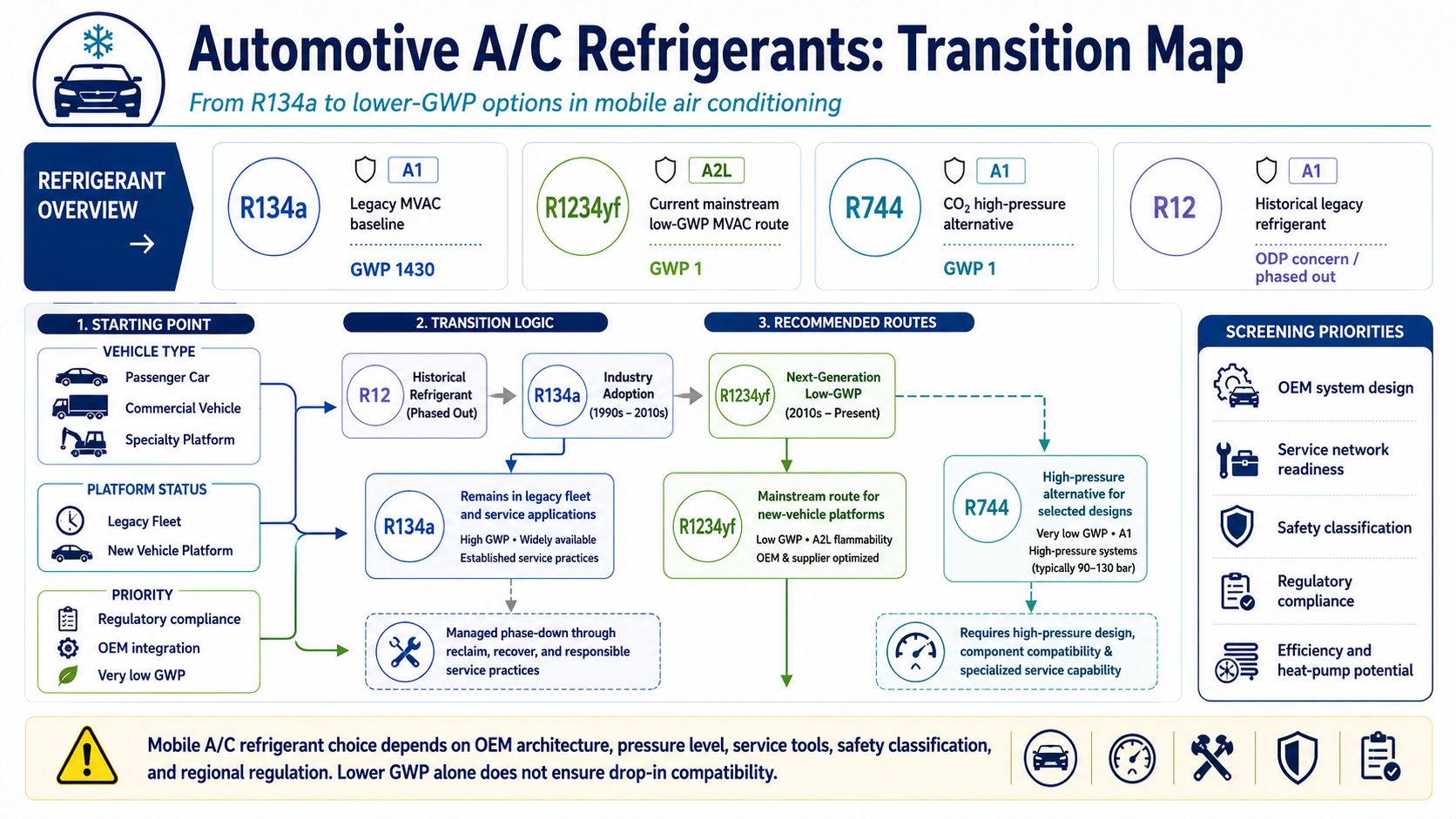
R134a → R1234yfThe climate-policy shift is primarily driven by GWP. R1234yf provides a very low direct refrigerant GWP but uses A2L system design and dedicated service practices.
CO2 vehicle thermal management
R744R744 uses a high-pressure architecture and is increasingly relevant in selected electric-vehicle and bus thermal-management systems.
Existing R134a fleet
Continue service where legally applicableNew-vehicle rules do not mean the global installed R134a fleet disappears immediately. Correct recovery, leak repair and refrigerant-specific service remain important.
EV heat-pump integration
Cabin + battery + power electronicsFor EVs, refrigerant choice is increasingly connected to the whole thermal system rather than cabin AC alone.
Current U.S. and EU transition framework
Regulatory limits are application-specific. Always check the exact equipment category, compliance date and use conditions.
U.S. MVAC transition uses a 150-GWP threshold by vehicle category and model year
EU passenger cars have operated under a <150 GWP MAC pathway since 2017
Safety class changes system design — not just the label
Flammability, toxicity, pressure and charge characteristics must be evaluated together.
R134a · R744
R134a is conventional-pressure A1; R744 is also A1 but uses a very different high-pressure system architecture.
R1234yf
Lower flammability is managed through vehicle system design, charge, component selection and service procedures.
R744
A1 safety class does not mean ordinary HFC service equipment can be used; pressure architecture is fundamentally different.
All MVAC refrigerants
Use vehicle-specific fittings, labels, recovery equipment and OEM procedures to avoid contamination and unsafe service.
Where the major refrigerant routes fit
These examples organize the application by system type and decision context rather than treating one refrigerant as universally best.
Passenger cars
R1234yf is the main current low-GWP route in many new vehicles.
R1234yf · legacy R134aElectric vehicles
Thermal management can integrate cabin and battery conditioning.
R1234yf · R744Buses
EU Climate Action highlights R744 use in new bus models.
R744 and market-specific alternativesHeavy-duty vehicles
U.S. Technology Transitions dates differ from light-duty passenger vehicles.
Vehicle- and model-specificOff-road / agricultural / construction
Do not generalize passenger-car rules to every mobile platform.
Specific SNAP and Technology Transitions categoriesLegacy service shops
Separate service equipment and technician procedures are essential.
R134a + R1234yf capabilityA practical refrigerant-screening flow for automotive ac
Use the system map below to move from application architecture to safety, regulatory and OEM-approved refrigerant choices.
Move from application to evidence
Use each tool for a different part of the refrigerant decision.
Refrigerant Finder
Screen by application, GWP target and safety context.
Open Finder →Comparison Tool
Compare GWP, safety and application role side by side.
Compare →GWP Calculator
Calculate refrigerant GWP reduction.
Calculate →CO₂e Calculator
Convert charge or leak mass into direct CO₂-equivalent.
Calculate CO₂e →P-T Chart
Review saturation pressure-temperature behavior.
Open P-T Chart →Automotive AC refrigerant questions
Direct answers to the most important application, safety and regulatory questions.
What refrigerant is used in modern car air conditioning?
R1234yf is a major current passenger-vehicle refrigerant in the U.S.and EU, while R134a remains common in the installed fleet and R744 is used in selected systems.
Is R1234yf replacing R134a?
Yes in many new passenger-vehicle platforms, largely because of its much lower GWP and regulatory requirements.
Can R1234yf be put into an R134a vehicle?
Not as a simple drop-in.Use the vehicle label and OEM service documentation; fittings, equipment and system approval differ.
Can existing R134a cars still be serviced in the U.S.?
Yes under current federal MVAC guidance where applicable.New-vehicle restrictions are separate from installed-base service.
Why is R744 used in some electric vehicles?
CO2 can support integrated heating and cooling architectures, but it requires a dedicated high-pressure system.
Is R1234yf flammable?
It is classified A2L, meaning lower flammability rather than nonflammability.
What is the U.S. GWP limit for new light-duty passenger vehicle AC?
The Technology Transitions limit is 150 beginning with Model Year 2025.
When does the U.S. 150-GWP rule apply to medium/heavy passenger vehicle categories?
EPA lists Model Year 2028 for medium-duty passenger vehicles, heavy-duty pickups and complete heavy-duty vans.
What is the EU mobile AC limit?
Directive 2006/40/EC effectively requires GWP below 150 for new covered vehicles from 2017.
Does an A1 refrigerant mean safer service equipment?
No.R744 is A1 but operates at much higher pressures than R134a, so equipment and procedures are completely different.
What refrigerant should an automotive technician use?
The exact refrigerant specified on the vehicle label and in OEM service information.
How is EV thermal management different from traditional AC?
EVs may integrate battery, power-electronics and cabin heating/cooling into one coordinated refrigerant system.
Primary references behind this guide
Time-sensitive claims prioritize current government and standards sources.
Current substitute listings and use conditions.
Open source →U.S. 150-GWP vehicle-category compliance dates.
Open source →MVAC refrigerant and existing-vehicle service context.
Open source →Official EU mobile air-conditioning GWP framework.
Open source →Current EU overview of R1234yf and R744 vehicle routes.
Open source →Internal detailed automotive refrigerant comparison.
Open source →Need help narrowing a automotive ac refrigerant route?
Start with the application architecture, compare refrigerant properties, then verify the exact OEM platform and regulatory requirements.