Domestic Refrigerator Refrigerants: R600a, R290, R134a & Low-GWP Rules
Household refrigeration has moved faster toward hydrocarbons than many large HVAC sectors because sealed appliances use small refrigerant charges and purpose-designed components. R600a is now a key low-GWP route, with R290 used in selected designs and R134a remaining mainly as an installed-base reference.
Primary modern hydrocarbon route for many household refrigerators and freezers.
Used in selected household and small refrigeration designs subject to equipment requirements.
Hydrocarbon blend listed by EPA for new household equipment subject to use conditions.
Major legacy installed-base refrigerant; EPA lists it as unacceptable in new U.S. household equipment from 2021.
Technology Transitions household refrigerator/freezer product limit from January 1, 2025.
Domestic refrigerators/freezers containing F-gases are prohibited from January 1, 2026 except where site safety requires them.
Charge, compressor, electrical components and ignition controls are engineered as a complete appliance.
How to choose refrigerants for domestic refrigeration
Start with the equipment architecture and duty, then screen safety classification, regional regulation, environmental metrics and OEM approval.
Always identify the refrigerant from the appliance label and OEM documentation.
Compressor, capillary tube, heat exchangers and charge are optimized for a specific fluid.
A3 appliances use small charges and ignition-risk controls designed into the product.
Recovery, charging and leak-repair tools must be appropriate to hydrocarbons where applicable.
Household refrigerators are already one of the most tightly constrained high-GWP appliance sectors.
Domestic Refrigeration refrigerant comparison
This matrix describes broad engineering and market roles. It is not an equipment approval or retrofit authorization.
| Refrigerant | EPA GWP | Safety | New Household Use | Typical Role | Transition Position |
|---|---|---|---|---|---|
| R600a | 1 | A3 | EPA acceptable with use conditions | Very common modern route | Leading low-GWP option |
| R290 | 3.3 | A3 | EPA acceptable with use conditions | Selected designs | Very-low-GWP option |
| R441A | 3 | A3 | EPA acceptable with use conditions | Selected designs | Very-low-GWP blend |
| R134a | 1,430 | A1 | Unacceptable in new U.S. equipment from 2021 | Large installed base | Legacy service reference |
| R513A | 630 | A1 | Historically acceptable | Specialized / legacy transition | Above current 150 product limit |
Major refrigerant pathways for domestic refrigeration
Different system architectures can meet the same application need with very different refrigerant strategies.
R600a household refrigerators
Small-charge hydrocarbon architectureR600a combines very low GWP with good fit for small sealed systems, but A3 classification makes charge control and component design essential.
R290 household / small appliances
Purpose-designed propane systemsR290 can be used in new household equipment subject to use conditions. It should not be treated as a casual conversion refrigerant.
Legacy R134a appliances
Installed-base serviceR134a remains relevant because millions of appliances were built around it, but EPA made it unacceptable in new U.S. household equipment from 2021.
Why domestic refrigeration transitioned early
Small charge + factory-controlled designCompared with large field-installed systems, factory-sealed appliances can manage hydrocarbon charge and ignition-control measures more consistently.
Current U.S. and EU transition framework
Regulatory limits are application-specific. Always check the exact equipment category, compliance date and use conditions.
U.S. household refrigeration: 150-GWP product limit from 2025, with R134a already out of new equipment
EU domestic refrigeration: fluorinated greenhouse gases are essentially phased out of new household appliances from 2026
Safety class changes system design — not just the label
Flammability, toxicity, pressure and charge characteristics must be evaluated together.
R600a · R290 · R441A
Higher flammability is controlled through small charge, sealed-system design, appropriate components and service procedures.
R134a
Nonflammable but high GWP; now mainly an installed-base service fluid in this application.
Hydrocarbon appliances
Overcharging can change performance and safety margin; use the exact factory charge specification.
Hydrocarbon appliances
Electrical components, service practices and ventilation must respect the flammable refrigerant design.
Where the major refrigerant routes fit
These examples organize the application by system type and decision context rather than treating one refrigerant as universally best.
Household refrigerator
Dominant low-GWP route in many modern products.
R600aHousehold freezer
Product-specific hydrocarbon designs.
R600a · selected R290Compact refrigerator
Small charge and factory-sealed design fit hydrocarbon use well.
R600aLegacy R134a refrigerator
Service according to appliance label and manufacturer guidance.
R134aSpecialized household design
Use only equipment designed and approved for the refrigerant.
R290 / R441A where listedDIY conversion
Refrigerant substitution changes safety and thermodynamic assumptions of the sealed system.
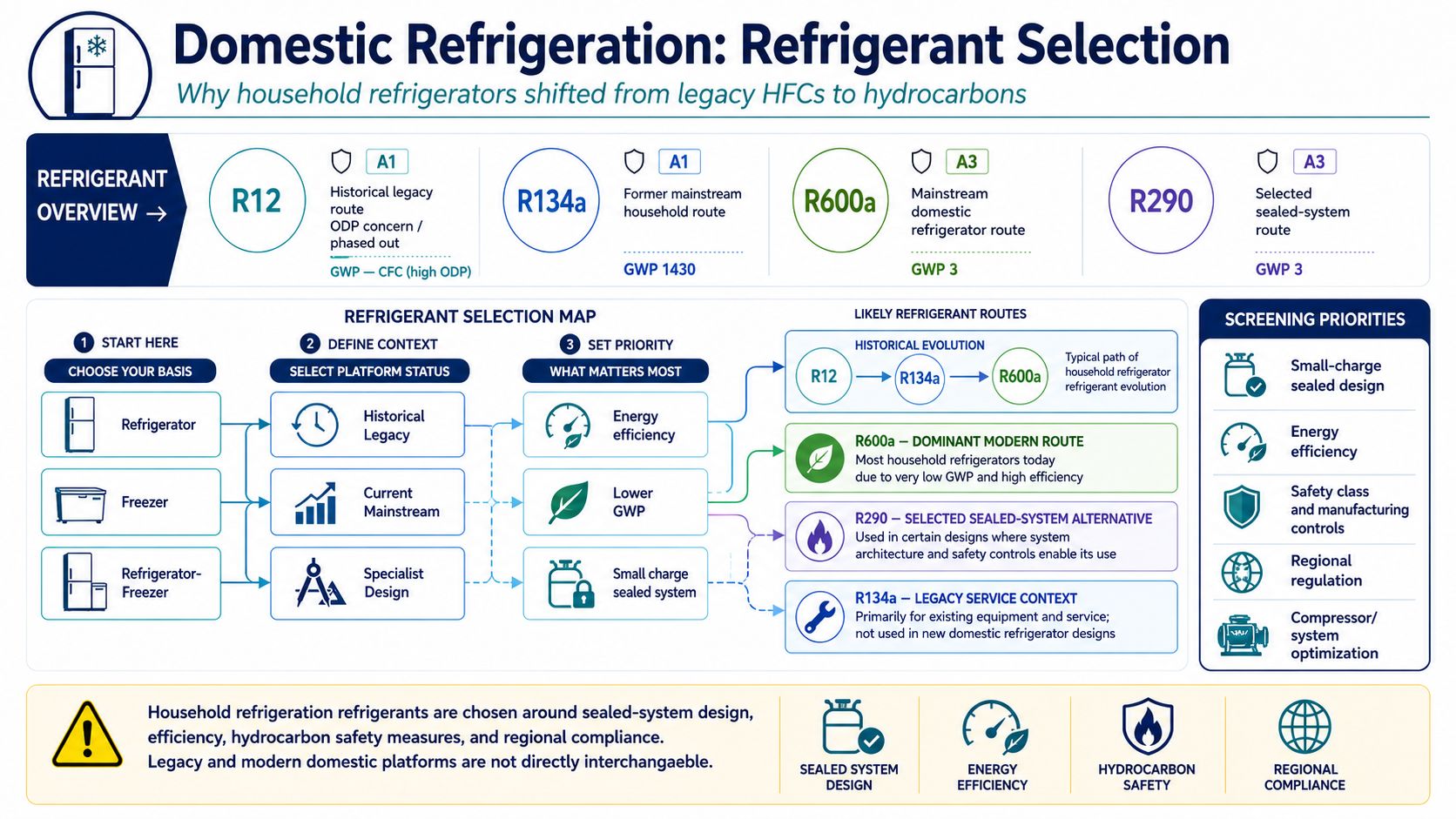
Not recommendedA practical refrigerant-screening flow for domestic refrigeration
Use the system map below to move from application architecture to safety, regulatory and OEM-approved refrigerant choices.
Move from application to evidence
Use each tool for a different part of the refrigerant decision.
Refrigerant Finder
Screen by application, GWP target and safety context.
Open Finder →Comparison Tool
Compare GWP, safety and application role side by side.
Compare →GWP Calculator
Calculate refrigerant GWP reduction.
Calculate →CO₂e Calculator
Convert charge or leak mass into direct CO₂-equivalent.
Calculate CO₂e →P-T Chart
Review saturation pressure-temperature behavior.
Open P-T Chart →Domestic Refrigeration refrigerant questions
Direct answers to the most important application, safety and regulatory questions.
What refrigerant do modern household refrigerators use?
R600a is a major modern household refrigerator refrigerant, with R290 used in selected designs.
What is R600a?
R600a is isobutane, an A3 hydrocarbon refrigerant with EPA Technology Transitions GWP 1.
Is R600a flammable?
Yes.It is classified A3, which is why appliance charge and ignition-control design matter.
Is R290 used in refrigerators?
Yes in selected purpose-designed household and small refrigeration appliances, subject to applicable use conditions.
Can I replace R134a with R600a in a refrigerator?
Do not assume so.The sealed system, charge, compressor, components and safety design differ.
Is R134a still used in household refrigerators?
It remains in the installed base, but EPA lists it as unacceptable in new U.S.household refrigerators/freezers from 2021.
What is the U.S. GWP limit for new household refrigerators?
150 from January 1, 2025 under Technology Transitions.
What changed in the EU in 2026?
New domestic refrigerators and freezers containing fluorinated greenhouse gases are prohibited from January 1, 2026 except where site safety requires them.
Why can hydrocarbons work well in household refrigerators?
Small factory-controlled charges and sealed-system design make it possible to manage flammability in purpose-built appliances.
Does A3 mean R600a refrigerators are unsafe?
No.It means the refrigerant is more flammable and the appliance must be designed, manufactured and serviced accordingly.
How do I know which refrigerant my refrigerator uses?
Check the appliance data label and service documentation.
What is the best refrigerant for a new domestic refrigerator?
The correct answer is the refrigerant used by a compliant, purpose-designed appliance platform; in many markets this is now R600a or another very-low-GWP route.
Primary references behind this guide
Time-sensitive claims prioritize current government and standards sources.
Current household refrigerant listings and use conditions.
Open source →150-GWP household product limit.
Open source →Current R600a, R290 and R134a GWP values.
Open source →Domestic refrigerator/freezer prohibitions.
Open source →Refrigerant safety-class reference.
Open source →Internal R600a technical profile.
Open source →Need help narrowing a domestic refrigeration refrigerant route?
Start with the application architecture, compare refrigerant properties, then verify the exact OEM platform and regulatory requirements.