Industrial Refrigeration Refrigerants: Ammonia, CO2, A2L & Low-GWP Options
Industrial refrigeration covers food processing, chemical production, pharmaceutical processes, manufacturing, ice rinks and other applications with very different temperature and load requirements. Refrigerant selection therefore begins with process duty, not a single global-warming number.
Core industrial vapor-compression and absorption refrigerant route.
CO2 route for cascade, secondary and transcritical industrial systems.
Hydrocarbon routes in purpose-designed industrial systems where flammability can be managed.
Sub-150 A2L new-equipment options listed by EPA for industrial process refrigeration subject to use conditions.
Another sub-150 new-equipment A2L industrial-process option.
Earlier R404A-class transition blends, still relevant in installed equipment.
U.S. Technology Transitions currently shows this industrial-process temperature band as not covered.
How to choose refrigerants for industrial refrigeration
Start with the equipment architecture and duty, then screen safety classification, regional regulation, environmental metrics and OEM approval.
The entering-evaporator temperature directly changes the U.S. Technology Transitions pathway.
For ≥−30°C systems, U.S. limits differ above and below 200 lb charge.
High-temperature cascade circuits have their own U.S. GWP treatment.
Ammonia toxicity, hydrocarbon flammability, A2L mitigation and CO2 pressure require different engineering controls.
Downtime, heat recovery, redundancy and maintenance capability often matter as much as refrigerant GWP.
Industrial Refrigeration refrigerant comparison
This matrix describes broad engineering and market roles. It is not an equipment approval or retrofit authorization.
| Refrigerant | EPA GWP | Safety | Industrial Role | Temperature / Architecture | Transition Signal |
|---|---|---|---|---|---|
| R717 | 1 | B2L | Large industrial / food / process | Central / low-charge / cascade | Strong natural route |
| R744 | 1 | A1 | Cascade / secondary / process cooling | Low-temp / high-pressure | Strong natural route |
| R290 | 3.3 | A3 | Purpose-designed industrial | Application-specific | Very-low-GWP route |
| R1270 | 1.8 | A3 | Purpose-designed industrial | Application-specific | Very-low-GWP route |
| R454C | 146 | A2L | New DX process refrigeration | ≥−30°C / application-specific | Sub-150 route |
| R455A | 146 | A2L | New DX process refrigeration | Application-specific | Sub-150 route |
| R457A | 137 | A2L | New DX process refrigeration | Application-specific | Sub-150 route |
| R448A / R449A | 1,386 / 1,396 | A1 | Installed base / retrofit | DX | Earlier transition routes |
Major refrigerant pathways for industrial refrigeration
Different system architectures can meet the same application need with very different refrigerant strategies.
Ammonia industrial plants
R717Ammonia remains a foundational industrial refrigerant because of efficiency, cost and long industrial experience. The tradeoff is ammonia-specific toxicity, materials and emergency-management requirements.
Ammonia / CO2 cascade and CO2 secondary
R717 + R744These architectures can reduce ammonia charge in occupied or production areas while using CO2 at low temperatures.
Hydrocarbon industrial systems
R290 · R1270Hydrocarbons deliver very low GWP but require purpose-designed A3 systems and ignition-risk management.
New A2L process refrigeration
R454C · R455A · R457A and related optionsEPA has added multiple A2L refrigerants to industrial process refrigeration subject to use conditions, creating lower-GWP fluorinated routes for appropriate new equipment.
Current U.S. and EU transition framework
Regulatory limits are application-specific. Always check the exact equipment category, compliance date and use conditions.
U.S. industrial process refrigeration: temperature, charge and cascade position control the GWP limit
EU industrial refrigeration: broad stationary-refrigeration limits tighten toward <150 GWP in 2030
Safety class changes system design — not just the label
Flammability, toxicity, pressure and charge characteristics must be evaluated together.
R717
Toxicity and material compatibility require ammonia-specific plant design, detection and emergency procedures.
R744
Nonflammable but high-pressure; relief, ventilation and concentration monitoring are central.
R290 · R1270
Higher flammability requires hazardous-area / ignition-source strategy appropriate to the plant.
R454C · R455A · R457A
Lower flammability can enable lower-GWP DX designs, but charge and mitigation requirements remain equipment-specific.
Where the major refrigerant routes fit
These examples organize the application by system type and decision context rather than treating one refrigerant as universally best.
Food processing
Large loads and low temperatures favor industrial natural-refrigerant architectures.
R717 · R744 · cascade combinationsChemical / pharmaceutical process cooling
Process temperature, contamination risk and site classification drive selection.
Application-specific A1/A2L/natural routesCold brine / glycol systems
Secondary loops can separate refrigerant machinery from process areas.
R717 or other primary refrigerantsVery-low-temperature process
Specialist cascade systems may be required.
R170 · R1150 · R744 / cascadeSmall process DX system
Charge size changes the U.S. threshold.
Sub-300 or sub-150 A2L routesLegacy HFC process system
Existing assets require separate retrofit and service analysis.
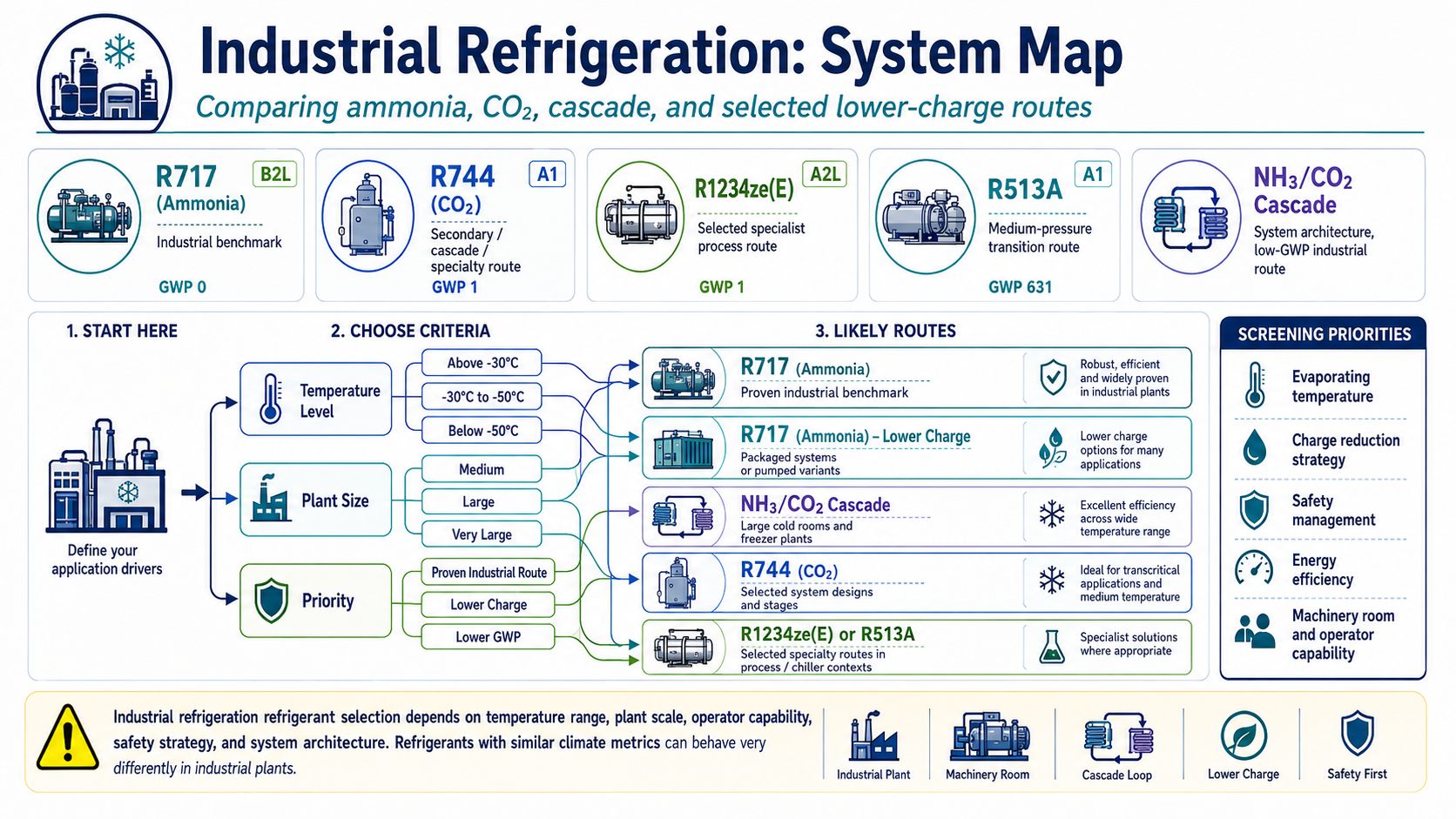
R448A · R449A · R404A/R507A historyA practical refrigerant-screening flow for industrial refrigeration
Use the system map below to move from application architecture to safety, regulatory and OEM-approved refrigerant choices.
Move from application to evidence
Use each tool for a different part of the refrigerant decision.
Refrigerant Finder
Screen by application, GWP target and safety context.
Open Finder →Comparison Tool
Compare GWP, safety and application role side by side.
Compare →GWP Calculator
Calculate refrigerant GWP reduction.
Calculate →CO₂e Calculator
Convert charge or leak mass into direct CO₂-equivalent.
Calculate CO₂e →P-T Chart
Review saturation pressure-temperature behavior.
Open P-T Chart →Industrial Refrigeration refrigerant questions
Direct answers to the most important application, safety and regulatory questions.
What refrigerants are used in industrial refrigeration?
Major routes include R717 ammonia, R744 CO2, hydrocarbons such as R290/R1270, and lower-GWP A2L blends such as R454C, R455A and R457A in suitable new systems.
Why is ammonia common in industrial refrigeration?
It has strong thermodynamic performance and long industrial experience, but requires ammonia-specific safety, materials and emergency-management systems.
How is CO2 used in industrial refrigeration?
R744 can be used in cascade, secondary and transcritical architectures, especially for low-temperature duties.
Are hydrocarbons used in industrial refrigeration?
Yes in purpose-designed systems where A3 flammability can be managed.
What is the U.S. GWP limit for industrial process refrigeration?
It depends on evaporator temperature, charge and cascade position; limits range from 150 to 700, and below −50°C is currently not covered.
What is the limit for large U.S. industrial systems at or above −30°C?
For systems with 200 lb or more refrigerant charge, excluding the high-temperature side of cascade systems, the limit is 150 from January 1, 2026.
What is the U.S. limit for smaller industrial systems at or above −30°C?
For less than 200 lb charge, the limit is 300 from January 1, 2026.
Why is the high-temperature side of a cascade treated separately?
EPA gives the high-temperature side of cascade systems a 300-GWP limit for the ≥−30°C category, recognizing the architecture separately from the low side.
Are R454C and R455A listed for industrial process refrigeration?
Yes, EPA lists them for new industrial-process refrigeration subject to use conditions.
Does the EU exempt all below −50°C industrial refrigeration?
No.Specific Annex IV and service provisions include exceptions for equipment designed below −50°C, but the full regulatory framework still needs to be checked.
Is lower GWP always more efficient in an industrial plant?
No.Efficiency depends on temperature lift, compression stages, heat recovery, component design and controls.
How should an industrial refrigerant be selected?
Start with process temperature, load, architecture, charge and site safety, then apply regulatory and lifecycle criteria.
Primary references behind this guide
Time-sensitive claims prioritize current government and standards sources.
Current industrial-process substitute listings.
Open source →Temperature-, charge- and cascade-specific U.S. limits.
Open source →Current GWP values.
Open source →EU stationary refrigeration and service restrictions.
Open source →Safety-class framework.
Open source →Internal ammonia technical profile.
Open source →Need help narrowing a industrial refrigeration refrigerant route?
Start with the application architecture, compare refrigerant properties, then verify the exact OEM platform and regulatory requirements.