Transport Refrigeration Refrigerants: R452A, R513A, CO2 & Low-GWP Transition
Transport refrigeration combines refrigeration engineering with mobile-duty constraints: vibration, ambient extremes, fuel or electric power, service availability, refrigerant leakage risk and cargo-temperature reliability. Road units, marine systems and intermodal containers also face different regulatory pathways.
Widely recognized R404A-class transport transition fluid for refrigerated trucks and trailers.
Lower-GWP A1 refrigerant listed by EPA for refrigerated transport.
CO2 listed by EPA for new refrigerated transport systems; dedicated high-pressure architecture.
Accepted in refrigerated transport and relevant in installed fleets, but above newer U.S. intermodal 700 threshold.
High-GWP legacy fleet references.
EPA lists cryogenic and direct nitrogen expansion transport systems as acceptable alternatives.
New intermodal container systems face a 700-GWP limit from July 27, 2027.
How to choose refrigerants for transport refrigeration
Start with the equipment architecture and duty, then screen safety classification, regional regulation, environmental metrics and OEM approval.
Truck/trailer, marine, rail and intermodal reefers are not one regulatory category.
Deep-frozen or below −50°C container duties can receive different regulatory treatment.
Diesel, electric, battery and shore-power strategies affect system efficiency and refrigerant design.
Fleet refrigerants must be supportable across routes, depots and countries.
Mobile systems experience vibration and connection stress that make charge containment important.
Transport Refrigeration refrigerant comparison
This matrix describes broad engineering and market roles. It is not an equipment approval or retrofit authorization.
| Refrigerant | EPA GWP | Safety | Road Trucks / Trailers | Intermodal / Marine | Transition Position |
|---|---|---|---|---|---|
| R452A | 2,140 | A1 | EPA acceptable for refrigerated trucks/trailers | Application-specific | Major legacy-transition fluid |
| R513A | 630 | A1 | EPA acceptable | EPA acceptable transport listing | Sub-700 A1 option |
| R744 | 1 | A1 | New dedicated systems | New dedicated systems | Very-low-GWP route |
| R448A | 1,386 | A1 | Accepted / installed fleets | Application-specific | Earlier transition route |
| R449A | 1,396 | A1 | Accepted / installed fleets | Application-specific | Earlier transition route |
| R404A | 3,922 | A1 | Legacy | Legacy | High-GWP installed base |
| Cryogenic N2 | 0 direct refrigerant GWP | A1 | Specialist | Specialist | Not-in-kind route |
Major refrigerant pathways for transport refrigeration
Different system architectures can meet the same application need with very different refrigerant strategies.
Truck and trailer vapor-compression units
R452A · R513A · legacy R448A/R449AR452A gained relevance because of transport performance characteristics, but its GWP now creates a transition challenge. R513A offers a sub-700 A1 route in the EPA refrigerated-transport list.
CO2 transport refrigeration
R744EPA lists R744 as acceptable in new refrigerated transport. It offers GWP 1 but requires a purpose-designed high-pressure system.
Intermodal containers
R513A / R744 and other compliant routesU.S. Technology Transitions sets a 700-GWP limit from July 27, 2027 for intermodal containers designed for box temperatures at or above −50°C.
Not-in-kind transport cooling
Cryogenic / direct nitrogen expansionEPA SNAP also recognizes non-vapor-compression transport approaches, showing that refrigerant transition can include system architecture changes.
Current U.S. and EU transition framework
Regulatory limits are application-specific. Always check the exact equipment category, compliance date and use conditions.
U.S. transport refrigeration: road, marine and intermodal rules are different
EU mobile refrigeration adds certification and leak-management obligations to the broader F-gas transition
Safety class changes system design — not just the label
Flammability, toxicity, pressure and charge characteristics must be evaluated together.
R452A · R513A · R448A · R449A
Nonflammable service route, but higher-GWP options face increasing regulatory and supply pressure.
R744
CO2 is nonflammable but requires high-pressure components, pressure relief and specialized service tools.
Nitrogen systems
Different hazards include asphyxiation, very low temperatures and pressure management.
All systems
Vibration, roadside service and multi-country fleet support make refrigerant identification and recovery discipline especially important.
Where the major refrigerant routes fit
These examples organize the application by system type and decision context rather than treating one refrigerant as universally best.
Refrigerated truck
Fleet transition depends on unit design and regional rules.
R452A · R513A · R744Trailer refrigeration
EPA specifically limits R452A listing to refrigerated trucks/trailers.
R452A · R513A · R744Intermodal reefer ≥−50°C
R513A and R744 are important reference points.
Sub-700 route required in U.S. from 2027Intermodal below −50°C
U.S. Technology Transitions currently shows this band as not covered.
SpecialistMarine refrigeration
U.S. road/marine restrictions differ from the intermodal numeric limit.
Equipment-specificCryogenic transport
Useful specialist route where vapor-compression is not the preferred architecture.
Nitrogen / not-in-kindA practical refrigerant-screening flow for transport refrigeration
Use the system map below to move from application architecture to safety, regulatory and OEM-approved refrigerant choices.
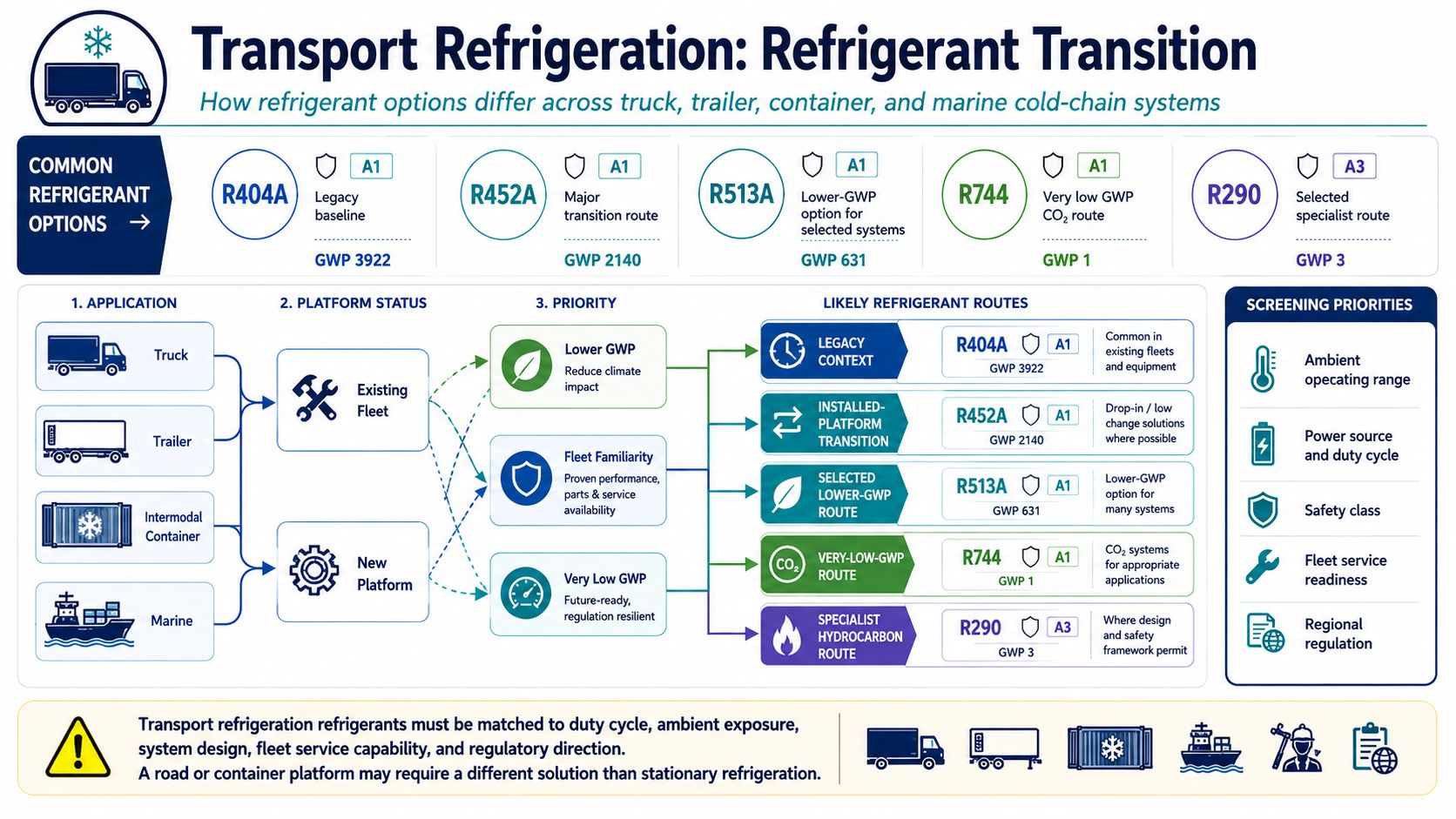
Move from application to evidence
Use each tool for a different part of the refrigerant decision.
Refrigerant Finder
Screen by application, GWP target and safety context.
Open Finder →Comparison Tool
Compare GWP, safety and application role side by side.
Compare →GWP Calculator
Calculate refrigerant GWP reduction.
Calculate →CO₂e Calculator
Convert charge or leak mass into direct CO₂-equivalent.
Calculate CO₂e →P-T Chart
Review saturation pressure-temperature behavior.
Open P-T Chart →Transport Refrigeration refrigerant questions
Direct answers to the most important application, safety and regulatory questions.
What refrigerants are used in transport refrigeration?
Common and transition routes include R452A, R513A, R744, R448A and R449A, with R404A/R507A still present in legacy fleets.
Why is R452A used in refrigerated trucks and trailers?
It was developed as an R404A-class transport alternative and EPA specifically lists it as acceptable for refrigerated trucks and trailers.
What is the GWP of R452A?
EPA Technology Transitions lists R452A at GWP 2,140.
Is R513A used in transport refrigeration?
Yes.EPA lists R513A as acceptable in refrigerated transport, and its GWP is 630.
Is CO2 used in transport refrigeration?
Yes.EPA lists R744 as acceptable in new refrigerated transport systems; it requires dedicated high-pressure equipment.
What is the U.S. intermodal reefer GWP limit?
For containers designed to operate at box temperatures at or above −50°C, the limit is 700 from July 27, 2027.
What about intermodal containers below −50°C?
EPA currently shows that Technology Transitions subsector as not covered.
Are road transport units under the same 700-GWP rule?
No.EPA uses a specified list of prohibited substances for road systems from January 1, 2025.
Are R448A and R449A long-term transport refrigerants?
They remain relevant in installed fleets, but their GWPs exceed the future U.S.700-GWP intermodal pathway.
Does the EU regulate mobile refrigeration technicians?
Yes.Regulation 2024/573 and implementing rules extend certification requirements to several mobile refrigeration categories and alternative refrigerants.
Why is service availability important for fleet refrigerant selection?
Transport equipment operates across locations, so refrigerant supply, tools and technician capability must follow the fleet.
How should a fleet choose a replacement refrigerant?
Start with the exact transport unit and OEM-approved options, then evaluate route geography, regulations, service network, energy use and refrigerant availability.
Primary references behind this guide
Time-sensitive claims prioritize current government and standards sources.
Current transport refrigerant listings.
Open source →Road, marine and intermodal restrictions and dates.
Open source →Current GWP values for R452A, R513A, R744 and others.
Open source →EU F-gas rules covering mobile refrigeration leak checks and training.
Open source →Certification requirements for stationary and mobile refrigeration with F-gases and alternatives.
Open source →Internal R452A technical and transition profile.
Open source →Need help narrowing a transport refrigeration refrigerant route?
Start with the application architecture, compare refrigerant properties, then verify the exact OEM platform and regulatory requirements.