Very-Low-Temperature Refrigerants: R170, R1150, CO2 & Cascade Systems
Very-low-temperature refrigeration is a specialist field. EPA defines this SNAP end use around temperatures of approximately −80°F (−62°C) or lower, where cascade systems, autocascade designs and ultra-low-temperature freezers must deliver reliability that ordinary comfort-cooling systems do not require.
Ethane route listed by EPA for new very-low-temperature refrigeration subject to use conditions.
Ethylene listed by EPA with use conditions and narrowed use limits.
CO2 accepted in very-low-temperature refrigeration and useful in cascade / intermediate stages.
Propane accepted with use conditions; often more relevant as a higher-temperature cascade stage.
Legacy very-low-temperature reference with high GWP.
Very high-GWP legacy ultra-low-temperature blend in specialized installed equipment.
Technology Transitions currently shows industrial-process refrigeration below −50°C as not covered; the SNAP very-low-temperature end use still governs substitute status.
How to choose refrigerants for very low temperature
Start with the equipment architecture and duty, then screen safety classification, regional regulation, environmental metrics and OEM approval.
−60°C, −80°C and −100°C-class systems require different refrigerant and compressor envelopes.
Low-stage and high-stage refrigerants must be selected as a coupled thermodynamic system.
R170, R1150 and R290 are A3 and require purpose-designed equipment and charge controls.
Medical, laboratory and freeze-drying applications may prioritize redundancy and pull-down performance.
Very-low-temperature SNAP listings and Technology Transitions temperature bands must be read together.
Very Low Temperature refrigerant comparison
This matrix describes broad engineering and market roles. It is not an equipment approval or retrofit authorization.
| Refrigerant | EPA GWP | Safety | Typical VLT Role | System Position | Transition Signal |
|---|---|---|---|---|---|
| R170 | 5.5 | A3 | Ultra-low-temperature low stage | Low stage / autocascade | Very-low-GWP specialist route |
| R1150 | 3.7 | A3 | Deeper ultra-low-temperature low stage | Low stage | Very-low-GWP specialist route |
| R744 | 1 | A1 | Cascade / intermediate / specialist low stage | Intermediate / low stage | Natural-refrigerant route |
| R290 | 3.3 | A3 | Higher-temperature cascade stage | High stage | Very-low-GWP route |
| R404A | 3,922 | A1 | Legacy stage refrigerant | High / intermediate stage | High-GWP legacy |
| R508B | 13,396 | A1 | Legacy ultra-low-temperature blend | Low stage | Very-high-GWP installed base |
Major refrigerant pathways for very low temperature
Different system architectures can meet the same application need with very different refrigerant strategies.
Ethane low stage
R170EPA lists R170 as acceptable with use conditions in new very-low-temperature refrigeration. Its A3 classification means equipment must be purpose-designed for hydrocarbon use.
Ethylene deeper low stage
R1150R1150 extends into deeper-temperature duties and EPA lists it with use conditions and narrowed use limits.
CO2 cascade / intermediate stage
R744R744 can be part of very-low-temperature cascades and offers GWP 1 with A1 classification, but pressure and triple-point / phase behavior must be respected.
High-stage hydrocarbon
R290R290 can serve higher-temperature stages in cascade systems, pairing a very-low-GWP refrigerant with a deeper low-stage fluid.
Current U.S. and EU transition framework
Regulatory limits are application-specific. Always check the exact equipment category, compliance date and use conditions.
U.S. very-low-temperature refrigeration: SNAP status remains critical while <−50°C TT categories are not covered
EU very-low-temperature applications retain explicit exceptions in several high-GWP restrictions
Safety class changes system design — not just the label
Flammability, toxicity, pressure and charge characteristics must be evaluated together.
R170 · R1150 · R290
Higher flammability requires purpose-designed sealed systems, charge control, ventilation and ignition-risk management.
R744
Nonflammable but high-pressure and phase-behavior limits require specialist design.
R404A · R508B
Nonflammability does not offset extremely high GWP and future supply / service pressure.
Multiple refrigerants
Each stage can have different pressure and flammability characteristics; service identification is essential.
Where the major refrigerant routes fit
These examples organize the application by system type and decision context rather than treating one refrigerant as universally best.
−60°C to −80°C freezer
Application-specific compressor and cascade design.
R170 / cascade combinationsBelow −80°C ULT freezer
Deeper-temperature fluid selected by equipment OEM.
R1150 or specialized low stageFreeze dryer
Reliability and pull-down profile matter as much as nominal temperature.
Cascade / autocascadeMedical / biological storage
Redundancy, alarms and temperature recovery are critical.
Purpose-designed ULT platformIndustrial test chamber
Specialist duty may use cascade or autocascade architecture.
R170 · R1150 · R744 combinationsLegacy ULT equipment
Service planning should consider availability and environmental impact.
R404A / R508B and other high-GWP blendsA practical refrigerant-screening flow for very low temperature
Use the system map below to move from application architecture to safety, regulatory and OEM-approved refrigerant choices.
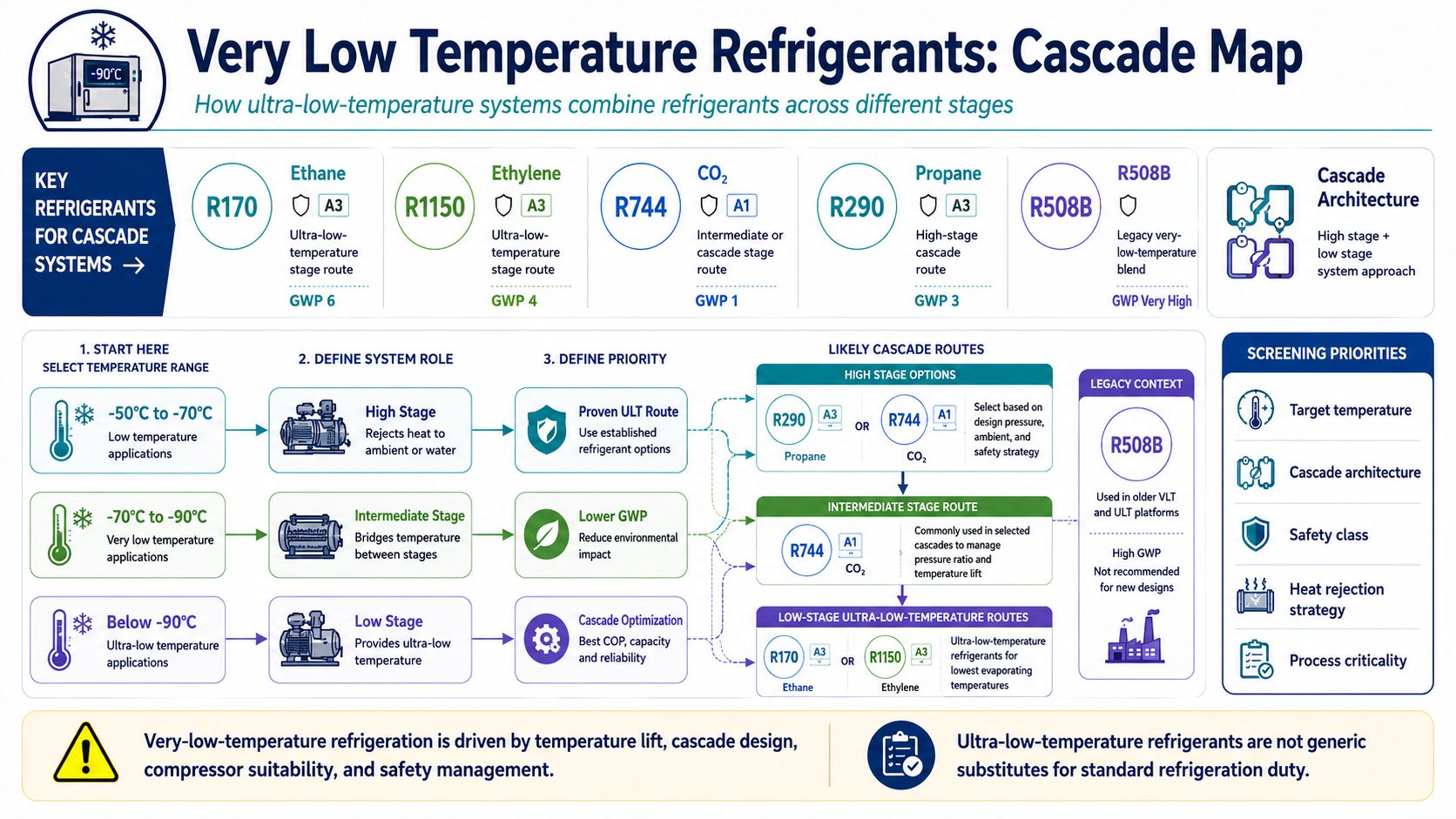
Move from application to evidence
Use each tool for a different part of the refrigerant decision.
Refrigerant Finder
Screen by application, GWP target and safety context.
Open Finder →Comparison Tool
Compare GWP, safety and application role side by side.
Compare →GWP Calculator
Calculate refrigerant GWP reduction.
Calculate →CO₂e Calculator
Convert charge or leak mass into direct CO₂-equivalent.
Calculate CO₂e →P-T Chart
Review saturation pressure-temperature behavior.
Open P-T Chart →Very Low Temperature refrigerant questions
Direct answers to the most important application, safety and regulatory questions.
What is very-low-temperature refrigeration?
EPA describes the SNAP end use as systems maintaining approximately −80°F (−62°C) or lower.
What refrigerants are used for ultra-low temperatures?
Current low-GWP specialist routes include R170, R1150, R744 and R290 in different cascade stages, while legacy systems can use high-GWP blends such as R404A or R508B.
What is R170 used for?
R170 ethane is used as a very-low-temperature refrigerant in purpose-designed systems and is EPA-listed with use conditions.
What is R1150 used for?
R1150 ethylene is used for deeper ultra-low-temperature duties and is EPA-listed with use conditions and narrowed use limits.
Is R170 flammable?
Yes.R170 is A3.
Is R1150 flammable?
Yes.R1150 is A3.
Can CO2 be used in ultra-low-temperature refrigeration?
Yes in selected cascade or specialist architectures; EPA lists R744 as acceptable in the very-low-temperature end use.
Why are cascade systems common at very low temperatures?
One refrigerant and compressor stage often cannot efficiently cover the full temperature lift, so multiple circuits share the load.
Does the U.S. 150/300/700 GWP rule apply below −50°C?
EPA’s current Technology Transitions table shows the industrial-process refrigeration category below −50°C as not covered.
Does the EU completely exempt below −50°C equipment?
No.Specific high-GWP placing-on-market and service restrictions include below −50°C exceptions, but other regulatory obligations can still apply.
Is R508B low GWP?
No.EPA Technology Transitions lists R508B at a very high GWP of 13,396.
How should a ULT refrigerant be selected?
Use the equipment OEM’s cascade or autocascade design and verify target temperature, pressure, safety, reliability and regulatory status for each stage.
Primary references behind this guide
Time-sensitive claims prioritize current government and standards sources.
Current R170, R1150, R290 and R744 listings.
Open source →EPA definition of the very-low-temperature end use.
Open source →Below −50°C industrial-process category treatment.
Open source →Current GWP values for R170, R1150, R508B and others.
Open source →Below −50°C exceptions and stationary refrigeration framework.
Open source →Safety-class reference.
Open source →Need help narrowing a very low temperature refrigerant route?
Start with the application architecture, compare refrigerant properties, then verify the exact OEM platform and regulatory requirements.