Air Conditioning Refrigerants: R32, R454B, R290 & R410A Transition
Air-conditioning refrigerant choice now depends heavily on equipment architecture. Split systems, VRF, packaged units, room air conditioners and chillers can face different refrigerant, safety and regulatory pathways even when they provide the same comfort-cooling function.
Single-component A2L route used in many residential and light-commercial systems.
Major North American lower-GWP new-equipment route for unitary and split HVAC.
Selected sub-700 A2L route used in some new HVAC platforms.
Very-low-GWP natural refrigerant used in purpose-designed self-contained and market-specific AC platforms.
Large installed base; above the U.S. 700-GWP limit for major new residential/light-commercial systems.
Legacy ozone-depleting installed base; production/import phaseout makes it a service and retrofit topic.
Legacy / transition refrigerant seen in some comfort-cooling and R22-era applications.
How to choose refrigerants for air conditioning
Start with the equipment architecture and duty, then screen safety classification, regional regulation, environmental metrics and OEM approval.
Split, packaged, rooftop, VRF and self-contained room AC systems do not share identical rules.
A2L and A3 refrigerants change charge, ignition-control and installation requirements.
System size affects standards, mitigation and in some regions the applicable regulatory threshold.
High ambient operation, seasonal efficiency and compressor envelope remain engineering factors separate from GWP.
The U.S. 700-GWP pathway and EU staged 150/750 thresholds lead to different long-term refrigerant choices.
Air Conditioning refrigerant comparison
This matrix describes broad engineering and market roles. It is not an equipment approval or retrofit authorization.
| Refrigerant | EPA GWP | Safety | Split / Unitary | VRF / Commercial | Role |
|---|---|---|---|---|---|
| R32 | 675 | A2L | Common / growing | Selected / common by market | Established A2L route |
| R454B | 465 | A2L | Growing in new equipment | Selected | North American transition route |
| R452B | 698 | A2L | Selected | Selected | Sub-700 A2L route |
| R290 | 3.3 | A3 | Purpose-designed / market-specific | Specialist | Natural very-low-GWP route |
| R410A | 2,088 | A1 | Large installed base | Large installed base | Higher-GWP legacy platform |
| R407C | 1,774 | A1 | Legacy / retrofit contexts | Selected legacy | R22-era transition reference |
| R22 | 1,810 | A1 | Legacy installed base | Legacy | HCFC service / retrofit topic |
Major refrigerant pathways for air conditioning
Different system architectures can meet the same application need with very different refrigerant strategies.
Residential split and unitary systems
R32 · R454B · R452BThese A2L refrigerants are prominent new-equipment routes. Their similar application does not establish component or service interchangeability.
Self-contained / room air conditioning
R290 plus sub-700 fluorinated options where permittedPurpose-designed self-contained products can enable hydrocarbon architectures that do not map directly to field-assembled split systems.
VRF systems
A2L transition with a later U.S. system dateEPA gives VRF systems a separate 700-GWP installation compliance date of January 1, 2027, with transition provisions.
Legacy R410A and R22 equipment
Service decision ≠ new-equipment ruleExisting equipment should be managed under OEM instructions and applicable service rules. A new refrigerant pathway does not automatically authorize a retrofit.
Current U.S. and EU transition framework
Regulatory limits are application-specific. Always check the exact equipment category, compliance date and use conditions.
U.S. air conditioning: major new residential/light-commercial systems moved to ≤700 GWP
EU air conditioning: the long-term pathway tightens below today’s U.S. 700-GWP route
Safety class changes system design — not just the label
Flammability, toxicity, pressure and charge characteristics must be evaluated together.
R410A · R407C · R22
Nonflammable classification does not override GWP, ODP or transition rules.
R32 · R454B · R452B
Lower flammability requires equipment, installation and service procedures built around A2L requirements.
R290
Very low GWP with higher flammability; architecture and allowable charge become central design constraints.
R410A / R22 systems
Existing systems require service planning that is separate from the refrigerant used in new equipment.
Where the major refrigerant routes fit
These examples organize the application by system type and decision context rather than treating one refrigerant as universally best.
Ductless mini-splits
Widely associated with R32 internationally; exact market approval varies.
R32 · market-specific A2L routesUnitary central AC
North American new-equipment transition emphasizes sub-700 A2L routes.
R454B · R32 · R452BVRF
Separate U.S. 2027 system compliance date.
Sub-700 A2L routesWindow / portable room AC
Self-contained architecture can support different refrigerant choices.
R290 · sub-700 alternativesRooftop / packaged commercial AC
Capacity, controls and OEM platform drive selection.
R32 · R454B · application-specific optionsLegacy comfort cooling
Installed-base service and replacement planning remain a major market need.
R410A · R22 · R407CA practical refrigerant-screening flow for air conditioning
Use the system map below to move from application architecture to safety, regulatory and OEM-approved refrigerant choices.
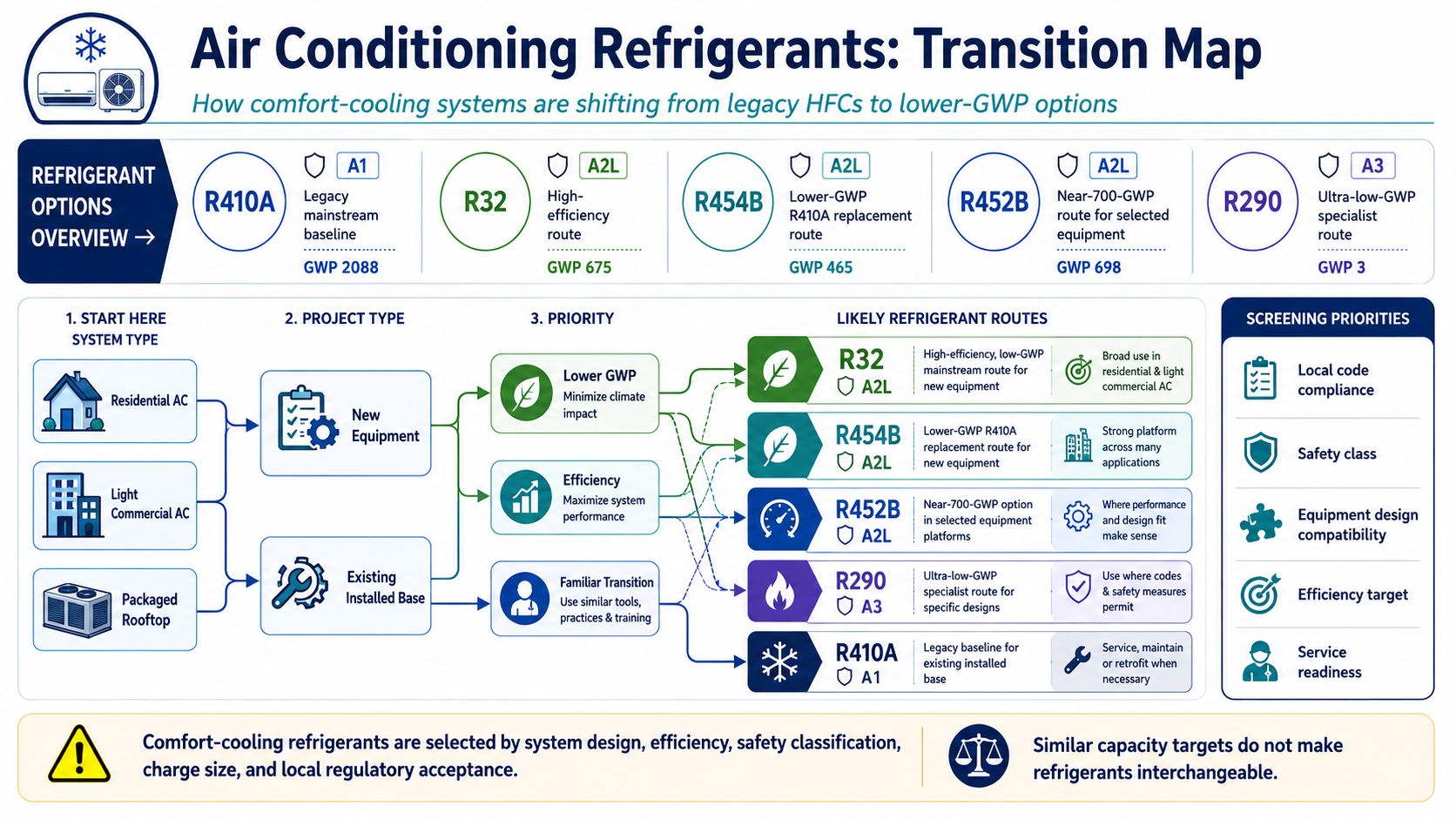
Move from application to evidence
Use each tool for a different part of the refrigerant decision.
Refrigerant Finder
Screen by application, GWP target and safety context.
Open Finder →Comparison Tool
Compare GWP, safety and application role side by side.
Compare →GWP Calculator
Calculate refrigerant GWP reduction.
Calculate →CO₂e Calculator
Convert charge or leak mass into direct CO₂-equivalent.
Calculate CO₂e →P-T Chart
Review saturation pressure-temperature behavior.
Open P-T Chart →Air Conditioning refrigerant questions
Direct answers to the most important application, safety and regulatory questions.
What refrigerants are used in air conditioners?
Current and emerging routes include R32, R454B, R452B and selected R290 systems, while R410A, R22 and R407C remain important installed-base references.
What is replacing R410A in air conditioning?
There is no universal replacement.New equipment is moving to refrigerants such as R32, R454B and R452B, with R290 used in different purpose-designed architectures.
Can R32 be put into an R410A air conditioner?
Do not assume so.R32 is A2L and has different thermodynamic and system-design requirements even though R410A contains R32 as one component.
Is R454B a drop-in replacement for R410A?
No.R454B is a new-equipment A2L transition route, not a universal drop-in for an existing R410A system.
Why is R290 used in some air conditioners?
Its GWP is very low, but A3 flammability means it is used in purpose-designed systems with appropriate charge and ignition-risk controls.
What is the U.S. GWP limit for residential air conditioning?
EPA applies a 700-GWP limit to major new stationary residential and light-commercial AC and heat-pump products/systems, with the main 2025 compliance dates.
When does the U.S. VRF refrigerant rule apply?
EPA lists a 700-GWP installation compliance date of January 1, 2027 for VRF systems, with specific transition provisions.
Does the EU use the same 700-GWP limit?
No.EU rules become stricter by equipment type and date, including 150-GWP and eventual non-F-gas pathways for several smaller AC categories.
Is R410A banned in all existing air conditioners?
No.New-equipment restrictions and installed-base servicing are different regulatory questions.
Is R22 still used in air conditioning?
Yes in legacy installed equipment, but it is an HCFC with production/import phaseout history and should be treated as an installed-base service and retrofit topic.
Does lower GWP mean better cooling efficiency?
No.Efficiency depends on complete equipment design, compressor, heat exchangers, controls and operating conditions.
How should I choose an AC refrigerant?
Start with the approved equipment platform, then verify safety, regulation, climate performance and service requirements.
Primary references behind this guide
Time-sensitive claims prioritize current government and standards sources.
Current U.S. AC and VRF GWP limits and dates.
Open source →End-use-specific refrigerant status and use conditions.
Open source →Current GWP values used for U.S. rule thresholds.
Open source →Official Annex IV AC and heat-pump restrictions.
Open source →Safety classification reference.
Open source →Internal engineering comparison of two major comfort-cooling refrigerants.
Open source →Need help narrowing a air conditioning refrigerant route?
Start with the application architecture, compare refrigerant properties, then verify the exact OEM platform and regulatory requirements.