
Refrigerant GWP (Global Warming Potential) measures how much warming a refrigerant causes if released into the atmosphere, compared with the same mass of carbon dioxide (CO₂) over a specified time period.
For example, R410A has a commonly used 100-year GWP of 2,088, while R32 has a GWP of 675 under the IPCC Fourth Assessment Report (AR4) reference. This means that releasing 1 kg of R410A produces approximately the same integrated warming effect over 100 years as releasing 2,088 kg of CO₂.
However, refrigerant GWP values are not always identical across different technical references.
You may find R454B listed as 465, 466, 467 or 531 depending on the regulatory reference, assessment report and calculation method used.
Understanding these differences is essential when comparing refrigerants, evaluating alternatives, calculating emissions or checking regulatory requirements.
Quick answer: GWP measures the direct climate impact of refrigerant emissions. A lower GWP generally means lower direct warming impact for the same released mass, but it does not automatically mean the refrigerant is safer, more energy-efficient or suitable for a particular HVAC/R system.
For a fast numerical lookup, use the Refrigerant GWP Calculator. This guide explains what the values mean, how they are calculated and why different sources sometimes report different numbers.
What Is GWP in Refrigerants?
GWP stands for Global Warming Potential.
It is a metric used to compare the climate effect of different greenhouse gases against carbon dioxide over a defined time horizon.
Carbon dioxide is assigned a GWP of 1.
Other greenhouse gases are compared against that reference.
GWP accounts for factors including:
- How effectively a gas absorbs outgoing infrared radiation.
- How its concentration changes after release.
- How long it remains in the atmosphere.
- The selected time horizon used to evaluate its warming effect.
In simplified terms, GWP compares the time-integrated radiative forcing caused by releasing a unit mass of a greenhouse gas with that caused by releasing the same mass of CO₂.
Why Is CO₂ Used as the Reference?
Carbon dioxide is the standard reference gas for global warming potential calculations.
By definition:
CO₂ GWP = 1
This gives scientists, engineers and policymakers a common basis for comparing different greenhouse gases.
For example, using commonly cited AR4 100-year values:
| Gas or Refrigerant | GWP100 |
|---|---|
| CO₂ / R744 | 1 |
| R32 | 675 |
| R134a | 1,430 |
| R410A | 2,088 |
| R404A | 3,922 |
These values describe direct climate impact per unit mass released, not system efficiency or cooling performance.
What Does a Refrigerant GWP Number Mean?
A refrigerant GWP number represents the warming effect of a released mass of refrigerant relative to the same mass of CO₂ over the specified time horizon.
Consider an example.
Refrigerant with GWP 675
If 1 kg of a refrigerant with GWP 675 escapes into the atmosphere, its 100-year integrated warming impact is represented as:
675 kg CO₂ equivalent
Refrigerant with GWP 2,088
If 1 kg of a refrigerant with GWP 2,088 escapes into the atmosphere, its corresponding impact is:
2,088 kg CO₂ equivalent
The second refrigerant has a greater direct warming impact per kilogram released.
This comparison assumes the same time horizon and compatible GWP reference methodology.
Does GWP Tell You How Much CO₂ a Refrigerant Contains?
No.
A GWP value does not indicate that a refrigerant physically contains that amount of carbon dioxide.
GWP is a climate-impact comparison factor, not a chemical composition measurement.
For example, R410A does not contain 2,088 kg of CO₂.
Its GWP100 of 2,088 means that releasing 1 kg of R410A has approximately the same integrated warming effect over 100 years as releasing 2,088 kg of CO₂ under that reference.
Common Refrigerant GWP Values
Some refrigerants have GWPs in the thousands, while others have values close to 1.
The following table provides a practical comparison of commonly used HVAC/R refrigerants.
The values below follow the U.S. EPA Technology Transitions reference basis used by Refrigerants.net where available. They should not be treated as universal values for every regulatory jurisdiction or scientific assessment.
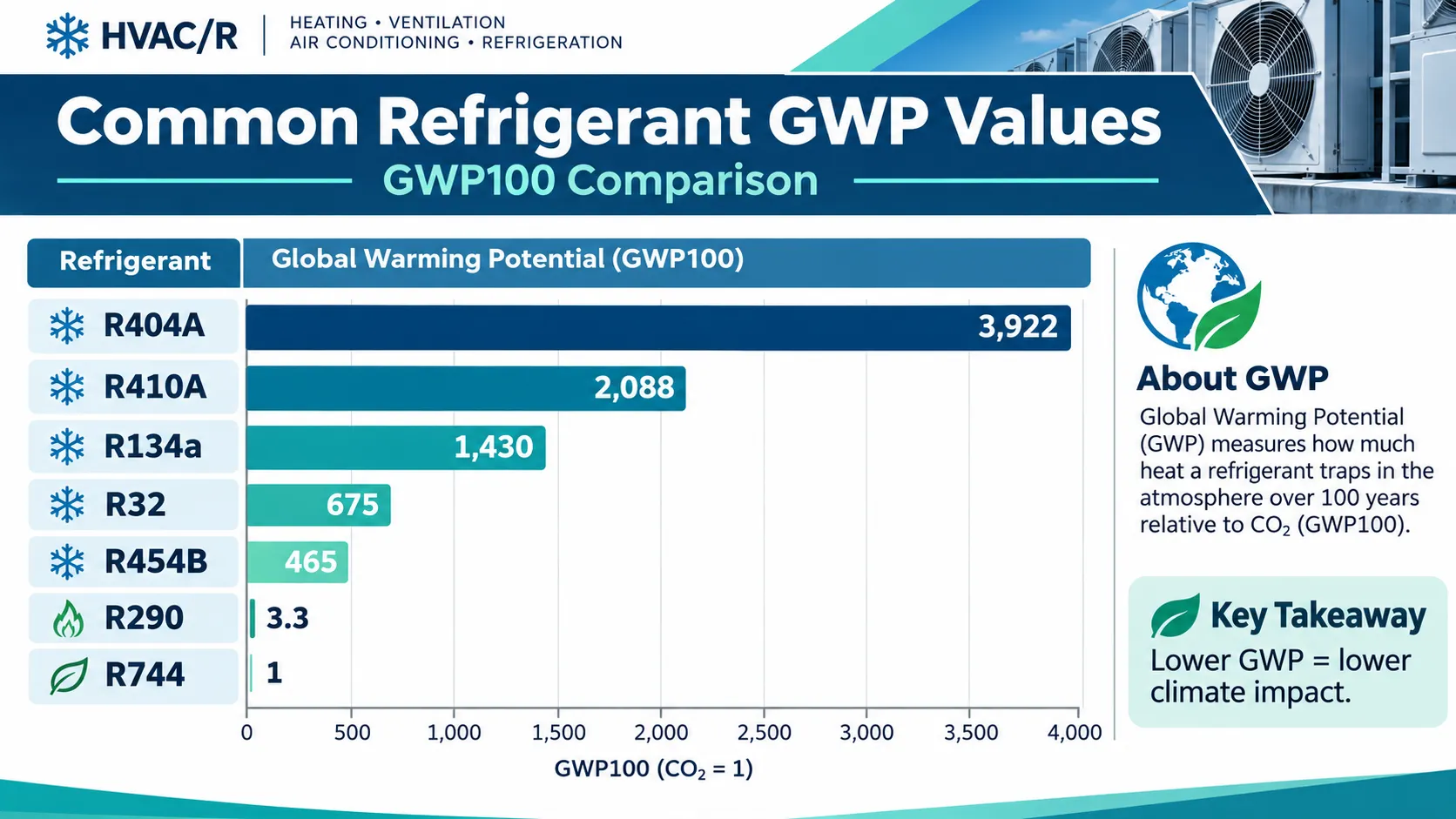
| Refrigerant | GWP100 | ASHRAE Safety Class | Common Application |
|---|---|---|---|
| R404A | 3,922 | A1 | Legacy commercial refrigeration |
| R410A | 2,088 | A1 | Existing air conditioning and heat pumps |
| R134a | 1,430 | A1 | Chillers, refrigeration and legacy automotive AC |
| R32 | 675 | A2L | Air conditioning and heat pumps |
| R513A | 630 | A1 | Chillers and selected refrigeration systems |
| R454B | 465 | A2L | Newer air conditioning and heat pumps |
| R454C | 146 | A2L | Commercial refrigeration |
| R290 | 3.3 | A3 | Refrigeration and heat pumps |
| R744 | 1 | A1 | CO₂ refrigeration and heat pumps |
| R1234yf | 1 | A2L | Automotive air conditioning |
Reference note: These figures use the website’s EPA-oriented lookup convention. Scientific publications using IPCC AR5 or AR6 may report different values, especially for refrigerant blends and very-low-GWP compounds.
Which Common Refrigerants Have High GWP?
R404A, R410A and R134a are examples of refrigerants with relatively high GWP values.
They remain important for understanding existing equipment, servicing and refrigerant transition planning.
However, their environmental characteristics have driven increased interest in lower-GWP alternatives.
Which Refrigerants Have Low GWP?
Examples of very-low-GWP refrigerants include:
- R744 — carbon dioxide.
- R290 — propane.
- R600a — isobutane.
- R717 — ammonia.
- R1234yf — an HFO refrigerant.
- R1234ze(E) — another HFO refrigerant.
These substances have different pressures, safety classes, applications and equipment requirements.
A low GWP value does not imply that they can be substituted directly for existing refrigerants.
For a broader comparison, see the Low-GWP Refrigerants Guide and Natural Refrigerants Guide.
What Is the Difference Between GWP20, GWP100 and GWP500?
GWP is calculated over a specified time horizon.
The most commonly discussed time horizons include:
| Metric | Time Horizon | Main Purpose |
|---|---|---|
| GWP20 | 20 years | Evaluates near-term warming impact |
| GWP100 | 100 years | Common reference for climate reporting and refrigerant regulation |
| GWP500 | 500 years | Evaluates warming over a longer period |
The same refrigerant can have different values depending on the time horizon.
GWP20: Short-Term Climate Impact
GWP20 evaluates the integrated warming impact over the first 20 years after emission.
For many relatively short-lived refrigerant gases, GWP20 is substantially higher than GWP100.
This happens because a larger portion of their warming effect occurs in the earlier years following release.
GWP100: The Common Industry Reference
GWP100 measures the integrated warming impact over 100 years.
It is widely used in:
- greenhouse-gas inventories;
- refrigerant comparison tables;
- environmental product assessments;
- HFC phase-down frameworks; and
- equipment GWP regulations.
When a refrigerant specification lists only “GWP,” it often refers to GWP100.
However, the underlying source should still be checked.
GWP500: Long-Term Climate Comparison
GWP500 evaluates the same relative warming concept over 500 years.
Longer time horizons place greater weight on gases that remain in the atmosphere for long periods.
Example: R134a Across Different Time Horizons
The IPCC AR4 values for R134a illustrate this distinction:
| Metric | R134a GWP |
|---|---|
| GWP20 | 3,830 |
| GWP100 | 1,430 |
| GWP500 | 435 |
This does not mean the chemical composition of R134a changes.
It means the assessment compares its integrated climate effect against CO₂ over different periods.
Important: Always compare GWP values calculated for the same time horizon and, where possible, the same assessment methodology.
Why Do Refrigerant GWP Values Differ Between Sources?
This is one of the most important questions when researching refrigerant global warming potential.
A refrigerant may appear with different GWP values on:
- equipment specifications;
- refrigerant manufacturer websites;
- environmental agency databases;
- academic publications;
- IPCC assessment tables; and
- HVAC/R technical guides.
These differences do not necessarily mean one source is wrong.
Often, the sources use different reference frameworks.
IPCC Assessment Reports
The Intergovernmental Panel on Climate Change periodically updates its scientific assessments.
Commonly referenced reports include:
- AR4 — Fourth Assessment Report, 2007.
- AR5 — Fifth Assessment Report, 2013–2014.
- AR6 — Sixth Assessment Report, 2021–2023.
These reports incorporate scientific information available at the time of each assessment.
Changes in atmospheric lifetime estimates, radiative efficiency and calculation methodology can produce different GWP values.
Refrigerant GWP: AR4 vs AR5 vs AR6
The 2026 ASHRAE Handbook—Refrigeration provides GWP100 comparisons across these three IPCC assessment frameworks.
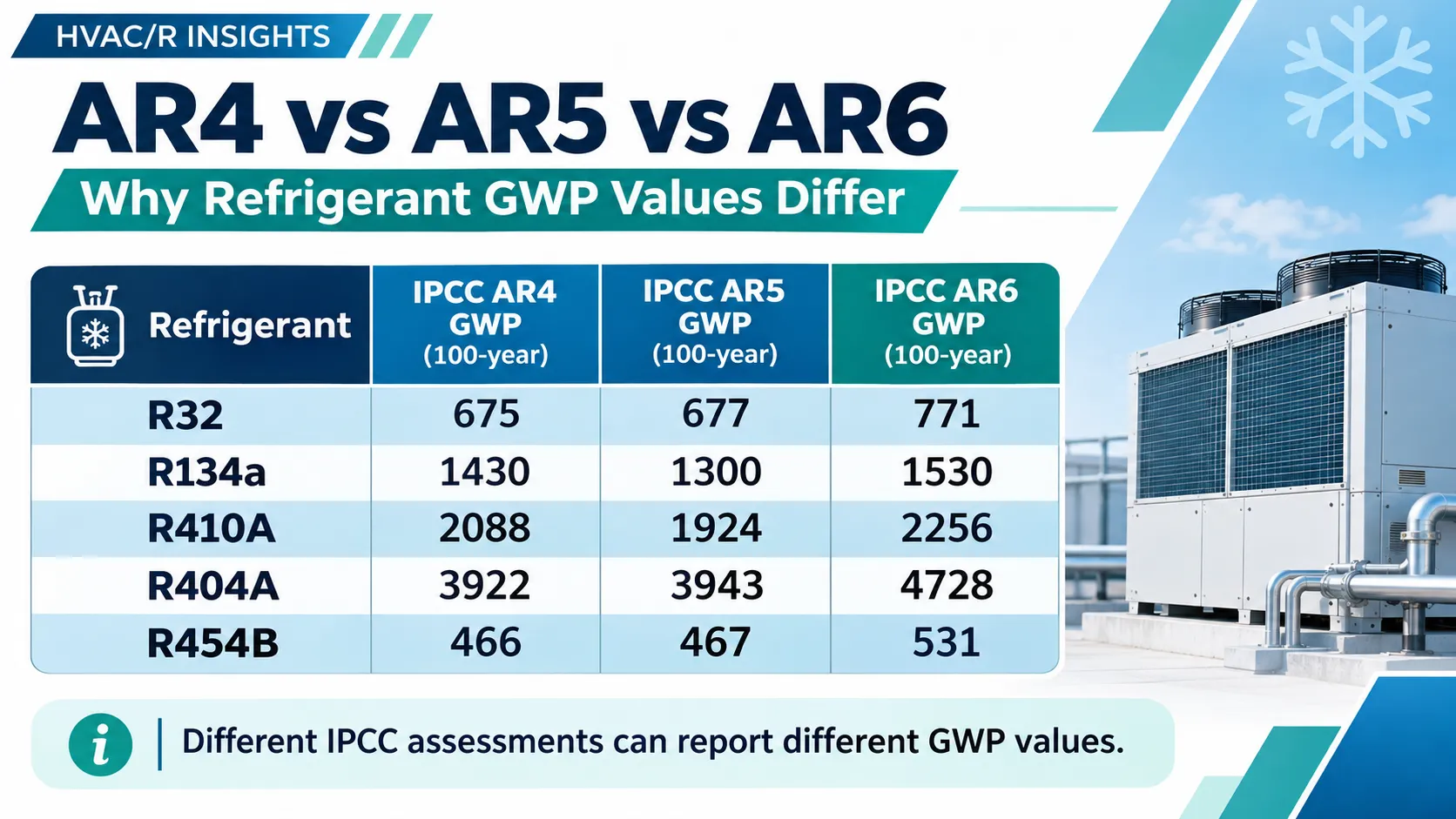
| Refrigerant | AR4 GWP100 | AR5 GWP100 | AR6 GWP100 |
|---|---|---|---|
| R32 | 675 | 677 | 771 |
| R134a | 1,430 | 1,300 | 1,530 |
| R410A | 2,088 | 1,924 | 2,256 |
| R404A | 3,922 | 3,943 | 4,728 |
| R454B | 466 | 467 | 531 |
Source: 2026 ASHRAE Handbook—Refrigeration, Chapter 1, Table 2.
This table shows that the same refrigerant can have different values even when the time horizon remains fixed at 100 years.
Example: Why Does R410A Have Different GWP Values?
R410A is commonly listed with a GWP of:
- 2,088 under AR4.
- 1,924 under AR5.
- 2,256 under AR6.
The refrigerant itself has not changed.
The reported GWP changes because the scientific assessment and underlying component values differ.
Example: Why Is R454B Sometimes Listed as 465 or 466?
R454B provides another useful example.
The U.S. EPA Technology Transitions reference table uses 465, while the 2026 ASHRAE Handbook lists 466 for AR4, 467 for AR5 and 531 for AR6.
A difference of one unit can arise from the specified reference dataset, blend calculation or rounding convention.
For regulatory decisions, the legally specified value is the one that matters.
For scientific comparisons, it is important to state the assessment framework.
Which GWP Value Should You Use?
The correct value depends on the purpose.
| Purpose | Recommended Approach |
|---|---|
| General refrigerant comparison | Use one clearly identified GWP100 reference |
| Scientific analysis | Specify the IPCC assessment and time horizon |
| U.S. regulatory compliance | Follow the GWP values and rules applicable to the program |
| EU regulatory compliance | Follow Regulation (EU) 2024/573 and its applicable annexes |
| Product documentation | Verify the manufacturer’s stated reference |
| Refrigerant emissions calculations | Use a consistent GWP basis for the reporting framework |
Do not automatically replace a legally specified GWP value with the newest scientific value. Regulatory requirements may intentionally reference a different assessment or dataset.
How Is the GWP of a Refrigerant Blend Calculated?
Many HVAC/R refrigerants are mixtures of multiple chemical components.
Examples include:
- R410A.
- R404A.
- R407C.
- R454B.
- R448A.
- R449A.
The GWP of a refrigerant blend is generally calculated as the mass-weighted average of the component GWPs.
The formula is:
Blend GWP = Σ (Component Mass Fraction × Component GWP)
All component values must use a consistent time horizon and compatible reference framework.
Example: Calculating R410A GWP
R410A contains:
- 50% R32 by mass.
- 50% R125 by mass.
Using IPCC AR4 GWP100 values:
| Component | Mass Fraction | GWP100 |
|---|---|---|
| R32 | 0.50 | 675 |
| R125 | 0.50 | 3,500 |
The weighted-average calculation is:
R410A GWP = (0.50 × 675) + (0.50 × 3,500)
= 337.5 + 1,750
= 2,087.5
Rounded to a whole number:
R410A GWP ≈ 2,088
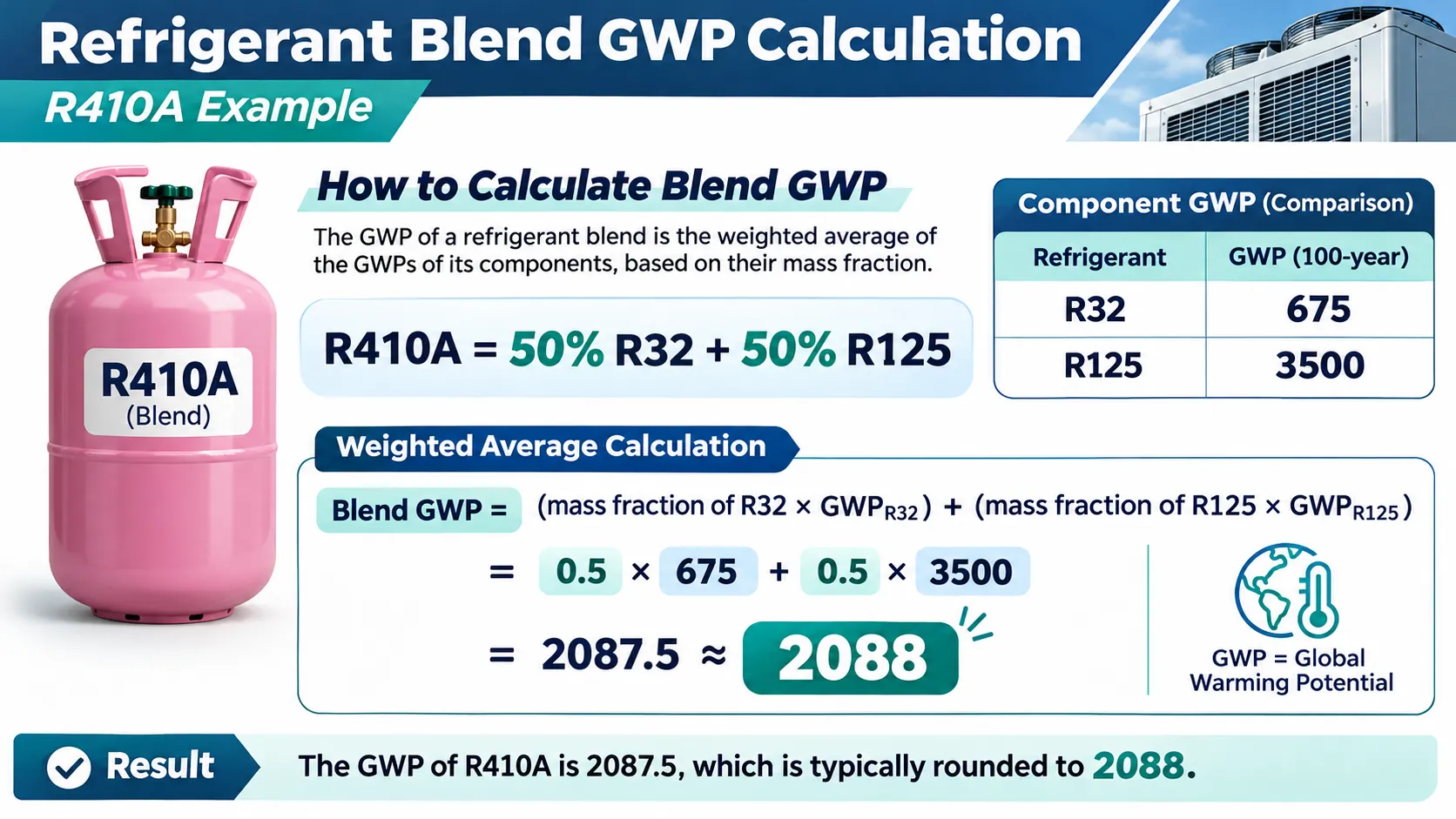
This demonstrates how a refrigerant blend’s GWP can be determined from its component composition.
Why Is Blend Composition Important?
A blend’s GWP depends on the relative mass fractions of its components.
Even small changes in composition can affect the calculated result.
However, the GWP of a blend does not tell you whether it is:
- azeotropic or zeotropic;
- flammable or nonflammable;
- suitable for retrofit;
- compatible with a compressor; or
- efficient in a particular application.
Those questions require additional refrigerant-property and equipment information.
Is Blend GWP the Same as Temperature Glide?
No.
GWP and temperature glide measure entirely different things.
GWP describes relative climate impact.
Temperature glide describes the temperature change during phase transition for a refrigerant blend at a given pressure.
A blend can have low GWP and meaningful glide, or high GWP and relatively little glide.
You can explore pressure-temperature behavior independently using the Refrigerant P-T Chart Tool.
GWP vs CO₂e: What Is the Difference?
GWP and carbon dioxide equivalent are closely related, but they are not the same measurement.
GWP is a relative warming factor.
CO₂e expresses the climate impact of an actual quantity of emitted greenhouse gas in equivalent CO₂ mass.
The basic equation is:
CO₂e = Refrigerant Mass Released × GWP
For a mass measured in kilograms, the result is expressed in kilograms of CO₂e.
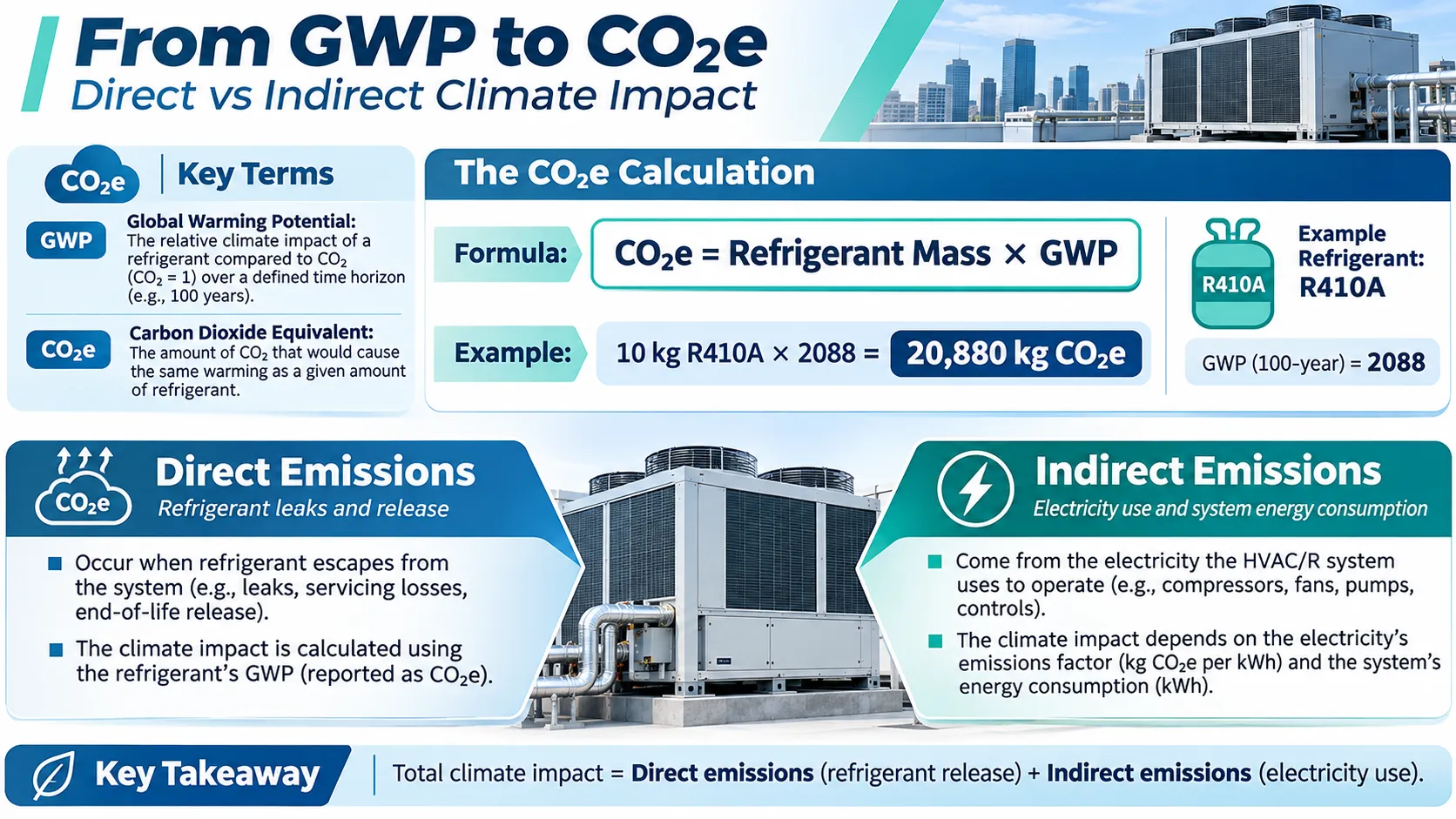
Example: 10 kg of R410A Released
Suppose a system loses 10 kg of R410A.
Using GWP100 = 2,088:
CO₂e = 10 kg × 2,088
= 20,880 kg CO₂e
That equals:
20.88 metric tons CO₂e
This calculation describes the direct climate impact of the refrigerant released.
It does not mean that a system containing 10 kg of refrigerant automatically releases that amount.
Example: A 10% Leak From a 10 kg System
Suppose an R410A system contains 10 kg of refrigerant and loses 10% of its charge.
Refrigerant released:
10 kg × 10% = 1 kg
Direct climate impact:
1 kg × 2,088 = 2,088 kg CO₂e
This distinction between total charge and actual released mass is essential.
Comparing Equal Refrigerant Losses
If 10 kg of each refrigerant were released, using the reference values below:
| Refrigerant | GWP100 | CO₂e From 10 kg Release |
|---|---|---|
| R410A | 2,088 | 20,880 kg |
| R134a | 1,430 | 14,300 kg |
| R32 | 675 | 6,750 kg |
| R454B | 465 | 4,650 kg |
| R290 | 3.3 | 33 kg |
| R744 | 1 | 10 kg |
These are direct-emission comparisons for equal released masses.
They are not comparisons of complete equipment lifecycle emissions or recommendations to substitute refrigerants in existing systems.
For a specific charge or leakage scenario, use the Refrigerant CO₂e Calculator.
GWP vs ODP vs Refrigerant Safety Class
These three properties are frequently discussed together, but they measure different characteristics.
| Metric | Full Name | What It Describes |
|---|---|---|
| GWP | Global Warming Potential | Relative climate impact of greenhouse-gas emissions |
| ODP | Ozone Depletion Potential | Potential to deplete stratospheric ozone |
| Safety Class | ASHRAE Refrigerant Safety Classification | Toxicity and flammability characteristics |
A refrigerant can have:
- Zero ODP but high GWP.
- Low GWP but higher flammability.
- A1 safety classification but high operating pressure.
- Low GWP but special equipment requirements.
For example, R410A has zero ODP but relatively high GWP.
R290 has very low GWP but is classified A3.
R744 has a GWP of 1 and an A1 classification, but CO₂ systems have distinct high-pressure engineering requirements.
Therefore, a refrigerant should never be selected using GWP alone.
For the safety classification framework, see the Refrigerant Safety Guide and A2L Refrigerants Guide.
Does Lower GWP Always Mean Lower Environmental Impact?
Not necessarily.
A lower-GWP refrigerant reduces the direct warming impact per kilogram emitted, assuming comparable GWP methodology.
But a refrigeration system creates environmental impacts in several ways.
Two major contributors are:
Direct Refrigerant Emissions
These occur when refrigerant escapes during:
- Normal system leakage.
- Equipment servicing.
- Accidental releases.
- Installation losses.
- Improper recovery or disposal.
Direct emissions depend on the amount released and its GWP.
Indirect Energy-Related Emissions
HVAC/R systems consume electricity to operate:
- Compressors.
- Fans.
- Pumps.
- Controls.
- Auxiliary equipment.
The associated climate impact depends on the amount of electricity consumed and the emissions intensity of the electricity supply.
An inefficient refrigeration system may produce significantly greater indirect emissions over its operating life.
Why System Efficiency Matters
Consider two refrigeration designs.
System A uses a refrigerant with lower GWP but requires more electricity.
System B uses a refrigerant with somewhat higher GWP but achieves better seasonal efficiency and has a lower leakage rate.
Which system has lower total climate impact?
The answer cannot be determined from refrigerant GWP alone.
It requires additional information about:
- Refrigerant charge.
- Annual leakage.
- System efficiency.
- Electricity consumption.
- Operating hours.
- Equipment lifetime.
- Recovery rate.
- Electricity emission factors.
This is why environmental evaluation increasingly considers the complete system.
What Are TEWI and LCCP?
Two broader environmental assessment concepts are frequently used in refrigeration engineering.
TEWI: Total Equivalent Warming Impact
TEWI considers the direct warming effect of refrigerant emissions and the indirect effect of energy consumption during the equipment’s operating life.
In simplified form:
TEWI = Direct Refrigerant Emissions + Indirect Energy-Related Emissions
The calculation may include refrigerant losses during operation and at end of life, as well as lifetime electricity consumption.
LCCP: Life Cycle Climate Performance
LCCP extends environmental assessment beyond operating emissions.
Depending on the methodology, it may include emissions associated with:
- Refrigerant production.
- Equipment manufacturing.
- Transportation.
- Energy consumption.
- Refrigerant leakage.
- Maintenance.
- End-of-life recovery and disposal.
LCCP is therefore broader than a simple refrigerant GWP comparison.
Key distinction: GWP describes a substance’s direct warming potential. TEWI and LCCP evaluate climate impacts over the operating life or wider lifecycle of equipment.
Why Does Refrigerant Charge Size Matter?
A lower refrigerant charge can reduce the amount of refrigerant potentially released.
For two systems using the same refrigerant:
- System A contains 2 kg.
- System B contains 20 kg.
A complete release from System B would result in ten times the emitted refrigerant mass.
However, charge size alone does not determine real-world emissions.
The actual leakage rate, servicing practices and recovery performance also matter.
Reducing refrigerant charge, preventing leaks and improving recovery can all reduce direct emissions.
These measures complement the use of lower-GWP refrigerants.
How Is GWP Used in Refrigerant Regulations?
GWP is a central metric in many refrigerant-transition policies.
However, different jurisdictions can use different:
- Reference datasets.
- Equipment categories.
- GWP thresholds.
- Implementation dates.
- Exemptions.
- Reporting requirements.
There is no single worldwide GWP threshold that determines whether every refrigerant is permitted.
Montreal Protocol and Kigali Amendment
The Kigali Amendment to the Montreal Protocol established an international framework for phasing down HFC production and consumption.
HFCs are important greenhouse gases even though they generally do not deplete stratospheric ozone.
The Kigali framework sets the overall direction of HFC reductions, while countries implement their obligations through national and regional measures.
United States: EPA Technology Transitions
In the United States, the EPA Technology Transitions Program establishes HFC restrictions for specific sectors and subsectors.
These include selected applications involving:
- Air conditioning.
- Heat pumps.
- Commercial refrigeration.
- Chillers.
- Other refrigeration equipment.
The applicable GWP threshold depends on the equipment category and compliance date.
The EPA also publishes a reference table identifying the GWP values used for the program.
A refrigerant’s GWP alone is not sufficient to establish whether a specific installation complies with every applicable rule.
European Union: F-Gas Regulation
The European Union’s F-gas Regulation (EU) 2024/573 establishes HFC phase-down measures, product restrictions and other controls.
The regulation includes GWP-based restrictions for different categories of equipment.
The applicable value must be determined from the regulation’s definitions and annexes.
It is not appropriate to assume that a GWP figure from a manufacturer’s marketing page automatically matches the value used for a regulatory determination.
Why Regulation-Specific GWP Matters
Suppose a regulation establishes a GWP threshold for a particular type of equipment.
A refrigerant with a reported value close to that threshold must be evaluated using the correct regulatory reference.
Do not switch between AR4, AR5 and AR6 merely to obtain a more favorable number.
For current jurisdiction-specific information, see the Refrigerant Regulations Hub.
How to Choose a Refrigerant Based on GWP
GWP is an important screening criterion, but it should be used within a broader selection process.
1. Identify the Application
Determine whether the refrigerant will be used in:
- Residential air conditioning.
- Heat pumps.
- Commercial refrigeration.
- Cold storage.
- Chillers.
- Industrial refrigeration.
- Automotive air conditioning.
Different applications have different operating and regulatory requirements.
2. Confirm Equipment Compatibility
Check which refrigerants are approved for the equipment.
Similar GWP or pressure does not mean refrigerants are interchangeable.
Never assume that an existing R410A system can be charged with R32 or R454B merely because they are relevant lower-GWP alternatives for newer equipment.
3. Evaluate Safety Classification
Consider:
- A1.
- A2L.
- A3.
- B1 or B2L where relevant.
Safety classifications influence equipment design, charge management, ventilation and other requirements.
4. Compare GWP Values on a Consistent Basis
Use the same reference framework when comparing refrigerants.
For example, do not compare an AR4 value for one refrigerant directly against an AR6 value for another without explaining the difference.
5. Evaluate Energy Efficiency
Compare equipment performance using metrics appropriate to the application.
These may include:
- COP.
- EER.
- SEER.
- SCOP.
- Part-load efficiency.
The most appropriate metric depends on the system and market.
6. Evaluate Leakage and Lifecycle Impact
Consider refrigerant charge, likely leakage, maintenance and end-of-life recovery.
For large commercial or industrial installations, TEWI or LCCP analysis may be appropriate.
7. Verify Regulatory and OEM Requirements
Finally, confirm that the refrigerant is permitted and suitable for the specific equipment and jurisdiction.
For a broader selection discussion, see Low-GWP Refrigerants and the Refrigerant Database.
Frequently Asked Questions
What is GWP in refrigerants?
GWP stands for Global Warming Potential. It measures the integrated warming effect of releasing a unit mass of refrigerant compared with releasing the same mass of CO₂ over a specified time horizon.
What does GWP 1 mean?
A GWP of 1 represents the reference warming effect of CO₂ over the selected time horizon.
R744 is carbon dioxide and therefore has a GWP of 1 by definition.
What is a good GWP for a refrigerant?
There is no universal threshold defining a good GWP.
A lower value generally reduces direct climate impact per kilogram released, but the preferred refrigerant depends on the application, system efficiency, safety, regulations and equipment compatibility.
What is the GWP of R410A?
R410A has a GWP100 of 2,088 under IPCC AR4, 1,924 under AR5 and 2,256 under AR6.
The AR4 value of 2,088 is commonly used in HVAC/R reference materials and in the Refrigerants.net calculator.
What is the GWP of R32?
R32 has a GWP100 of 675 under AR4, 677 under AR5 and 771 under AR6.
It has substantially lower direct warming potential than R410A when compared on the same assessment basis.
What is the GWP of R404A?
R404A has a GWP100 of 3,922 under AR4, 3,943 under AR5 and 4,728 under AR6.
It is a relatively high-GWP refrigerant associated with existing commercial refrigeration equipment.
What is the GWP of R454B?
R454B is listed as GWP 465 in the U.S. EPA Technology Transitions reference table. The 2026 ASHRAE Handbook reports AR4 = 466, AR5 = 467 and AR6 = 531.
The appropriate value depends on the reporting or regulatory reference.
What is the difference between GWP20 and GWP100?
GWP20 compares integrated warming effects over 20 years, while GWP100 compares them over 100 years.
The same refrigerant may have significantly different values because the selected time horizon changes the relative contribution of its warming effect.
Why do refrigerant GWP values differ between websites?
Different websites may use different IPCC assessment reports, regulatory reference tables, blend calculations or rounding conventions.
The source and assessment methodology should be identified before comparing numerical values.
How is the GWP of a refrigerant blend calculated?
A blend’s GWP is generally the mass-weighted average of its components’ GWPs.
For example, R410A contains 50% R32 and 50% R125 by mass. Using AR4 values, its calculated GWP is 2,087.5, typically rounded to 2,088.
What is the difference between GWP and CO₂e?
GWP is a relative warming factor.
CO₂e applies that factor to an actual amount of emitted gas.
For example, releasing 1 kg of R410A with a GWP of 2,088 corresponds to 2,088 kg CO₂e.
Does GWP include electricity consumption?
No.
Refrigerant GWP describes the relative direct warming impact of the refrigerant itself.
Electricity-related emissions are considered separately in broader assessments such as TEWI and LCCP.
Is R290 a zero-GWP refrigerant?
No.
R290 propane has a very low GWP but not literally zero GWP.
The EPA-oriented reference used on Refrigerants.net lists R290 at approximately 3.3.
Is R1234yf a zero-GWP refrigerant?
No.
R1234yf has a very low GWP, but its reported value depends on the assessment framework.
The EPA reference used on Refrigerants.net lists it as 1, while the 2026 ASHRAE Handbook lists an AR6 GWP100 of approximately 0.501.
Which refrigerant has the lowest GWP?
Several natural refrigerants and HFOs have very low GWP values.
R744 has GWP 1 by definition. R1234yf, R1234ze(E), R290 and other refrigerants also have low values under relevant assessment frameworks.
However, a universal ranking requires the same time horizon and data source, and GWP alone does not determine application suitability.
Does lower GWP always mean a better refrigerant?
No.
A lower-GWP refrigerant may require different safety controls, compressor technology, operating pressure or system design.
The correct choice considers environmental impact together with efficiency, safety, compatibility, regulations and lifecycle performance.
Final Takeaway
Refrigerant global warming potential is one of the most important metrics in modern HVAC/R environmental evaluation.
However, understanding GWP requires more than memorizing a number.
The key principles are:
- GWP measures relative direct warming potential, not total system efficiency.
- GWP100 is a common reference, but GWP20 and GWP500 evaluate different time horizons.
- AR4, AR5 and AR6 can report different values for the same refrigerant.
- Refrigerant blend GWP is generally calculated using mass-weighted component values.
- CO₂e combines GWP with the actual mass released.
- Lower GWP reduces direct warming impact per kilogram released, but does not automatically guarantee lower total lifecycle emissions.
- Regulations must be evaluated using the applicable legal GWP reference and equipment requirements.
A useful way to approach refrigerant comparison is:
Identify the refrigerant → Confirm the GWP reference → Compare on a consistent basis → Evaluate safety and efficiency → Calculate potential emissions → Verify equipment and regulatory requirements.
For a fast numerical comparison, use the Refrigerant GWP Calculator.
To calculate the impact of a specific charge or leak, use the CO₂e Calculator.
For broader refrigerant selection, explore Low-GWP Refrigerants, Natural Refrigerants and the Refrigerant Database.
Technical References
The following primary technical and regulatory resources provide the reference basis for the GWP definitions, calculations and comparison tables used in this guide.
- ASHRAE Handbook—Refrigeration, 2026, Chapter 1 — Refrigerant GWP100 values across IPCC AR4, AR5 and AR6.
- U.S. EPA — Technology Transitions GWP Reference Table — Regulatory reference values for HFCs, blends and substitutes.
- UNEP OzonAction — Refrigerant Blends: Calculating Global Warming Potentials — Mass-weighted blend GWP calculations.
- UNFCCC — Global Warming Potentials, IPCC Fourth Assessment Report — AR4 GWP100 reference values.
- European Commission — F-Gas Legislation — Regulation (EU) 2024/573 and related regulatory framework.
GWP values should always be interpreted with their stated time horizon and reference methodology. Regulatory applicability depends on jurisdiction, equipment category, implementation date and current legal requirements.
