
Refrigerant safety is about much more than whether a refrigerant is classified as A1, A2L, A3 or B2L.
HVAC/R technicians may also need to manage oxygen-displacement risk, toxicity, flammability, cold-contact injuries, high pressure, thermal decomposition, refrigerant charge, room volume and leak concentration.
That is why a refrigerant’s safety class should never be treated as a complete safety assessment.
A useful way to think about real-world refrigerant safety is:
Refrigerant safety = refrigerant properties + charge size + space + system design + detection, ventilation and operating controls.
For a detailed explanation of refrigerant classifications such as A1, A2L, A3 and B2L, see our Refrigerant Safety Guide. This article focuses instead on practical hazards, handling and service safety.
Important: This guide provides general HVAC/R safety information. Actual procedures must follow the current refrigerant Safety Data Sheet (SDS), equipment manufacturer’s instructions, applicable standards, workplace procedures and local regulations.
What Are the Main Refrigerant Safety Hazards?
Different refrigerants create different hazard profiles.
A refrigerant may have relatively low toxicity but still create an oxygen-deficient atmosphere after a major leak. Another may have extremely low GWP but require stricter ignition-source control. A refrigerant classified A1 may still operate at very high pressure.
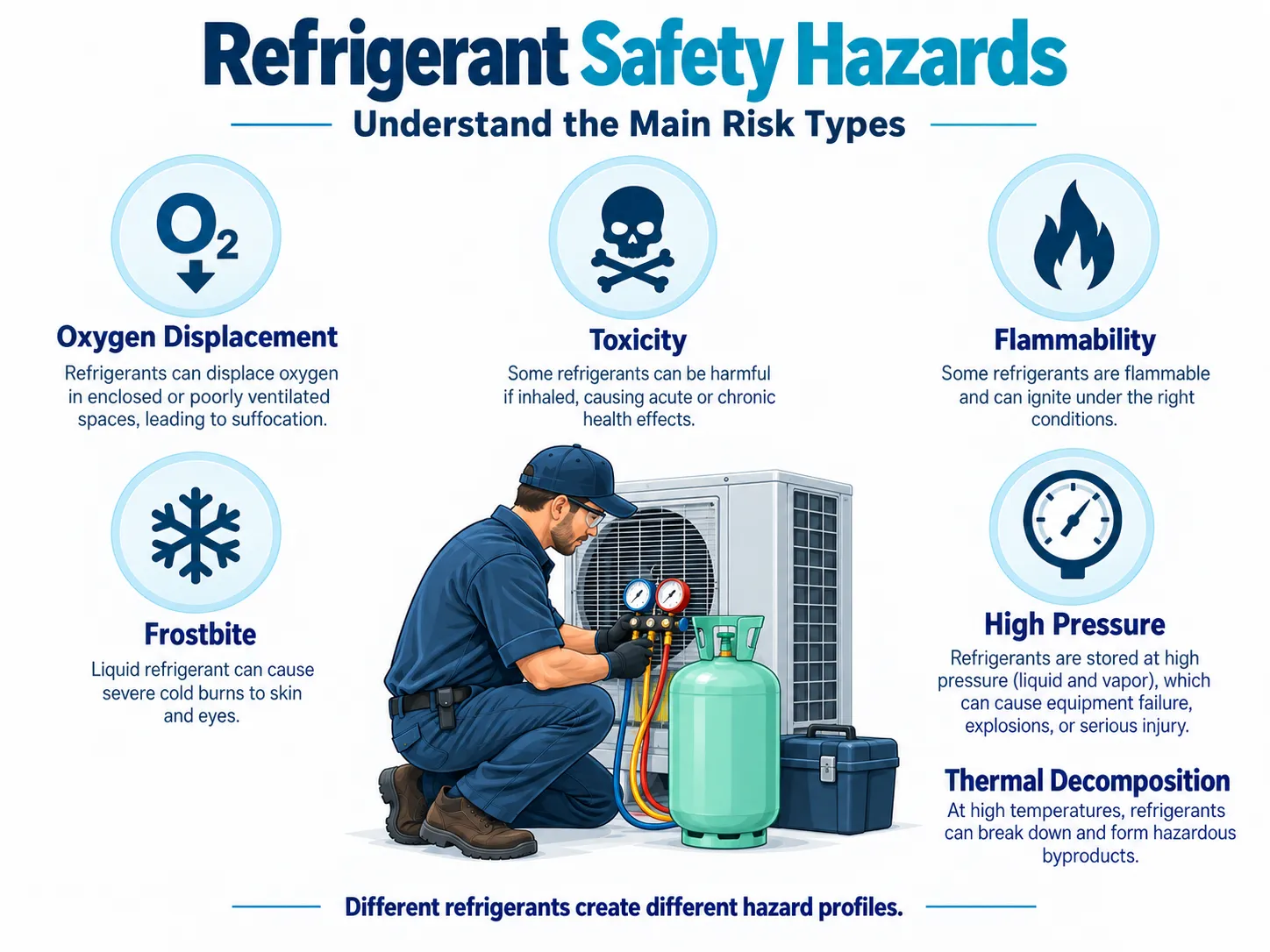
The main hazards HVAC/R professionals should understand include:
| Hazard | Typical Cause | Main Concern |
|---|---|---|
| Oxygen displacement | Large refrigerant release in an enclosed or poorly ventilated space | Asphyxiation |
| Toxicity | Exposure above applicable concentration limits | Acute or chronic health effects |
| Flammability | Flammable refrigerant mixed with air plus an ignition source | Fire or combustion |
| Frostbite / cold burns | Direct contact with rapidly expanding liquid refrigerant | Skin or eye injury |
| High pressure | System or cylinder pressure, trapped liquid, incorrect equipment | Mechanical injury or equipment failure |
| Thermal decomposition | Refrigerant exposed to excessive heat or flame | Hazardous decomposition products |
These hazards do not apply equally to every refrigerant or every installation.
The correct risk assessment must consider the refrigerant and the system around it.
Refrigerant Safety Classes: A1, A2L, A3 and B2L
ASHRAE Standard 34 and ISO 817 classify refrigerants primarily according to two characteristics:
- toxicity
- flammability
The letter indicates the toxicity group, while the number indicates flammability behavior.
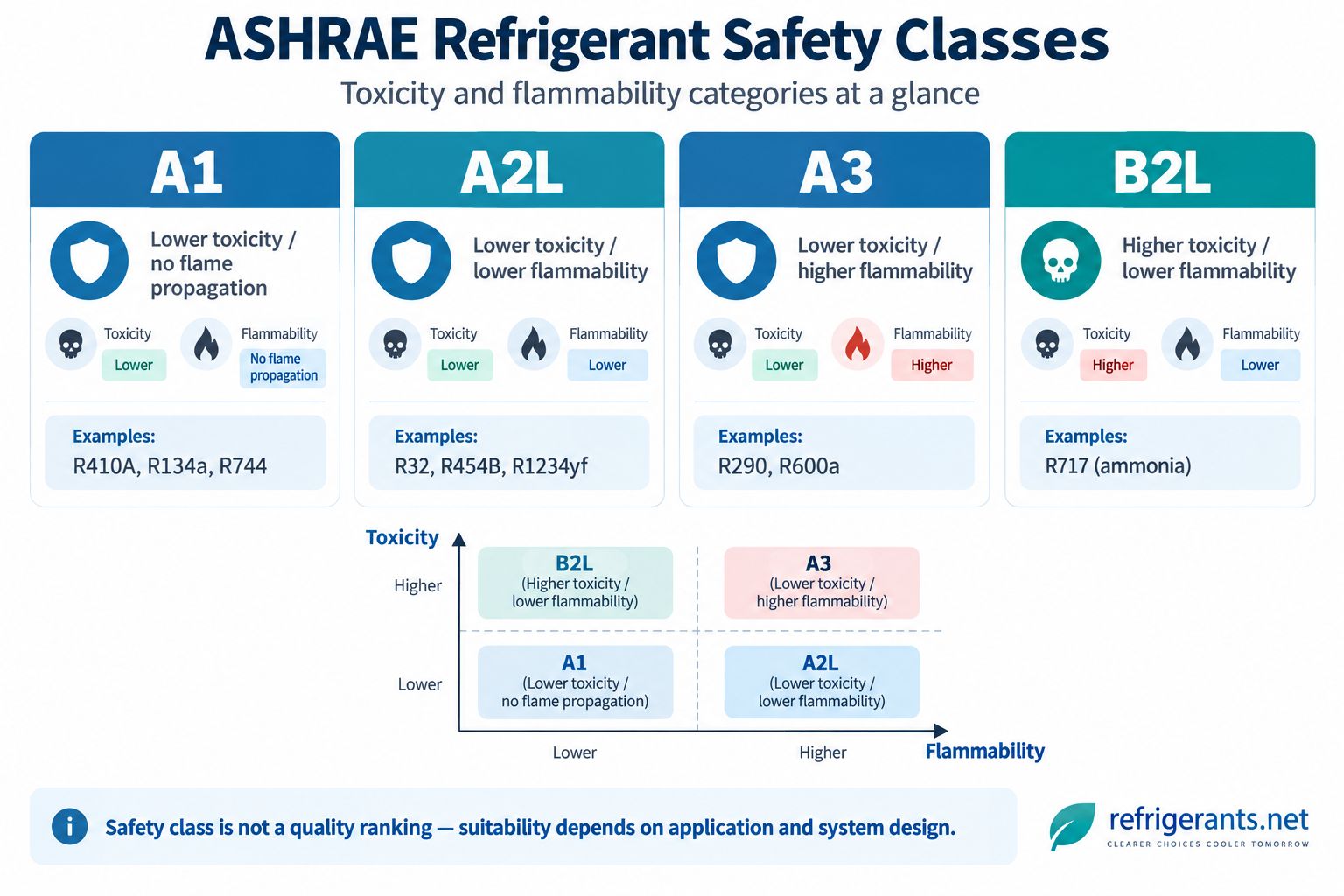
A simplified overview is:
| Safety Class | General Description | Common Examples |
|---|---|---|
| A1 | Lower toxicity group / no flame propagation under classification conditions | R410A, R134a, R744 |
| A2L | Lower toxicity group / lower flammability with limited burning velocity | R32, R454B, R1234yf |
| A3 | Lower toxicity group / higher flammability | R290, R600a |
| B2L | Higher toxicity group / lower flammability with limited burning velocity | R717 |
What Does “A” Mean?
Class A represents the lower-toxicity group under the refrigerant classification framework.
It does not mean:
non-toxic under every possible exposure condition.
Large concentrations should still be prevented and exposure minimized.
What Do 1, 2L and 3 Mean?
The numerical part describes flammability characteristics under standardized test conditions.
Class 1 refrigerants show no flame propagation under the specified classification test.
Class 2L refrigerants are flammable but meet additional lower-burning-velocity criteria.
Class 3 refrigerants have higher flammability characteristics.
This distinction is why an A2L refrigerant should never simply be described as “nonflammable.”
For a complete explanation of all eight groups, including A2, B1, B2 and B3, see the Refrigerant Safety Guide.
Safety Class Does Not Describe Every Hazard
This point is especially important.
A refrigerant safety class primarily describes toxicity and flammability.
It does not fully describe:
- system pressure;
- cold-contact injury;
- refrigerant charge;
- potential room concentration;
- decomposition products;
- cylinder hazards;
- required ventilation;
- leak detection requirements; or
- whether a particular piece of equipment is approved for that refrigerant.
For example, R744 is classified A1.
That does not mean a CO₂ refrigeration system has no significant safety engineering considerations.
R744 systems can operate at substantially higher pressures than many conventional HFC/HFO systems, and a large CO₂ release can create an unsafe atmosphere.
Safety class is therefore one input into risk assessment, not the entire risk assessment.
Oxygen Displacement and Asphyxiation
A refrigerant does not need to be highly toxic or flammable to create a dangerous atmosphere.
A sufficiently large refrigerant release in an enclosed or poorly ventilated space can displace air and reduce available oxygen.
Potential risk areas can include:
- machinery rooms;
- equipment rooms;
- cold rooms;
- basements;
- pits;
- equipment enclosures; and
- other poorly ventilated spaces.
The actual accumulation pattern depends on the refrigerant’s physical properties, leak location, airflow, room geometry and ventilation.
The important principle is:
Lower toxicity does not mean there is no asphyxiation risk.
A significant leak should therefore be considered in terms of possible refrigerant concentration in the occupied space, not merely refrigerant safety class.
Refrigerant Frostbite and Cold Burns
Liquid refrigerant can rapidly cool as it is released from a pressurized system.
Direct contact may cause severe cold injury to:
- hands;
- skin;
- eyes; and
- face.
This is why refrigerant service commonly requires suitable personal protective equipment.
Depending on the task and site procedure, this may include:
- eye or face protection;
- refrigerant-compatible protective gloves;
- suitable work clothing; and
- appropriate footwear.
The specific PPE should be selected according to the SDS, employer procedures and the work being performed.
Never assume that a refrigerant is safe to touch because it belongs to a lower-toxicity class.
High-Pressure Refrigerant Hazards
Refrigeration and air-conditioning systems store refrigerant under pressure.
Potential physical hazards can come from:
- damaged hoses;
- incorrectly rated gauges;
- incorrect recovery equipment;
- damaged cylinders;
- trapped liquid refrigerant;
- excessive heat exposure;
- defective pressure-relief systems; or
- components used outside their rated pressure.
Pressure risk also varies significantly by refrigerant and system architecture.
R744 Is a Useful Example
R744 is an A1 refrigerant, but CO₂ systems can operate at very high pressure.
Therefore:
A1 classification does not mean low-pressure equipment.
Pressure ratings, relief devices, piping design and service tools must match the actual system.
This is another reason refrigerant safety cannot be summarized by an A1/A2L/A3 label alone.
Thermal Decomposition
Some refrigerants can form hazardous decomposition products when exposed to excessive heat or flame.
This can become relevant during activities such as:
- brazing;
- welding;
- fire exposure; or
- other high-temperature work.
The safest principle is straightforward:
Do not treat open-flame work on a refrigerant circuit as routine work without first following the required recovery, isolation and equipment-specific safety procedure.
Technicians should use the current SDS and OEM instructions for the specific refrigerant and system.
A2L Refrigerant Safety
The transition toward lower-GWP refrigerants has made A2L safety especially important in modern HVAC/R work.
Common A2L refrigerants include:
- R32;
- R454B;
- R1234yf;
- R1234ze(E);
- R454C; and
- R455A.
A2L refrigerants have lower flammability characteristics than A3 hydrocarbons, but they are still classified as flammable.
Therefore:
A2L means lower flammability, not nonflammability.
Depending on the equipment and application, A2L systems may involve requirements relating to:
- allowable refrigerant charge;
- room or equipment volume;
- possible leak concentration;
- ventilation;
- leak mitigation;
- ignition-source management;
- approved electrical components;
- refrigerant detection; and
- service procedures.
Always follow the requirements for the specific equipment, rather than applying generic A2L rules to every installation.
For more detail, see the A2L Refrigerants Guide.
A3 Refrigerant Safety
A3 refrigerants include hydrocarbons such as:
- R290 propane;
- R600a isobutane; and
- R1270 propylene.
These refrigerants can offer very low GWP and excellent thermodynamic properties, but their higher flammability changes how equipment must be designed and serviced.
Important considerations may include:
- limited refrigerant charge;
- ignition-source control;
- ventilation;
- approved components;
- leak management; and
- technician procedures.
An A3 classification does not mean that a refrigerant cannot be used safely.
It means:
The equipment and risk controls must be appropriate for a higher-flammability refrigerant.
Purpose-designed R290 and R600a equipment demonstrates why refrigerant hazard and system risk are not the same thing.
Why Refrigerant Charge Size Matters
Imagine two systems using the same refrigerant.
One contains:
100 grams
The other contains:
20 kilograms
The possible consequences of a complete release are obviously different.
A larger refrigerant charge can create a higher possible concentration after a leak.
That can affect:
- oxygen displacement;
- toxicity exposure;
- flammable concentration;
- room-volume requirements;
- ventilation requirements; and
- mitigation strategy.
This is why refrigerant safety rules frequently consider charge size rather than simply stating:
“Refrigerant X is safe.”
There is no meaningful refrigerant-safety assessment without considering how much refrigerant is present.
Why Room Volume and Ventilation Matter
Charge size alone is still not enough.
Consider the same refrigerant charge released into:
- a small sealed room; versus
- a large ventilated industrial space.
The resulting concentrations can be very different.
Important factors include:
- room volume;
- occupancy;
- airflow;
- natural ventilation;
- mechanical ventilation;
- equipment location;
- possible accumulation zones; and
- leak-release characteristics.
This leads to one of the most important principles in refrigerant safety:
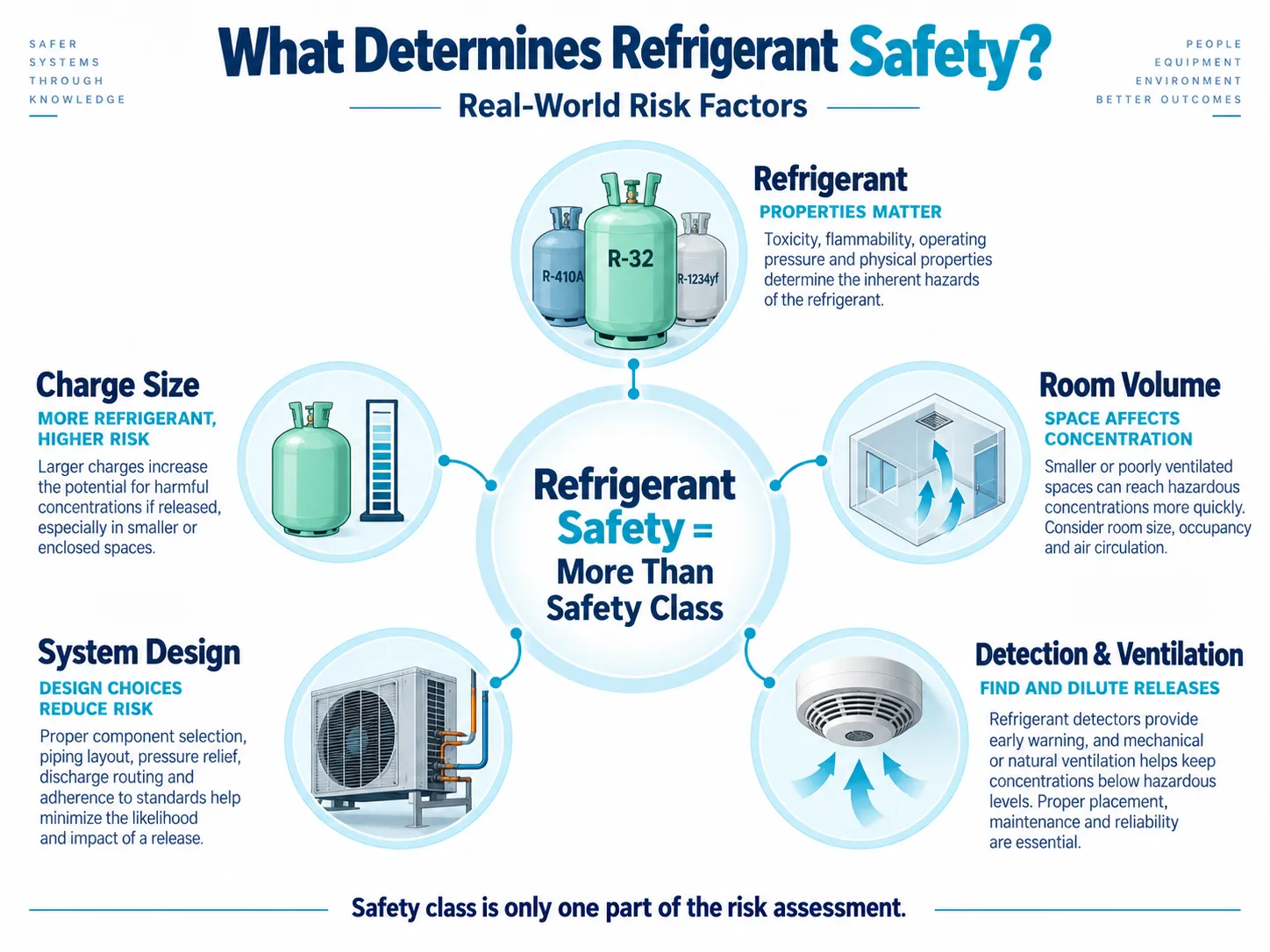
Refrigerant safety cannot be determined from the refrigerant name alone.
Real-world risk depends on the combination of:
Refrigerant + Charge Size + Room Volume + System Design + Detection / Ventilation
Refrigerant Leak Detection
Leak detection can serve two very different purposes.
Portable Refrigerant Leak Detection
Portable leak detectors are commonly used during HVAC/R service to locate the source of a suspected leak.
Typical considerations include:
- refrigerant compatibility;
- required sensitivity;
- sensor technology;
- response time;
- service environment; and
- calibration or maintenance requirements.
Fixed Refrigerant Detection
Fixed refrigerant detection systems can continuously monitor an occupied space, machinery room or equipment area.
Depending on the application, a detector may be integrated with:
- alarms;
- ventilation;
- equipment shutdown;
- mitigation controls; or
- building-management systems.
A fixed safety monitor and a portable service leak detector therefore solve different problems.
For a deeper explanation, see the Refrigerant Leak Detection Guide.
Safe Refrigerant Handling Workflow
Good refrigerant safety begins before a hose is connected.
A practical service workflow should establish what refrigerant is present, what hazards apply and whether the tools and work environment are appropriate.
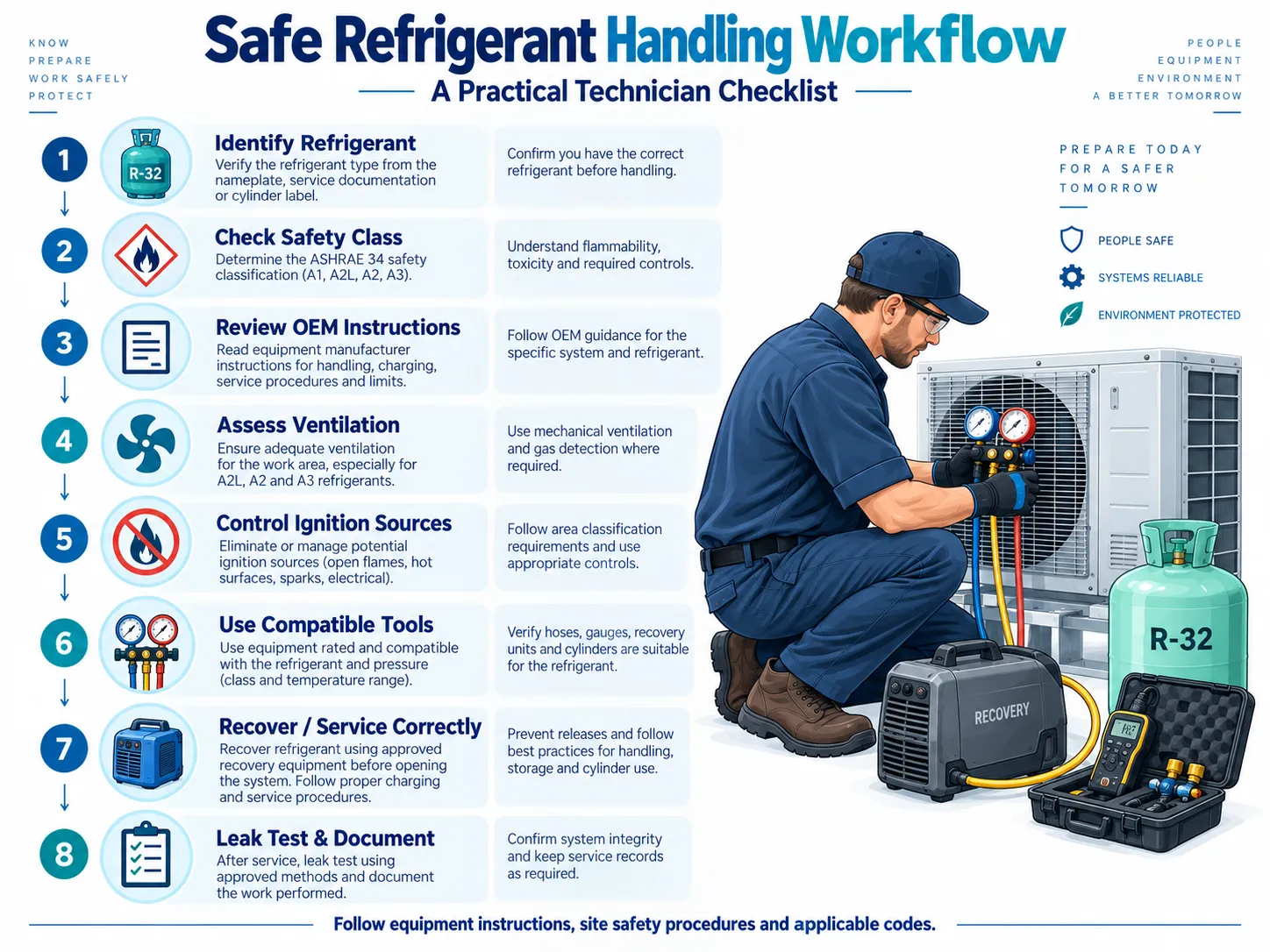
1. Identify the Refrigerant
Verify the refrigerant using:
- equipment nameplate;
- OEM documentation;
- service records; and
- correct cylinder labeling.
Do not assume refrigerant type based on system appearance or pressure alone.
2. Check the Safety Class
Determine whether the refrigerant is:
- A1;
- A2L;
- A2;
- A3;
- B1;
- B2L;
- B2; or
- B3.
Then identify additional system-specific hazards not captured by the safety class.
3. Review OEM Instructions
Check the equipment manufacturer’s service requirements before opening or charging the system.
The approved procedure may specify:
- compatible refrigerant;
- service tools;
- recovery process;
- evacuation;
- leak testing;
- charge method;
- charge quantity; and
- safety precautions.
4. Assess the Work Area
Consider:
- ventilation;
- room size;
- occupancy;
- potential refrigerant accumulation;
- ignition sources;
- required detection; and
- emergency access.
5. Manage Ignition Sources Where Applicable
For flammable refrigerants, identify and control potential ignition sources according to the applicable equipment, workplace and code requirements.
6. Use Compatible Tools
Service equipment must be suitable for:
- refrigerant type;
- safety class;
- pressure range; and
- service procedure.
This can include gauges, hoses, recovery machines, vacuum pumps, detectors and cylinders.
7. Recover and Service Correctly
Recover refrigerant using appropriate equipment rather than intentionally releasing it.
Avoid unnecessary refrigerant loss and prevent cross-contamination.
8. Leak Test and Document
After service, verify system integrity using an approved method and document the work as required.
Refrigerant Recovery Safety
Recovery is a fundamental part of modern HVAC/R service.
Important principles include using:
- refrigerant-compatible recovery equipment;
- appropriately rated recovery cylinders;
- correct refrigerant identification;
- appropriate weighing or fill-control practices; and
- procedures that prevent refrigerant mixing.
Do Not Mix Refrigerants
Mixing refrigerants can:
- contaminate recovery cylinders;
- complicate reclamation;
- make identification difficult;
- create unpredictable service conditions; and
- increase disposal or processing cost.
A recovery cylinder containing an unknown mixture should not simply be assumed to contain one labeled refrigerant.
Refrigerant Cylinder Safety
Refrigerant cylinders contain pressurized material and must be treated accordingly.
Basic good practice includes:
- use the correct approved cylinder;
- keep labels readable;
- protect cylinders from physical damage;
- secure cylinders appropriately;
- protect cylinder valves;
- keep cylinders away from excessive heat;
- follow applicable fill limits;
- avoid unauthorized refrigerant mixing; and
- follow transport and storage regulations.
The exact requirements vary by refrigerant, cylinder type and jurisdiction.
Always follow the cylinder manufacturer, refrigerant supplier, workplace procedure and applicable transport rules.
Brazing and Open-Flame Work
Open-flame work deserves particular attention because it can combine several hazards:
- residual refrigerant;
- flammable refrigerant;
- high temperature;
- ignition sources; and
- decomposition products.
The refrigerant circuit should be prepared according to the required OEM and service procedure before brazing or similar work begins.
For A2L or A3 systems, technicians must also consider the refrigerant’s flammability characteristics and applicable safety procedures.
Never assume that a system is ready for brazing simply because pressure appears to have been relieved.
What Should You Do If a Refrigerant Leak Is Suspected?
The exact response depends on:
- refrigerant;
- leak size;
- room;
- concentration;
- equipment;
- occupancy; and
- site emergency procedures.
However, some general principles apply.
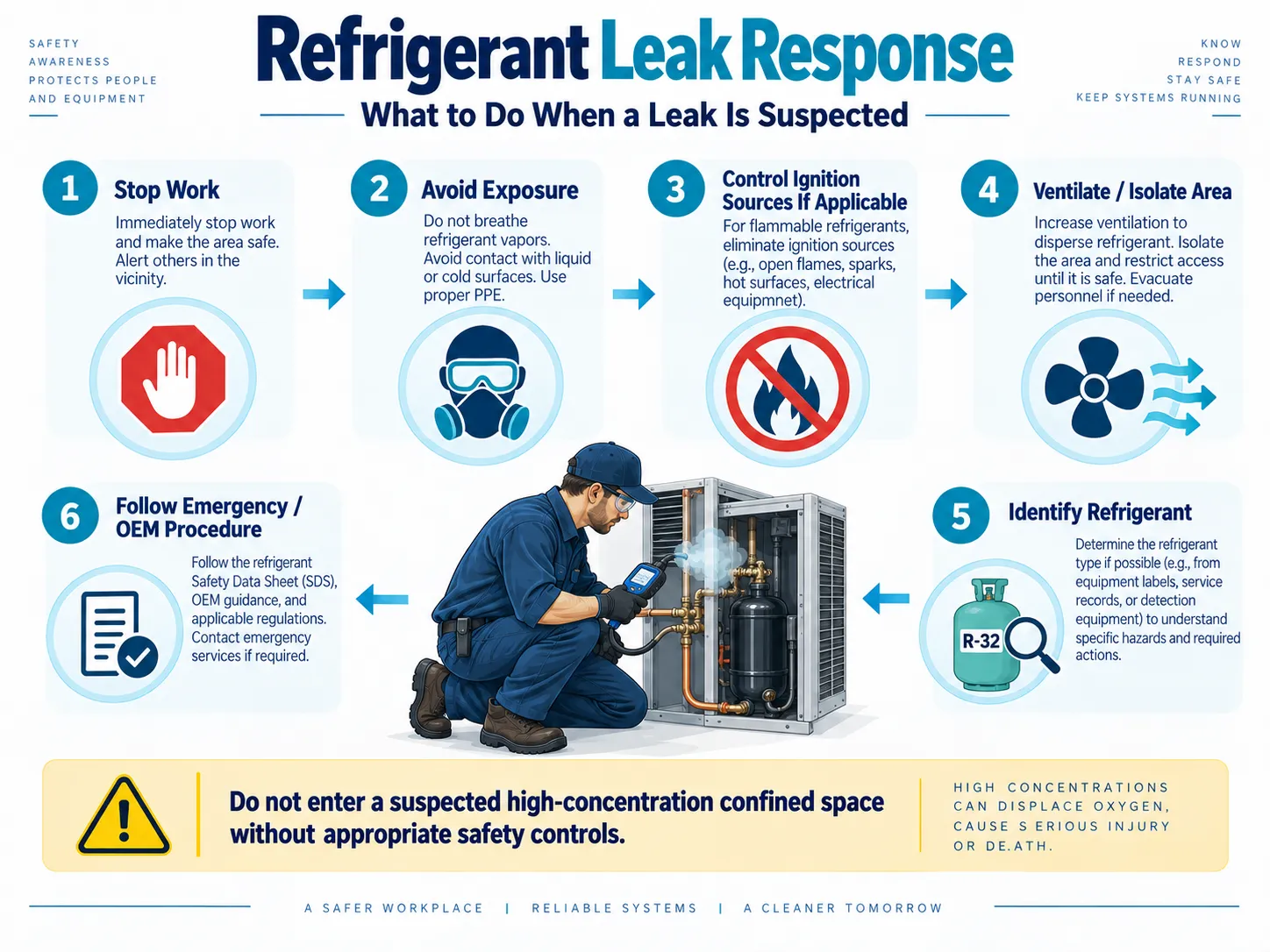
1. Stop Work
Do not continue routine service while an uncontrolled leak is occurring.
2. Avoid Exposure
Do not intentionally breathe refrigerant vapor or contact escaping liquid refrigerant.
Move away from an unsafe area.
3. Consider Ignition Sources
If the refrigerant is flammable, ignition sources may need to be controlled according to the approved emergency procedure.
Do not create additional risk while attempting to control them.
4. Ventilate or Isolate the Area
Where the approved procedure permits, ventilation may be used to reduce refrigerant concentration.
Restrict unnecessary entry into affected areas.
5. Identify the Refrigerant
If possible, determine the refrigerant from:
- equipment labeling;
- service records;
- SDS information; or
- approved identification methods.
6. Follow the Emergency Procedure
Use the:
- site emergency plan;
- SDS;
- OEM guidance;
- applicable regulations; and
- emergency services where required.
Do not enter a suspected high-concentration confined space without appropriate training, equipment and safety controls.
A large or unknown refrigerant leak in an enclosed space is not routine HVAC service work.
Common Refrigerant Safety Mistakes
Assuming A1 Means “No Hazard”
A1 addresses toxicity and flame-propagation classification.
It does not eliminate pressure, oxygen displacement, cold-contact or other hazards.
Assuming A2L Means Nonflammable
A2L refrigerants are flammable.
Their lower burning velocity distinguishes them from other flammability classes, but appropriate controls are still required.
Ignoring Refrigerant Charge
A small charge and a large charge can create very different leak scenarios.
Ignoring Room Volume
Possible refrigerant concentration depends heavily on the volume and ventilation of the affected space.
Using the Wrong Service Tools
Tools should match the refrigerant, pressure range, safety class and equipment procedure.
Mixing Refrigerants During Recovery
Cross-contamination can create significant servicing and reclamation problems.
Heating Refrigerant Cylinders Improperly
Excessive heating can increase cylinder pressure and create serious risk.
Follow approved refrigerant-handling procedures.
Overfilling Recovery Cylinders
Recovery cylinders must remain within their applicable capacity and filling requirements.
Performing Hot Work Without Correct System Preparation
Residual refrigerant can create additional hazards during brazing or other high-temperature operations.
Focusing Only on the Refrigerant Label
Real risk depends on the complete installation:
refrigerant + charge + room + system + controls.
Refrigerant Safety by Refrigerant Type
The following comparison shows why different refrigerants require different safety priorities.
| Refrigerant | Safety Class | Major Safety Focus |
|---|---|---|
| R410A | A1 | Pressurized system, cold-contact injury and high-concentration leak risk |
| R32 | A2L | Lower flammability, charge, space and approved equipment |
| R454B | A2L | Lower flammability, system approval and blend-specific service requirements |
| R1234yf | A2L | Lower flammability and application-specific equipment requirements |
| R290 | A3 | Higher flammability and charge / ignition-source control |
| R600a | A3 | Higher flammability, typically in small-charge purpose-designed systems |
| R744 | A1 | High operating pressure and possible unsafe CO₂ concentration |
| R717 | B2L | Toxicity, lower flammability and industrial containment / ventilation |
This table is not a ranking of refrigerants from safe to unsafe.
It shows that different refrigerants require different engineering controls.
Refrigerant Safety Standards and Regulations
Refrigerant safety is governed by several overlapping frameworks.
ASHRAE Standard 34
ASHRAE Standard 34 provides refrigerant designations and safety classifications based on toxicity and flammability.
ASHRAE Standard 15
ASHRAE Standard 15 addresses safety requirements for refrigeration systems and their application.
ISO 817
ISO 817 provides an international framework for refrigerant designation and safety classification.
Product Safety Standards
Depending on the equipment and market, applicable IEC, UL or other product standards may affect:
- refrigerant charge;
- equipment construction;
- ignition sources;
- leak mitigation;
- ventilation; and
- detection.
EPA SNAP
In the United States, EPA’s Significant New Alternatives Policy program evaluates substitutes for specific end uses and can establish use conditions for particular refrigerants and applications.
Local Requirements
Building codes, mechanical codes, fire codes, workplace safety requirements and the Authority Having Jurisdiction may impose additional requirements.
The correct compliance question is therefore not:
“Is this refrigerant safe?”
but:
“Is this refrigerant approved and correctly applied in this equipment, installation and jurisdiction?”
Refrigerant Safety FAQ
Are refrigerants dangerous?
Refrigerants can present hazards including toxicity, flammability, oxygen displacement, cold-contact injury and pressure-related hazards. The actual risk depends on the refrigerant, charge, system, installation and safety controls.
Is R410A safe?
R410A is classified A1, meaning it belongs to the lower-toxicity group and shows no flame propagation under the applicable classification conditions. It can still present pressure, frostbite and high-concentration exposure risks.
Are A2L refrigerants safe?
A2L refrigerants can be safely used in equipment and installations designed for them. Their lower flammability requires appropriate system design, charge management, tools, installation practices and service procedures.
What does A2L mean?
A2L identifies a refrigerant in the lower-toxicity group with lower flammability and limited burning velocity under the ASHRAE classification framework.
Is R32 flammable?
Yes. R32 is classified A2L and should not be described as nonflammable.
Is R454B flammable?
Yes. R454B is also classified A2L.
Is R290 dangerous?
R290 is classified A3 because of its higher flammability. It can be used safely in purpose-designed equipment that follows applicable charge limits and safety requirements.
Can refrigerant cause suffocation?
A sufficiently large refrigerant release in an enclosed or poorly ventilated space can displace air and create an asphyxiation hazard.
Can refrigerant cause frostbite?
Yes. Escaping liquid refrigerant can rapidly cool and cause severe cold-contact injury to skin or eyes.
Is R744 completely safe because it is A1?
No. R744’s A1 classification addresses toxicity and flammability classification. CO₂ systems can operate at very high pressures, and high concentrations of CO₂ can create serious exposure hazards.
Do A1 refrigerants require safety precautions?
Yes. A1 does not mean hazard-free. Pressure, exposure, cold-contact, leak concentration and service-related hazards still need to be considered.
Do A1 refrigerants need leak detection?
It depends on the refrigerant, charge, system, room, applicable standard and regulatory requirements. Safety class alone does not determine whether fixed detection is required.
What PPE should be used when handling refrigerants?
PPE depends on the refrigerant and task. Eye protection, suitable gloves and protective clothing are common basic controls, but the SDS and workplace procedure should determine the actual requirement.
Can different refrigerants be mixed?
Refrigerants should not be intentionally mixed unless a specific manufactured refrigerant blend is being handled as designed. Mixing recovered refrigerants can contaminate cylinders and complicate reclamation or disposal.
Why does refrigerant charge size affect safety?
The amount of refrigerant available for release influences possible concentration in a room and therefore can affect toxicity, oxygen displacement and flammability risk.
Is refrigerant safety only about flammability?
No. Refrigerant safety can involve toxicity, oxygen displacement, pressure, cold-contact injury, thermal decomposition and other system-specific risks in addition to flammability.
Final Takeaway
Refrigerant safety cannot be reduced to one label.
A1 does not mean hazard-free.
A2L does not mean nonflammable.
A3 does not automatically mean unsuitable.
B2L does not mean a refrigerant cannot be used effectively.
The real question is whether the complete HVAC/R system manages the relevant hazards correctly.
A practical safety assessment should consider:
refrigerant properties + charge quantity + room volume + system design + pressure + ventilation + detection + service procedures + applicable standards
For detailed safety-class information, continue with the Refrigerant Safety Guide.
For lower-flammability refrigerants such as R32 and R454B, see the A2L Refrigerants Guide.
For refrigerant monitoring technologies, continue with the Refrigerant Leak Detection Guide.
The safest refrigerant system is not simply the one with the “safest” refrigerant label. It is the one in which the refrigerant, equipment, installation, controls and service practices are designed to work safely together.
