
What makes a good refrigerant?
At first glance, the answer might seem simple: a refrigerant should cool efficiently, be safe, have a low environmental impact and cost as little as possible.
In practice, refrigerant selection is much more complicated.
A refrigerant that performs extremely well in an industrial refrigeration plant may be unsuitable for a domestic refrigerator. A refrigerant with extremely low global warming potential may require additional flammability controls. Another may be nonflammable but operate at very high pressure or carry a higher climate impact.
The key point is:
There is no single “best refrigerant” for every HVAC/R application. A good refrigerant is one that provides the right balance of thermodynamic performance, safety, environmental impact, system compatibility, regulation and practical usability for the specific equipment.
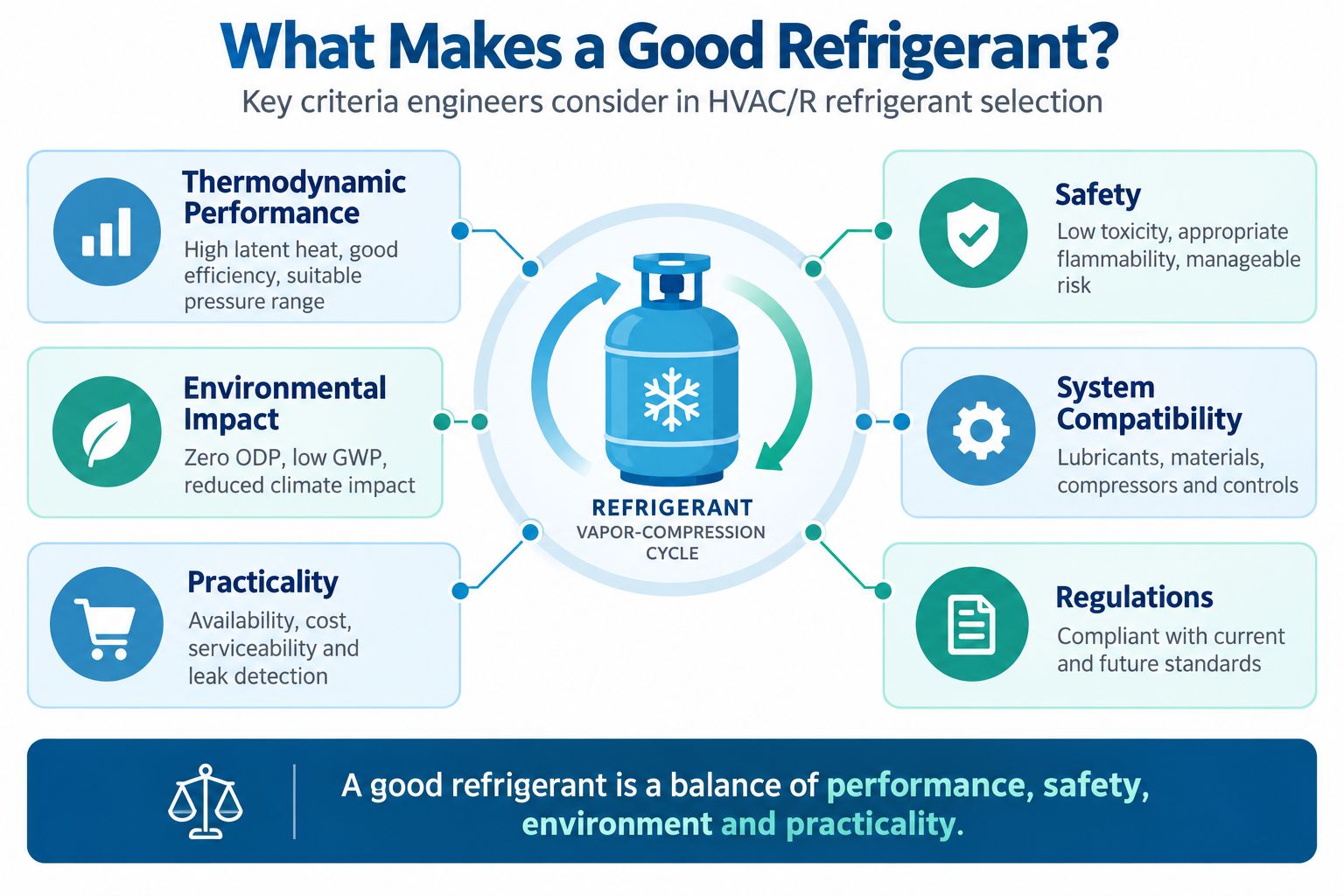
That balance is why modern refrigerant selection increasingly happens at the system level, not simply by comparing one refrigerant property.
What Are the Properties of an Ideal Refrigerant?
If engineers could design a theoretically perfect refrigerant, it would combine many desirable characteristics:
- high refrigeration capacity;
- high latent heat of vaporization;
- good heat-transfer performance;
- suitable vapor density;
- moderate operating pressures;
- low compression ratio;
- sufficiently high critical temperature;
- manageable compressor discharge temperature;
- low viscosity;
- good chemical stability;
- compatibility with lubricants and system materials;
- low toxicity;
- low or no flammability;
- zero ozone depletion potential;
- very low global warming potential;
- easy leak detection;
- good availability;
- reasonable cost;
- easy recovery and servicing; and
- long-term regulatory viability.
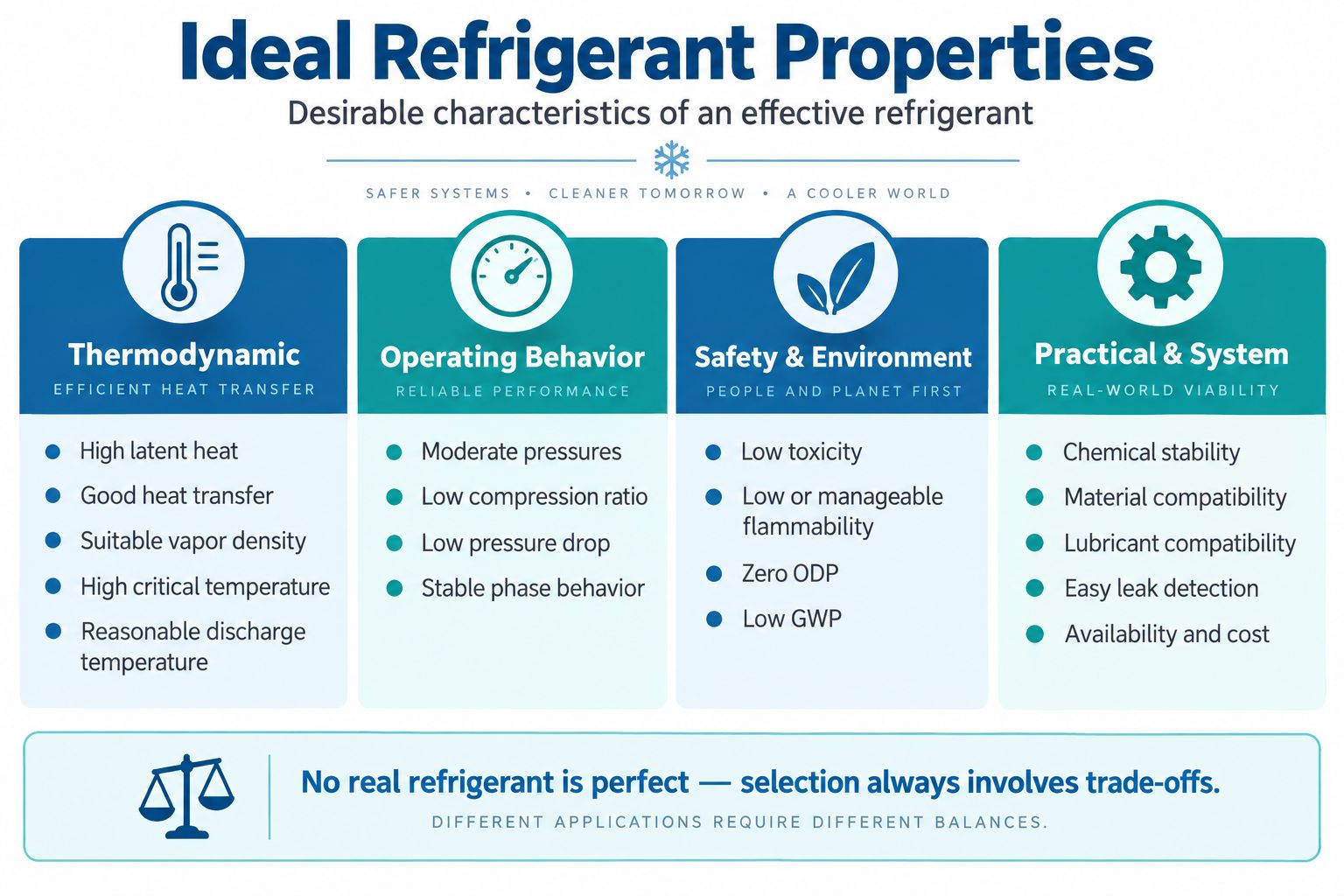
The problem is that no real refrigerant is perfect in every category.
Improving one characteristic can introduce a disadvantage somewhere else.
That is why engineers do not simply search for the refrigerant with the lowest GWP, lowest pressure or highest latent heat. They evaluate the complete system.
1. Strong Thermodynamic Performance
The first requirement is obvious: a refrigerant must move heat effectively.
A vapor-compression refrigeration system relies on refrigerant repeatedly evaporating, being compressed, condensing and expanding.
A good refrigerant should perform those processes efficiently within the intended operating range.
High Latent Heat
When refrigerant evaporates, it absorbs heat.
A refrigerant with relatively high latent heat can absorb more energy per unit mass during phase change.
This can help reduce the refrigerant mass flow required for a given cooling capacity.
However, latent heat alone does not determine whether a refrigerant is efficient.
Other factors include:
- vapor density;
- compressor work;
- pressure ratio;
- suction pressure;
- discharge temperature;
- heat exchanger behavior; and
- system architecture.
A refrigerant should therefore be evaluated as part of the complete refrigeration cycle.
Suitable Vapor Density
Vapor density affects how much refrigerant mass a compressor can move for a given displacement.
If suction vapor density is very low, the compressor may need greater displacement to achieve the required capacity.
Higher volumetric refrigeration capacity can make compact compressor designs possible, but it can also come with different pressure or temperature characteristics.
This is one reason two refrigerants with similar COP values may still require very different compressor designs.
Good Heat-Transfer Properties
A good refrigerant should transfer heat efficiently in both the evaporator and condenser.
Relevant properties include:
- thermal conductivity;
- viscosity;
- density;
- surface tension;
- two-phase behavior; and
- flow characteristics.
Lower viscosity can reduce pressure losses through piping and heat exchangers.
Good heat-transfer performance can improve system efficiency or help reduce heat exchanger size.
2. Practical Operating Pressure
It is common to hear that an ideal refrigerant should have “low pressure.”
That is an oversimplification.
What engineers really want is a practical pressure range for the intended equipment.
If evaporating pressure is too low, parts of the system may operate below atmospheric pressure. Leaks can then draw air and moisture into the system.
If condensing pressure is extremely high, the equipment requires:
- higher-pressure compressors;
- stronger piping;
- appropriately rated valves;
- higher-pressure heat exchangers; and
- suitable service tools.
But high pressure does not automatically mean a refrigerant is poor.
R744, or carbon dioxide, is the clearest example.
CO₂ refrigeration systems operate at much higher pressures than conventional HFC/HFO systems, yet R744 can be an excellent refrigerant when the entire system is engineered around those pressures.
The better question is therefore:
Are the refrigerant pressures appropriate and manageable for this equipment architecture?
If you need to compare saturation pressure behavior, the Refrigerant Pressure-Temperature Chart can be used to compare common HVAC/R refrigerants.
3. Suitable Critical Temperature
Every refrigerant has a critical temperature.
Above this temperature, conventional distinction between saturated liquid and saturated vapor disappears.
For many conventional vapor-compression systems, a sufficiently high critical temperature is desirable because the refrigerant can reject heat through normal condensation across the expected operating envelope.
As condensing conditions approach the critical point:
- thermodynamic behavior changes;
- heat rejection becomes more challenging;
- system controls become more important; and
- efficiency can change significantly.
Again, R744 demonstrates why the word “ideal” depends on application.
CO₂ has a relatively low critical temperature and often operates transcritically under warmer conditions.
That does not mean R744 is a bad refrigerant.
It means CO₂ systems require a different heat-rejection process and control strategy.
4. Manageable Compressor Discharge Temperature
Compression increases refrigerant temperature.
Some refrigerants and operating conditions can result in relatively high discharge temperatures.
Excessive compressor discharge temperature can affect:
- compressor lubricant;
- motor insulation;
- valves;
- seals;
- compressor reliability; and
- system life.
This factor becomes particularly important in:
- heat pumps;
- low-temperature refrigeration;
- high compression-ratio applications; and
- very cold ambient conditions.
For example, refrigerants with attractive volumetric capacity may still require careful discharge-temperature management in particular heat-pump designs.
No refrigerant property should therefore be evaluated in isolation.
5. Chemical Stability
A refrigerant may circulate inside a sealed system for many years.
It should remain sufficiently stable under:
- repeated compression;
- elevated temperatures;
- contact with lubricants;
- contact with metals;
- moisture contamination;
- electrical components; and
- normal equipment operating conditions.
Chemical instability can contribute to:
- acid formation;
- deposits;
- lubricant degradation;
- corrosion; or
- compressor damage.
But there is an interesting environmental trade-off here.
Historically, extreme chemical stability could also mean a refrigerant survived in the atmosphere for a long time after being released.
So the ideal characteristic is not simply:
“the most stable molecule possible.”
It is:
stable enough inside the refrigeration system while having acceptable environmental behavior after release.
6. Compatibility with Compressors, Lubricants and Materials
A refrigerant never operates by itself.
It interacts with almost every part of the HVAC/R system:
- compressor;
- lubricant;
- copper;
- aluminum;
- steel;
- seals;
- elastomers;
- plastics;
- motor insulation;
- adhesives; and
- control components.
Lubricant Compatibility
Refrigerant-lubricant interaction is particularly important.
Engineers may need to evaluate:
- oil miscibility;
- oil solubility;
- viscosity;
- oil return;
- chemical stability; and
- lubrication quality.
A refrigerant that cannot return oil reliably to the compressor can create serious long-term reliability problems.
Material Compatibility
Elastomers and plastics can swell, shrink or degrade depending on the refrigerant and lubricant combination.
Metals may also require consideration.
This is one reason similar pressure does not mean two refrigerants are interchangeable.
A replacement refrigerant needs to be compatible with the entire equipment platform, not merely the compressor pressure range.
7. Appropriate Safety Characteristics
A good refrigerant must have safety characteristics that can be effectively managed in its intended application.
ASHRAE refrigerant safety classifications combine two broad factors:
- toxicity;
- flammability.
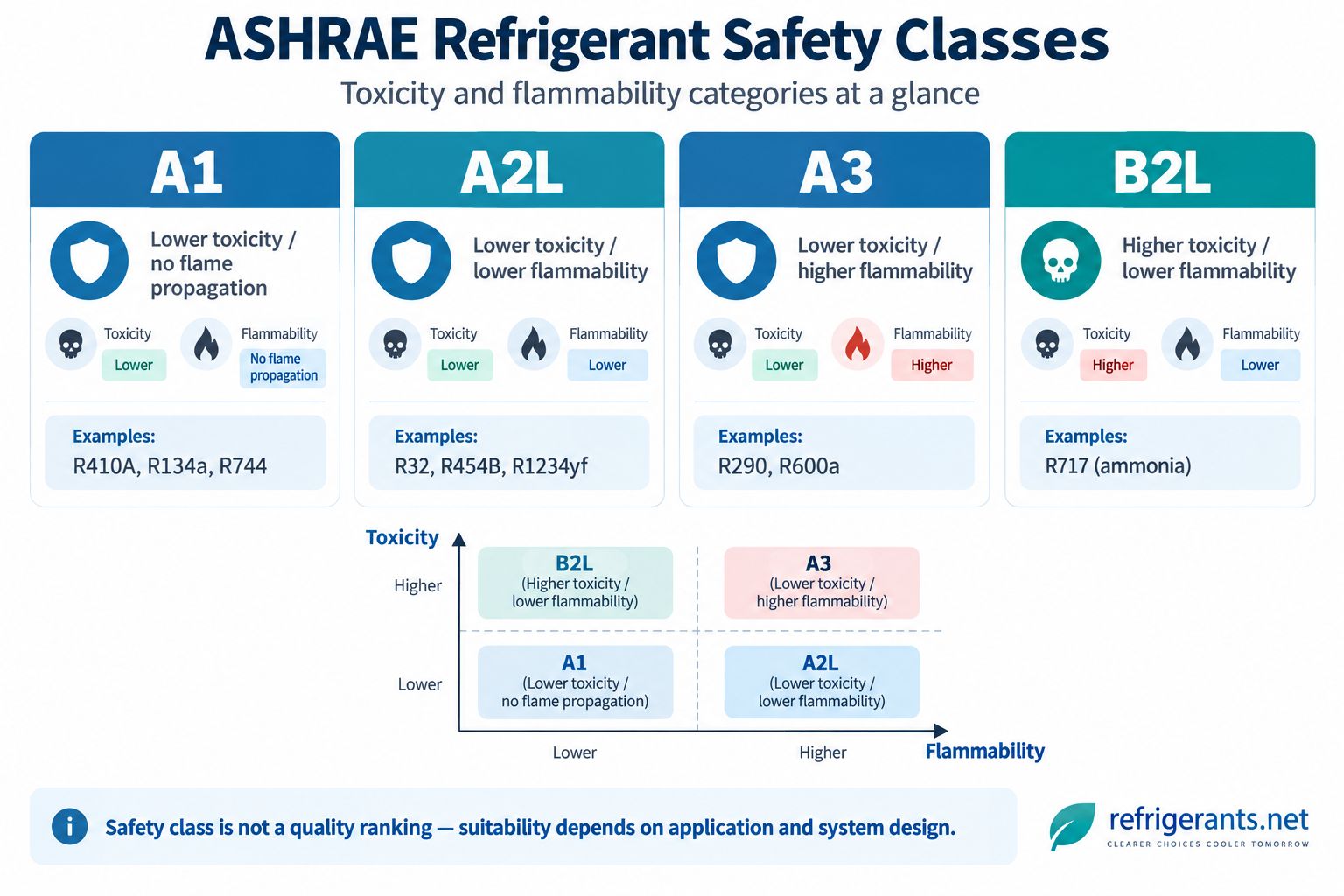
Common examples include:
| Safety Class | General Characteristic | Examples |
|---|---|---|
| A1 | Lower toxicity / no flame propagation | R410A, R134a, R744 |
| A2L | Lower toxicity / lower flammability with limited burning velocity | R32, R454B, R1234yf |
| A3 | Lower toxicity / higher flammability | R290, R600a |
| B2L | Higher toxicity / lower flammability with limited burning velocity | R717 |
These classifications are useful, but they should not be treated as a ranking from “best” to “worst.”
An A1 refrigerant is not automatically the best refrigerant for every application.
Likewise, A2L, A3 and B2L refrigerants can all be appropriate when equipment and installations are specifically designed around their properties.
For a deeper explanation, see the A2L Refrigerants Guide.
8. Low Toxicity — But Consider the Entire Application
Low toxicity is clearly desirable, particularly in occupied spaces.
However, even refrigerants in the lower-toxicity safety group must be managed correctly.
A large refrigerant release can:
- displace oxygen;
- create high local concentrations;
- create decomposition products if exposed to fire or extreme heat; or
- exceed allowable exposure levels.
This means refrigerant safety cannot be decided from a safety-class label alone.
Important factors also include:
- refrigerant charge;
- room volume;
- ventilation;
- leak probability;
- detector requirements;
- mitigation systems; and
- equipment location.
Safety is therefore an application-level decision.
9. Low or Manageable Flammability
Nonflammability has obvious advantages.
It can simplify:
- equipment design;
- installation;
- service procedures;
- refrigerant charge management; and
- risk mitigation.
However, the transition toward lower-GWP refrigerants increasingly involves refrigerants with some degree of flammability.
Examples include:
- R32 — A2L;
- R454B — A2L;
- R1234yf — A2L;
- R290 — A3;
- R600a — A3.
That does not make these refrigerants “bad.”
Instead, equipment must be designed around their properties.
Depending on the refrigerant and application, this can involve:
- charge limits;
- leak detection;
- airflow requirements;
- ignition-source control;
- ventilation;
- specific service tools; and
- technician procedures.
Modern refrigerant selection therefore involves manageable risk rather than the unrealistic expectation of zero hazard in every category.
10. Zero Ozone Depletion Potential
A modern refrigerant should ideally have zero ozone depletion potential (ODP).
Earlier CFC and HCFC refrigerants demonstrated the environmental consequences of releasing chlorine-containing compounds that can damage stratospheric ozone.
Legacy R22, for example, is an HCFC with non-zero ODP.
Most modern HFCs, HFOs and natural refrigerants have zero ODP.
For new refrigerant platforms, zero ODP is now generally a baseline expectation rather than a differentiating advantage.
11. Low Global Warming Potential
Global warming potential, or GWP, compares the warming effect of a greenhouse gas with carbon dioxide over a defined time horizon.
Reducing GWP has become one of the major drivers of modern refrigerant transition.
But GWP should not become the only selection criterion.
The Low-GWP Refrigerants Guide makes an important distinction:
A low GWP number does not automatically mean a refrigerant is safer, more efficient, compatible with existing equipment or suitable for every market.
For example:
- R744 has extremely low direct climate impact but requires high-pressure equipment.
- R290 combines very low GWP with A3 flammability.
- R717 offers excellent industrial refrigeration performance but has a B2L classification and specific material requirements.
- R32 has substantially lower GWP than R410A but introduces A2L requirements.
- R454B lowers GWP further in many new HVAC platforms but remains an A2L blend.
The better question is:
How does the refrigerant perform as part of the entire system?
12. Direct vs Indirect Climate Impact
Evaluating environmental performance requires more than looking at refrigerant GWP.
There are two major sources of climate impact.
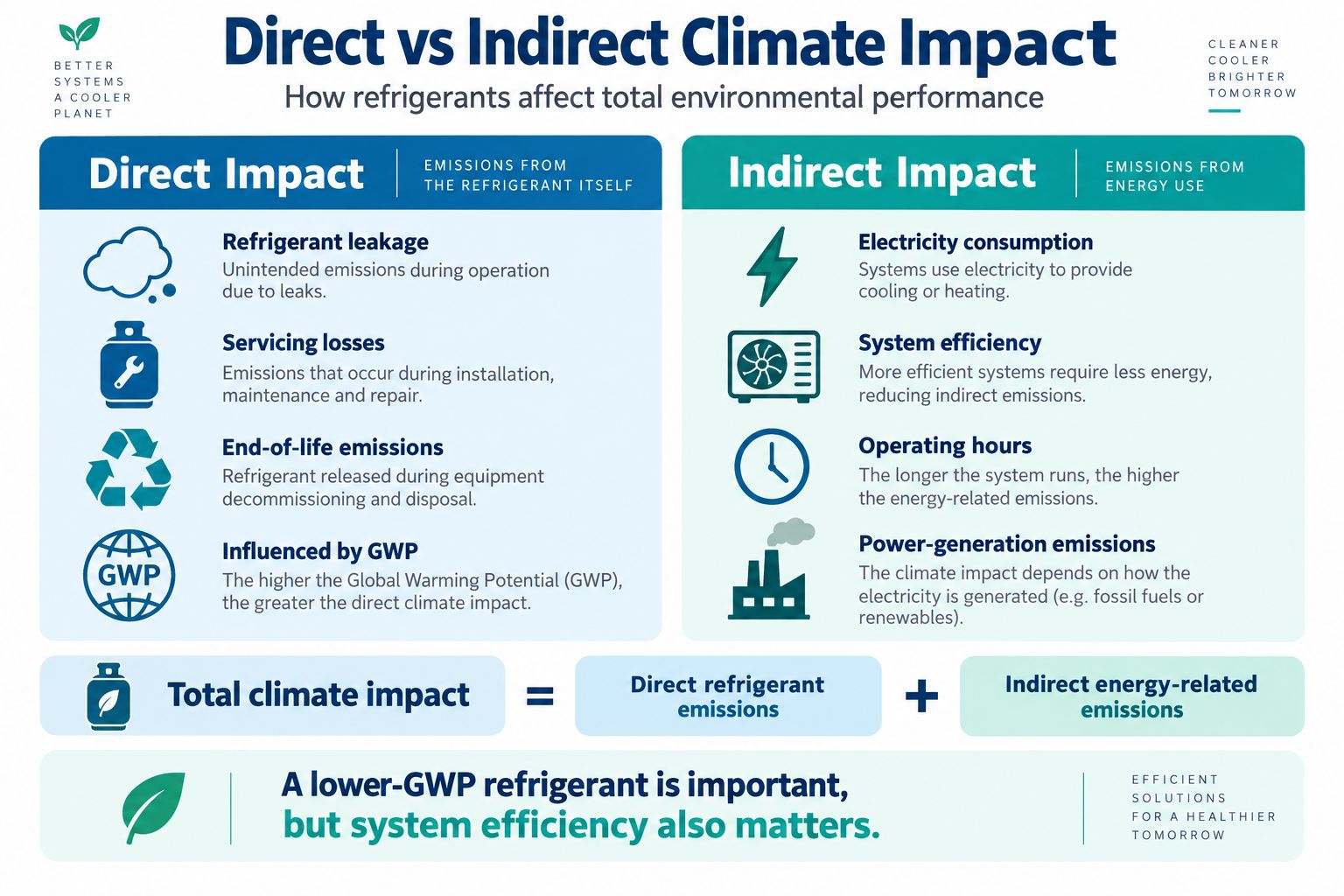
Direct Climate Impact
Direct emissions occur when refrigerant escapes into the atmosphere.
Potential sources include:
- equipment leakage;
- installation losses;
- servicing;
- accidents; and
- end-of-life refrigerant loss.
The climate impact of those emissions is strongly influenced by the refrigerant’s GWP and the amount released.
Indirect Climate Impact
HVAC/R equipment consumes energy throughout its operating life.
If a system requires more electricity, that energy consumption may create additional greenhouse-gas emissions depending on how electricity is generated.
Indirect impact is influenced by:
- system efficiency;
- climate;
- operating hours;
- part-load performance;
- controls;
- heat exchanger performance; and
- electricity-generation mix.
Therefore:
A lower-GWP refrigerant is important, but system energy efficiency also matters.
The best environmental solution is usually a combination of low refrigerant emissions and high system efficiency.
13. Appropriate Temperature Glide
Not all refrigerants evaporate and condense in exactly the same way.
Pure refrigerants and azeotropic blends can be represented by essentially one saturation temperature at a given pressure.
Zeotropic blends may change temperature during phase change.
This is called temperature glide.
Glide can influence:
- evaporator design;
- condenser design;
- counterflow heat exchangers;
- superheat calculations;
- subcooling calculations;
- refrigerant charging; and
- service procedures.
For refrigerants with meaningful glide, technicians often need to distinguish between:
- bubble point;
- dew point.
Glide is not automatically good or bad.
Its value depends on whether the system has been designed to use or accommodate it.
14. Easy Leak Detection and Serviceability
Even well-designed refrigeration systems can develop leaks during their service life.
A practical refrigerant ecosystem should support:
- leak detection;
- charging;
- evacuation;
- recovery;
- recycling;
- reclamation; and
- safe equipment servicing.
Serviceability becomes increasingly important as refrigerant properties change.
A technician working with:
- an A2L refrigerant;
- an A3 hydrocarbon;
- a high-pressure CO₂ system; or
- an ammonia plant
may need very different equipment and training.
A refrigerant may perform extremely well technically but still be difficult to adopt if the service ecosystem is not ready.
15. Availability and Cost
An HVAC/R system can remain in service for 10, 15 or 20 years.
Refrigerant availability therefore matters throughout the equipment lifecycle.
Important practical questions include:
- Is the refrigerant available in the target market?
- Is the supply chain mature?
- Is the price stable enough?
- Can technicians obtain compatible tools?
- Can the refrigerant be recovered and reclaimed?
- Will future regulation affect supply?
- Will service refrigerant remain available during the equipment’s life?
The lowest-cost refrigerant at the time of installation is not necessarily the lowest-cost option over the entire lifecycle.
16. Regulatory Viability
A refrigerant also needs to be appropriate under the regulations that apply to the specific market and equipment category.
Regulatory status can depend on:
- country;
- equipment type;
- application;
- refrigerant GWP;
- safety class;
- charge size;
- capacity;
- installation date; and
- whether equipment is new or existing.
A refrigerant may be acceptable in one application while restricted in another.
Similarly, a refrigerant permitted for servicing an installed system may not necessarily be suitable for newly manufactured equipment.
This means regulatory suitability should never be summarized simply as:
“Refrigerant X is legal” or “Refrigerant X is banned.”
The correct question is:
Is this refrigerant compliant for this particular application, market and implementation date?
Refrigerant Selection Is About Trade-Offs
The reason there is no universal ideal refrigerant becomes clear when the desirable properties are placed side by side.
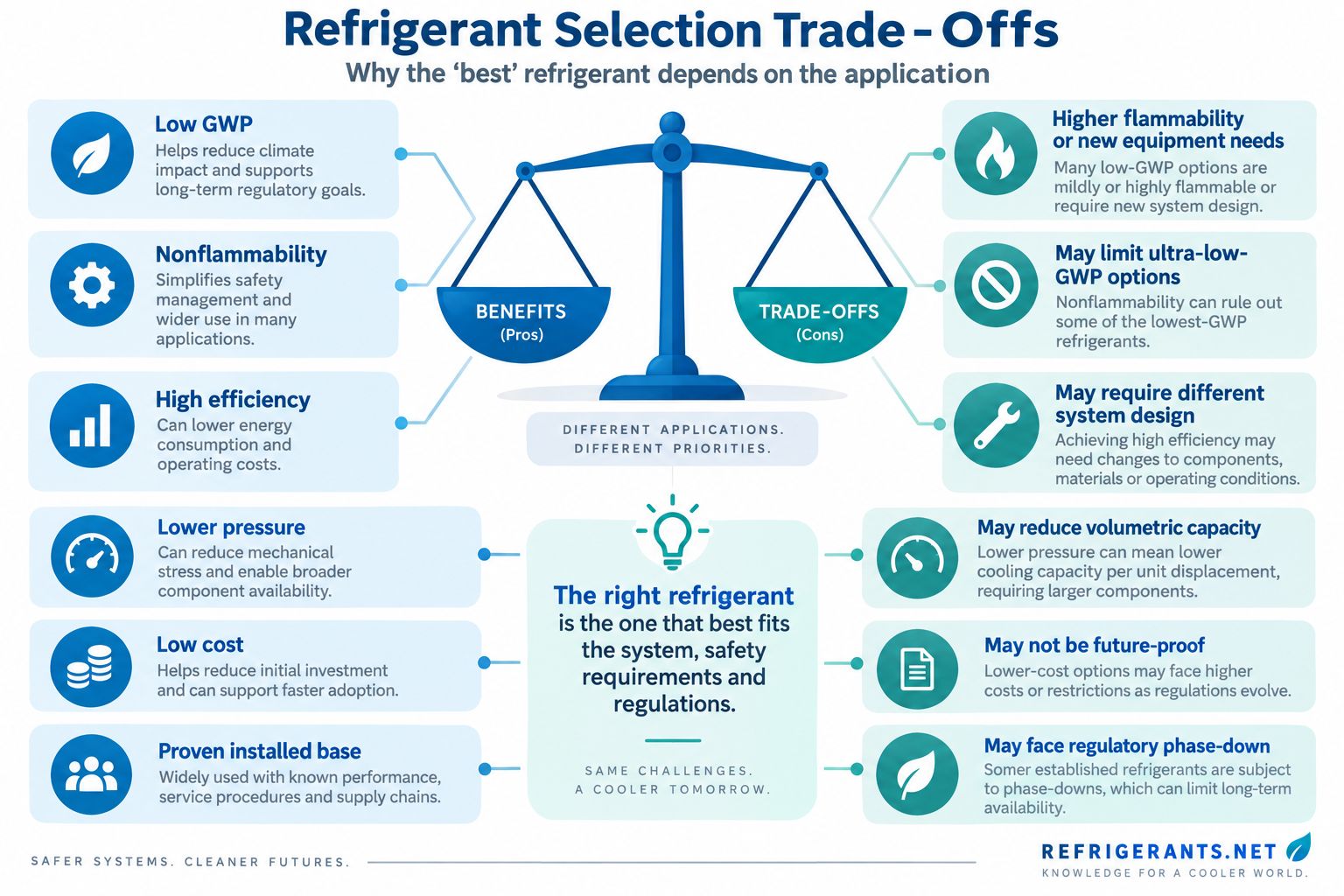
| Desired Property | Potential Trade-Off |
|---|---|
| Very low GWP | May involve flammability or different system design |
| No flame propagation | Can reduce the number of ultra-low-GWP options |
| Lower operating pressure | May reduce volumetric capacity |
| High volumetric capacity | May involve higher pressure or discharge temperature |
| Low first cost | May not provide the best long-term regulatory position |
| Large installed base | Does not guarantee suitability for future new equipment |
| High chemical stability | Can sometimes contribute to long atmospheric persistence |
| Natural refrigerant | Does not automatically mean low hazard or easy retrofit |
This is the most important concept in refrigerant selection:
Improving one property can create a new engineering challenge somewhere else.
There is rarely a refrigerant that wins every category simultaneously.
What Makes a Good Refrigerant for Different Applications?
A good refrigerant for one application may be a poor choice for another.
Residential Air Conditioning
Important characteristics can include:
- seasonal efficiency;
- volumetric capacity;
- compact equipment;
- manageable pressure;
- acceptable safety characteristics;
- low GWP;
- serviceability; and
- compliance with residential equipment standards.
This is why new AC platforms increasingly use refrigerants such as R32 and R454B rather than simply choosing the refrigerant with the absolute lowest GWP available.
Heat Pumps
Heat pumps may operate across a wide evaporating and condensing temperature range.
Engineers need to consider:
- low-ambient capacity;
- pressure ratio;
- discharge temperature;
- high-temperature heating performance;
- compressor compatibility; and
- seasonal efficiency.
Different heat-pump architectures can therefore favor different refrigerants.
Domestic Refrigerators
Domestic refrigerators use small sealed systems.
R600a is widely used in this application because purpose-designed appliances can take advantage of its thermodynamic and environmental characteristics while controlling the small A3 refrigerant charge.
Commercial Refrigeration
Food retail and commercial refrigeration can prioritize:
- low-temperature performance;
- system leakage;
- charge size;
- energy efficiency;
- service infrastructure; and
- long-term regulatory viability.
Solutions may include:
- low-GWP blends;
- hydrocarbons;
- R744 systems; or
- distributed system architectures.
Industrial Refrigeration
Large industrial facilities can support more sophisticated safety systems and trained personnel.
R717 ammonia remains highly important because of its excellent thermodynamic performance and low direct climate impact.
Its B2L classification and material requirements, however, mean the system must be designed specifically for ammonia.
Automotive Air Conditioning
Automotive AC systems need to consider:
- compact packaging;
- leakage;
- crash conditions;
- service infrastructure;
- global regulations; and
- refrigerant charge.
These requirements help explain why automotive refrigerant selection differs from residential HVAC or industrial refrigeration.
Is a Natural Refrigerant Automatically a Better Refrigerant?
No.
The term natural refrigerant includes several refrigerants with very different properties.
Examples include:
- R290 — propane;
- R600a — isobutane;
- R744 — carbon dioxide;
- R717 — ammonia.
They generally offer very low direct climate impact, but their engineering characteristics are very different.
R290 and R600a are A3 hydrocarbons.
R744 is A1 but operates at very high pressures.
R717 provides excellent industrial performance but carries a B2L safety classification and particular material-compatibility requirements.
Natural refrigerants can be excellent choices, but they still need to be matched to the application.
See the Natural Refrigerants Guide for a deeper comparison.
Is the Lowest-GWP Refrigerant Always the Best?
No.
Suppose Refrigerant A has an extremely low GWP but performs poorly in a particular system architecture, while Refrigerant B has a somewhat higher GWP but enables substantially higher efficiency and lower leakage.
The full lifecycle result may not be obvious from GWP alone.
A meaningful assessment may include:
- refrigerant GWP;
- refrigerant charge;
- annual leakage;
- service losses;
- recovery rate;
- equipment efficiency;
- operating hours;
- climate;
- equipment life; and
- electricity-generation emissions.
That is why GWP is an important metric, not a complete refrigerant-selection algorithm.
Does A1 Mean Better Than A2L or A3?
No.
ASHRAE safety classification describes particular hazard characteristics.
It does not rank refrigerants by overall quality.
An A1 refrigerant may simplify flammability management.
An A2L refrigerant may provide a lower-GWP path while requiring specific mitigation.
An A3 refrigerant may offer extremely low GWP and strong performance but require strict charge and ignition-control measures.
A B2L refrigerant such as R717 can be highly effective in industrial installations engineered around its characteristics.
Safety class should therefore answer:
“What hazards need to be managed?”
—not:
“Which refrigerant is best?”
Can One Refrigerant Replace Another If the Pressures Are Similar?
Not necessarily.
Pressure-temperature similarity is only one part of compatibility.
Two refrigerants may differ in:
- composition;
- safety class;
- volumetric capacity;
- compressor mass flow;
- discharge temperature;
- lubricant requirements;
- temperature glide;
- elastomer compatibility;
- control strategy;
- charge amount; and
- regulatory approval.
For this reason, refrigerants should not be treated as interchangeable solely because their PT curves look similar.
Use the Refrigerant Comparison section when evaluating specific refrigerant pairs.
A Practical Refrigerant Selection Checklist
A useful way to evaluate refrigerants is to work through the selection process in stages.
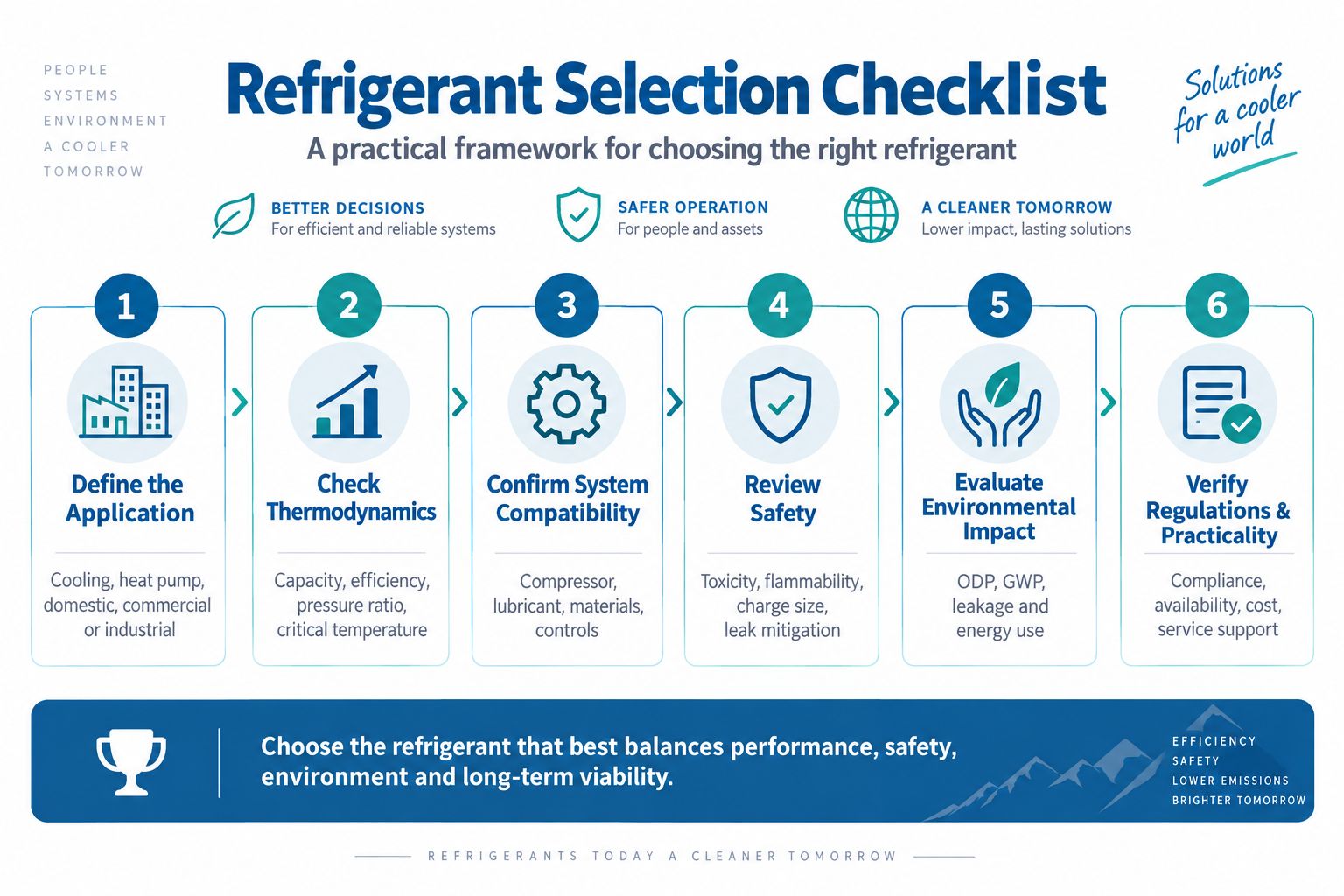
1. Define the Application
Ask:
- Is this air conditioning, refrigeration or heat pumping?
- Residential, commercial or industrial?
- What evaporating temperature is required?
- What condensing conditions are expected?
- What climate will the equipment operate in?
2. Check Thermodynamic Performance
Evaluate:
- capacity;
- COP;
- vapor density;
- pressure ratio;
- discharge temperature;
- critical temperature;
- pressure drop; and
- heat-transfer characteristics.
3. Confirm System Compatibility
Check:
- compressor technology;
- lubricant;
- metals;
- elastomers;
- controls;
- expansion device;
- refrigerant charge; and
- pressure rating.
4. Review Safety
Determine:
- toxicity class;
- flammability class;
- charge limits;
- room volume;
- ventilation requirements;
- leak-detection requirements; and
- mitigation measures.
5. Evaluate Environmental Impact
Consider:
- ODP;
- GWP;
- leakage;
- refrigerant charge;
- recovery;
- energy efficiency; and
- total lifecycle emissions.
6. Verify Regulations and Practicality
Finally evaluate:
- current regulation;
- future restrictions;
- refrigerant availability;
- cost;
- technician familiarity;
- recovery infrastructure; and
- long-term serviceability.
A refrigerant that performs well across all six areas is much more likely to be a good choice than one selected from a single headline property.
Comparing Some Common Refrigerant Choices
The following examples illustrate how different refrigerants solve different engineering problems.
| Refrigerant | Major Strength | Main Engineering Consideration |
|---|---|---|
| R32 | Strong HVAC performance and lower GWP than R410A | A2L system requirements and discharge temperature |
| R454B | Lower-GWP option for newer HVAC platforms | A2L classification and blend behavior |
| R290 | Very low GWP and strong thermodynamic properties | A3 flammability |
| R744 | Very low direct climate impact and A1 classification | Very high pressure and transcritical behavior |
| R717 | Excellent industrial refrigeration performance | B2L classification and material/safety requirements |
| R1234yf | Very low GWP and established automotive use | A2L system requirements |
| R410A | Established A1 HVAC technology and large installed base | High GWP and declining role in many new-equipment markets |
| R22 | Proven legacy HVAC performance | ODP and long-term phaseout/service limitations |
The table is not a ranking.
Each refrigerant can make sense in the correct application.
You can explore refrigerants by family and application in the Refrigerant Database.
Frequently Asked Questions
What makes a good refrigerant?
A good refrigerant combines efficient thermodynamic performance, practical operating pressures, suitable safety characteristics, chemical and material compatibility, low environmental impact, serviceability, availability and regulatory suitability for the intended system.
What are the desirable properties of a refrigerant?
Desirable properties include high latent heat, good heat transfer, suitable vapor density, practical pressure levels, sufficiently high critical temperature, low viscosity, chemical stability, material compatibility, low toxicity, manageable flammability, zero ODP and low GWP.
What is an ideal refrigerant?
An ideal refrigerant is a theoretical fluid that would combine excellent efficiency, high capacity, safe operating characteristics, chemical stability, zero ODP, extremely low GWP, low cost and complete system compatibility.
No real refrigerant satisfies every desirable property simultaneously.
What is the most important property of a refrigerant?
There is no single most important property for every application.
Safety may dominate one application, efficiency another, very-low-temperature performance another and regulatory requirements another.
The correct choice depends on the complete system.
Why is high latent heat desirable in a refrigerant?
High latent heat allows more heat to be absorbed per unit mass during evaporation, potentially reducing the refrigerant mass flow required for a given cooling load.
Why should a refrigerant have low viscosity?
Lower viscosity generally reduces frictional pressure losses through pipes and heat exchangers, supporting efficient refrigerant circulation.
Why is high critical temperature desirable?
For conventional subcritical systems, a critical temperature comfortably above the expected condensing temperature helps maintain practical condensation and efficient heat rejection.
The ideal value still depends on the application.
Should a good refrigerant be nonflammable?
Nonflammability can simplify safety management, but it is not the only selection criterion.
A2L and A3 refrigerants can be appropriate when systems are specifically designed for their safety characteristics.
Should the best refrigerant have the lowest possible GWP?
Low GWP is desirable for reducing direct climate impact, but GWP should be considered together with efficiency, safety, equipment design, refrigerant charge, leakage and regulation.
Is a natural refrigerant always environmentally better?
Natural refrigerants generally have very low GWP, but complete environmental performance also depends on system efficiency, leakage, operating conditions and equipment design.
Why does refrigerant compatibility matter?
A refrigerant interacts with compressor oil, metals, plastics, elastomers, seals and controls. Poor compatibility can lead to material degradation, lubricant problems, leakage or equipment failure.
Is R290 a good refrigerant?
R290 can be an excellent refrigerant in purpose-designed equipment because of its strong thermodynamic performance and very low GWP. Its A3 flammability means charge limits and system safety design are critical.
Is R744 a good refrigerant?
R744 can be an excellent refrigerant for systems designed around its high operating pressure and transcritical behavior. It is widely relevant to applications such as commercial refrigeration, heat pumps and transport refrigeration.
Is R717 ammonia a good refrigerant?
R717 offers excellent thermodynamic performance and very low direct climate impact, making it important in industrial refrigeration. Its B2L classification and material compatibility requirements mean specialized system and safety design are necessary.
Is R32 better than R454B?
Neither is universally better.
R32 is a single-component A2L refrigerant with strong volumetric capacity, while R454B is an A2L blend with lower GWP and different system behavior.
The choice should be made at the equipment-platform level rather than by treating either refrigerant as a field substitute for the other.
See the R32 vs R454B comparison for a detailed analysis.
Final Takeaway
A good refrigerant is not simply the refrigerant with:
- the lowest GWP;
- the lowest pressure;
- the highest latent heat;
- the safest classification; or
- the lowest price.
The best refrigerant for a particular system is the one that achieves the most appropriate balance of:
thermodynamic performance + safety + environmental impact + system compatibility + regulatory viability + lifecycle practicality
That is why refrigerant selection is becoming increasingly application-specific.
R32 and R454B can suit purpose-designed modern HVAC systems.
R290 can provide excellent efficiency and very low GWP where A3 safety requirements can be properly managed.
R744 can perform extremely well in systems engineered around high-pressure CO₂ technology.
R717 remains highly valuable in industrial refrigeration.
And existing A1 refrigerants continue to play an important role in installed equipment even as new-system regulations and technologies evolve.
Instead of asking:
What is the best refrigerant?
the more useful engineering question is:
Which refrigerant provides the best balance of performance, safety, environmental impact and long-term viability for this particular application?
That is what ultimately makes a good refrigerant.
