
ASHRAE refrigerant classifications provide a standardized way to describe two important refrigerant hazard characteristics:
toxicity and flammability.
Under ANSI/ASHRAE Standard 34, a refrigerant safety group combines:
- a letter — A or B — representing the toxicity group; and
- a flammability class — 1, 2L, 2 or 3.
The result is one of eight possible safety groups:
A1, A2L, A2, A3, B1, B2L, B2 and B3.
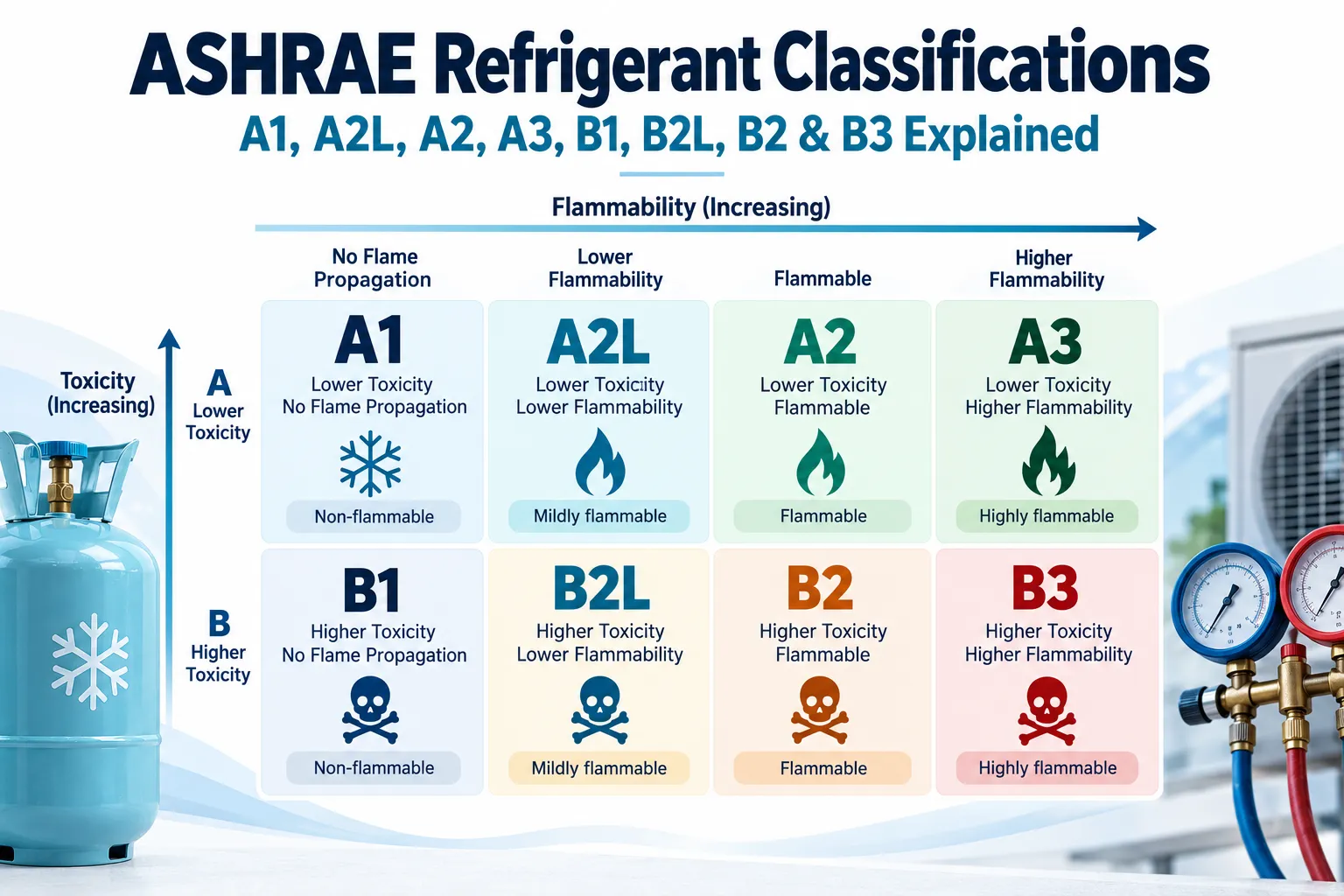
The basic rule is simple:
Letter = toxicity group
Number = flammability class
However, the classification should not be interpreted as a complete measure of refrigerant risk.
It does not directly describe refrigerant pressure, GWP, ODP, system charge, allowable room concentration, equipment compatibility or whether a refrigerant can be used in a particular application.
For those wider questions, see the Refrigerant Safety Guide.
ASHRAE Refrigerant Classification Quick Reference
The complete Standard 34 safety-group structure can be represented as a matrix.
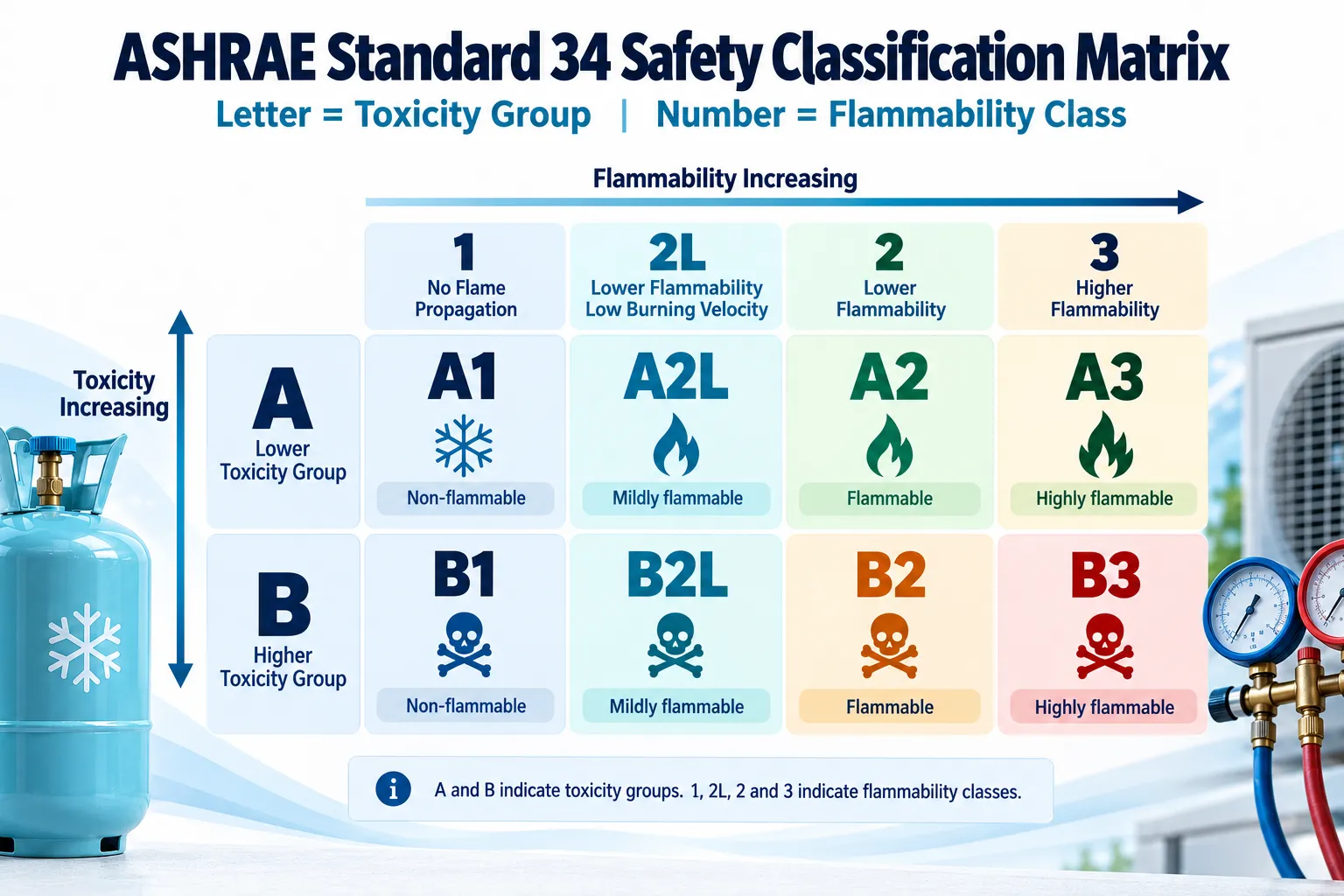
| Toxicity Group | Class 1 | Class 2L | Class 2 | Class 3 |
|---|---|---|---|---|
| A — Lower toxicity group | A1 | A2L | A2 | A3 |
| B — Higher toxicity group | B1 | B2L | B2 | B3 |
In simplified terms:
- A1 — lower toxicity group, no flame propagation under the classification test
- A2L — lower toxicity group, lower flammability with low burning velocity
- A2 — lower toxicity group, Class 2 flammability
- A3 — lower toxicity group, higher flammability
- B1 — higher toxicity group, no flame propagation
- B2L — higher toxicity group, lower flammability with low burning velocity
- B2 — higher toxicity group, Class 2 flammability
- B3 — higher toxicity group, higher flammability
This classification framework is useful because it allows engineers, manufacturers and technicians to understand important refrigerant hazard characteristics from a short code such as A1 or A2L.
What Is ASHRAE Standard 34?
The full title is:
ANSI/ASHRAE Standard 34 — Designation and Safety Classification of Refrigerants
Standard 34 establishes a uniform framework for:
- refrigerant numbering and designation;
- refrigerant safety classification;
- toxicity grouping;
- flammability classification;
- refrigerant concentration limits; and
- the data and procedures used when assigning classifications.
The current base edition is ASHRAE Standard 34-2024, maintained through published addenda.
The 2024 edition expanded the standard with additional refrigerants and updated technical information, including burning-velocity data for flammable refrigerants and revisions intended to improve alignment with ISO 817.
Standard 34 should not be confused with a complete refrigeration-system safety code.
It primarily answers:
What is this refrigerant, and how is it classified?
System-level safety requirements involve other standards, equipment rules and local codes.
How Does ASHRAE Classify Refrigerants?
The safety group combines two independent dimensions.
The basic formula is:
Safety Group = Toxicity Group + Flammability Class
For example:
R32 = A2L
- A = lower toxicity group under the Standard 34 classification framework
- 2L = Class 2 refrigerant meeting the additional low-burning-velocity criterion
R290 = A3
- A = lower toxicity group
- 3 = higher flammability class
R717 = B2L
- B = higher toxicity group
- 2L = lower-flammability subclass with low burning velocity
The two characters should always be read together.
What Do A and B Mean in Refrigerant Classification?
The letters A and B refer to toxicity grouping.
They do not mean simply:
- A = safe
- B = dangerous
The Standard 34 framework uses an Occupational Exposure Limit (OEL) threshold.
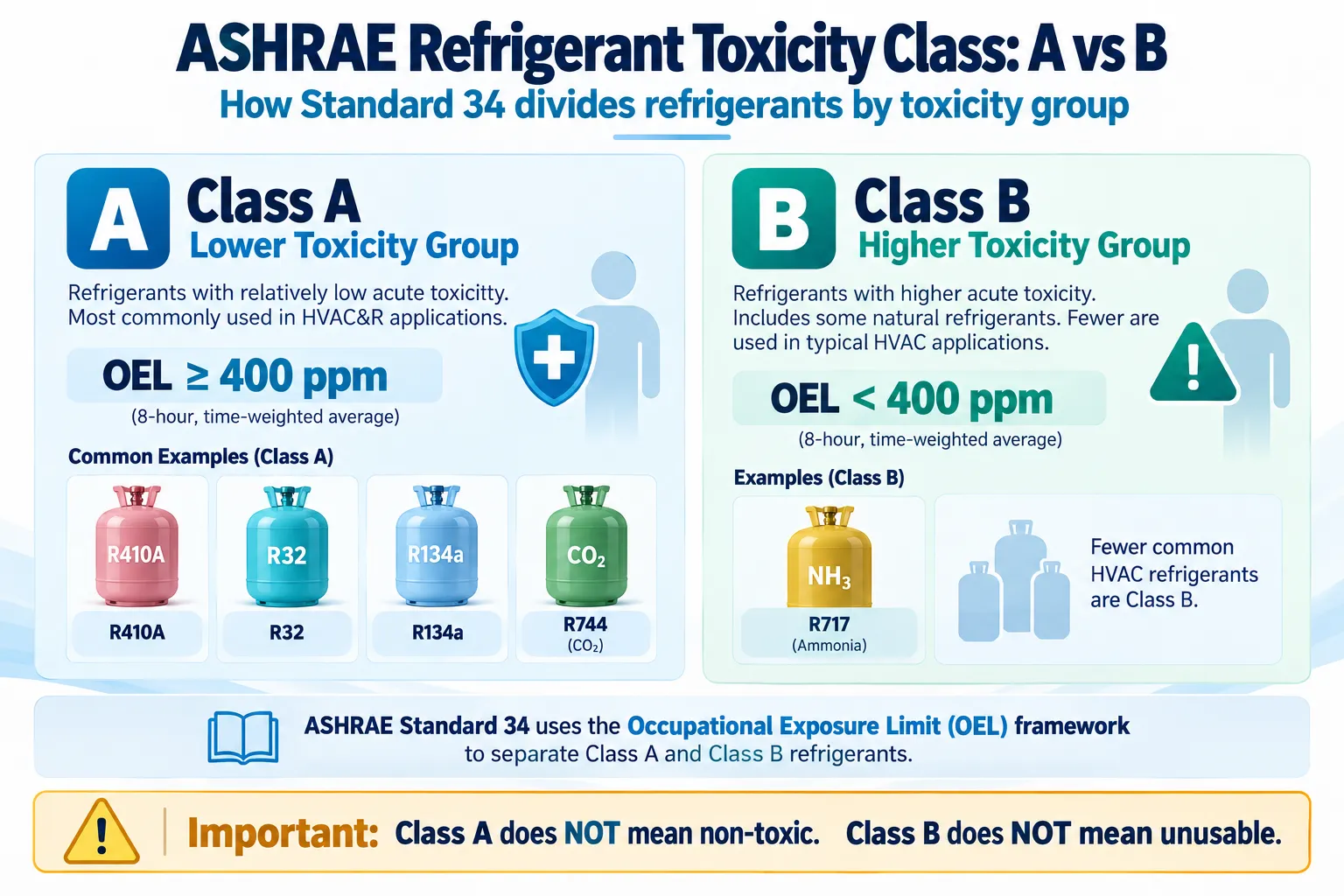
Class A — Lower Toxicity Group
Class A refrigerants have an OEL of:
400 ppm or greater
within the classification framework.
Common Class A refrigerants include:
- R22
- R32
- R134a
- R410A
- R454B
- R290
- R600a
- R744
Notice how different these refrigerants are.
R410A is A1.
R32 is A2L.
R290 is A3.
The letter A alone therefore tells you nothing about flammability.
Does Class A Mean Non-Toxic?
No.
This is one of the most common misunderstandings about ASHRAE refrigerant classifications.
Class A means lower toxicity group according to the Standard 34 OEL framework. It does not mean the refrigerant is harmless at every concentration.
A large release can still create:
- oxygen-displacement hazards;
- excessive refrigerant concentration;
- frostbite risk;
- decomposition products; or
- other application-specific hazards.
Class B — Higher Toxicity Group
Class B refrigerants have an OEL of:
less than 400 ppm
under the classification framework.
Examples include:
- R123 — B1
- R717 ammonia — B2L
- R30 — B2
Class B also does not mean that a refrigerant cannot be used safely.
R717 is one of the most important industrial refrigerants in the world.
Its B2L classification simply means that its toxicity and flammability characteristics require an appropriate system design, containment strategy, ventilation, detection and operating procedure.
What Do 1, 2L, 2 and 3 Mean?
The second part of the ASHRAE safety classification describes flammability.
The four relevant classifications are:
1 → 2L → 2 → 3
They represent increasingly significant flammability characteristics under the Standard 34 test framework.
Class 1 — No Flame Propagation
Class 1 refrigerants do not exhibit flame propagation under the specified Standard 34 test conditions.
Common examples include:
- R22
- R134a
- R404A
- R410A
- R744
These refrigerants commonly appear as A1 when combined with Class A toxicity.
However:
Class 1 does not mean the refrigerant has no hazards.
For example, R744 is A1 but CO₂ refrigeration systems can operate at very high pressures.
R410A is also A1 but has completely different thermodynamic and environmental characteristics.
Safety class describes specific hazards, not the complete engineering profile.
What Is Class 2L?
Class 2L is especially important because many modern lower-GWP HVAC/R refrigerants fall into this category.
Examples include:
A Class 2L refrigerant meets the underlying Class 2 flammability criteria and additionally has a maximum burning velocity of:
100 mm/s or less
under the specified classification conditions.
This lower burning velocity distinguishes 2L refrigerants from other Class 2 refrigerants.
Does A2L Mean Nonflammable?
No.
A2L refrigerants can propagate flame under the relevant test conditions.
The correct terminology is generally:
lower flammability
rather than:
nonflammable
This distinction has become increasingly important as R32, R454B and other A2L refrigerants are adopted in newer HVAC and heat-pump equipment.
For a full application-focused guide, see A2L Refrigerants.
Class 2 vs Class 2L: What Is the Difference?
This is one of the most frequently misunderstood parts of ASHRAE Standard 34.
2L is a subclass of Class 2.
It is not simply an independent step placed arbitrarily between Class 1 and Class 2.
Both Class 2 and Class 2L refrigerants exhibit flame propagation under the classification conditions.
The additional defining characteristic of 2L is its low burning velocity.
| Property | Class 2L | Class 2 |
|---|---|---|
| Flame propagation | Yes | Yes |
| Meets Class 2 criteria | Yes | Yes |
| Maximum burning velocity ≤ 100 mm/s | Yes | Not required |
| Common in current HVAC transition | Very common | Less common |
| Example | R32 | R152a |
R152a is an example of an A2 refrigerant.
R32 is A2L.
These are different classifications even though both belong to the Class A toxicity group.
Class 2 Refrigerants
Class 2 refrigerants exhibit flame propagation but fall below the Class 3 flammability thresholds defined using lower flammability limit and heat-of-combustion criteria.
Examples include:
- R152a — A2
- R142b — A2
- R161 — A2
Class 2 refrigerants are less prominent in today’s mainstream comfort-air-conditioning transition than A2L refrigerants, but Class 2 remains an important part of the complete Standard 34 classification structure.
Class 3 — Higher Flammability
Class 3 is the higher-flammability category.
Common refrigerants in this class include hydrocarbons such as:
- R290 propane
- R600a isobutane
- R1270 propylene
Because these refrigerants belong to toxicity Class A, they are typically classified A3.
Class 3 does not mean that these refrigerants cannot be used safely.
R600a is widely used in purpose-designed domestic refrigeration.
R290 is increasingly important in commercial refrigeration, heat pumps and selected HVAC/R applications.
The classification means the system must be designed and applied with the refrigerant’s higher flammability in mind.
The Eight ASHRAE Refrigerant Safety Groups
Although A1, A2L, A3 and B2L receive most of the attention in modern HVAC/R discussions, Standard 34 contains eight possible groups.
A1 Refrigerants
Lower toxicity group + Class 1
Common examples:
- R22
- R134a
- R404A
- R410A
- R448A
- R449A
- R744
A1 is frequently described as the least restrictive toxicity/flammability combination within the classification matrix.
However, A1 does not describe pressure, GWP, ODP or system suitability.
A2L Refrigerants
Lower toxicity group + Class 2L
Common examples:
- R32
- R454B
- R1234yf
- R1234ze(E)
- R454C
- R455A
A2L has become especially important in the transition toward lower-GWP equipment.
These refrigerants have lower burning velocity than other Class 2 refrigerants but remain flammable.
A2 Refrigerants
Lower toxicity group + Class 2
Examples include:
- R152a
- R142b
- R161
These refrigerants exhibit Class 2 flammability but do not receive the 2L subclass designation.
A3 Refrigerants
Lower toxicity group + Class 3
Common examples:
- R290
- R600a
- R1270
Many common A3 refrigerants are hydrocarbons.
They can offer very low GWP and strong thermodynamic performance, while requiring system design appropriate for higher flammability.
B1 Refrigerants
Higher toxicity group + Class 1
Examples include:
- R123
- R245fa
- selected refrigerants and blends in specialist applications
B1 refrigerants are less common in today’s mainstream residential HVAC market than A1 or A2L refrigerants.
B2L Refrigerants
Higher toxicity group + Class 2L
The most important example is:
R717 ammonia
R717 has been used for generations in industrial refrigeration because of its excellent thermodynamic performance.
Its B2L classification reflects the combination of higher toxicity grouping and lower-flammability behavior.
Industrial ammonia systems therefore require purpose-designed equipment and safety controls.
B2 Refrigerants
Higher toxicity group + Class 2
An example is:
R30 — dichloromethane
B2 refrigerants are uncommon in modern mainstream HVAC/R compared with A1, A2L, A3 and B2L refrigerants.
B3 Refrigerants
Higher toxicity group + Class 3
B3 represents the combination of:
- higher toxicity group; and
- higher flammability.
This category exists within the Standard 34 classification framework but is rarely encountered in common modern HVAC/R applications.
That is why most practical industry discussions focus heavily on A1, A2L, A3 and B2L.
Common Refrigerants by ASHRAE Safety Class
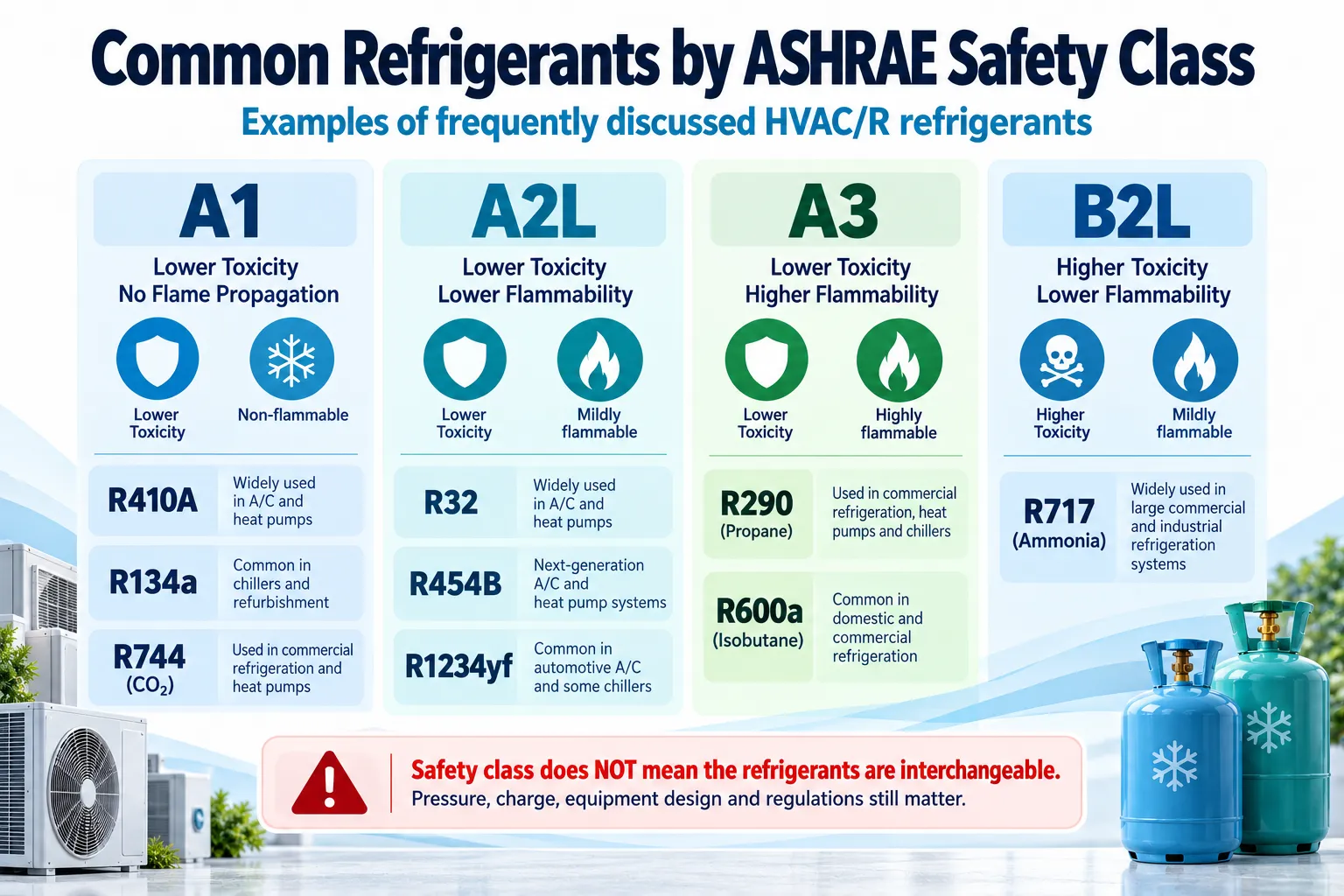
The following table summarizes several refrigerants frequently encountered in HVAC/R.
| Refrigerant | Common Name / Type | ASHRAE Safety Class | Typical Context |
|---|---|---|---|
| R22 | HCFC-22 | A1 | Legacy AC and refrigeration |
| R134a | HFC-134a | A1 | Chillers, refrigeration, legacy automotive |
| R404A | HFC blend | A1 | Legacy commercial refrigeration |
| R410A | HFC blend | A1 | Existing AC and heat pumps |
| R744 | Carbon dioxide | A1 | Commercial refrigeration, heat pumps |
| R32 | Difluoromethane | A2L | AC and heat pumps |
| R454B | HFO/HFC blend | A2L | New AC and heat-pump platforms |
| R1234yf | HFO | A2L | Automotive air conditioning |
| R1234ze(E) | HFO | A2L | Chillers and specialist HVAC/R |
| R152a | HFC | A2 | Specialist applications |
| R290 | Propane | A3 | Refrigeration and heat pumps |
| R600a | Isobutane | A3 | Domestic refrigeration |
| R123 | HCFC | B1 | Legacy/specialist chiller applications |
| R717 | Ammonia | B2L | Industrial refrigeration |
| R30 | Dichloromethane | B2 | Specialist/historical context |
You can browse current refrigerant profiles and safety classes in the Refrigerant Database.
Is A1 Safer Than A2L or A3?
If you look only at the two characteristics classified by Standard 34 — toxicity group and flammability — A1 represents the lower-toxicity, no-flame-propagation combination.
But that does not mean an A1 refrigeration system is automatically safer in every real-world situation.
Consider two A1 refrigerants:
R410A
- A1
- relatively high HVAC operating pressure
- high GWP
- common in existing AC systems
R744
- A1
- very high system pressure
- very low GWP
- different system architecture
They share the same ASHRAE safety group but require very different equipment and safety strategies.
Therefore:
Safety classification is a hazard classification, not a complete system-risk ranking.
System risk also depends on:
- refrigerant charge;
- operating pressure;
- room volume;
- equipment design;
- ventilation;
- detection;
- occupancy; and
- applicable system standards.
The Refrigerant Safety Guide explains these wider considerations.
Why Are A2L Refrigerants Becoming More Common?
Many legacy HVAC refrigerants combine convenient A1 characteristics with relatively high GWP.
As regulations and equipment platforms shift toward lower-GWP refrigerants, manufacturers need alternatives that balance:
- thermodynamic performance;
- environmental impact;
- safety;
- charge;
- compressor design; and
- practical equipment architecture.
A2L refrigerants expand that design space.
Examples include:
- R32;
- R454B;
- R1234yf; and
- R1234ze(E).
This does not mean the HVAC industry has simply decided to accept more risk.
Instead, new equipment is being designed around a different hazard profile, with requirements appropriate to lower-flammability refrigerants.
Does ASHRAE Safety Class Determine Refrigerant Charge Limits?
No.
This is another common misconception.
Knowing that R32 is A2L does not by itself tell you the maximum allowable charge in every installation.
Actual charge limits can depend on:
- equipment category;
- application;
- room size;
- installation location;
- refrigerant properties;
- mitigation measures;
- applicable product standard;
- mechanical/building code; and
- jurisdiction.
Standard 34 provides classification information and refrigerant concentration-limit data, but the allowable use of a refrigerant must be evaluated within the relevant system and application standards.
Does ASHRAE Classification Tell You Refrigerant Pressure?
No.
The safety class does not tell you:
- saturation pressure;
- compressor discharge pressure;
- critical pressure;
- system design pressure; or
- cylinder pressure.
For example:
R410A = A1
and
R744 = A1
yet their pressure characteristics are dramatically different.
Use a Pressure-Temperature Chart when you need refrigerant saturation-pressure information.
Does ASHRAE Classification Tell You GWP?
No.
ASHRAE safety class and GWP measure completely different characteristics.
For example:
- R410A — A1, relatively high GWP
- R744 — A1, GWP reference value 1
- R32 — A2L, substantially lower GWP than R410A
- R290 — A3, very low GWP
Therefore:
A1 does not mean environmentally better, and A2L or A3 does not mean environmentally worse.
For environmental comparisons, see the Low-GWP Refrigerants Guide.
ASHRAE Standard 34 vs ASHRAE Standard 15
Standard 34 and Standard 15 address related but different questions.
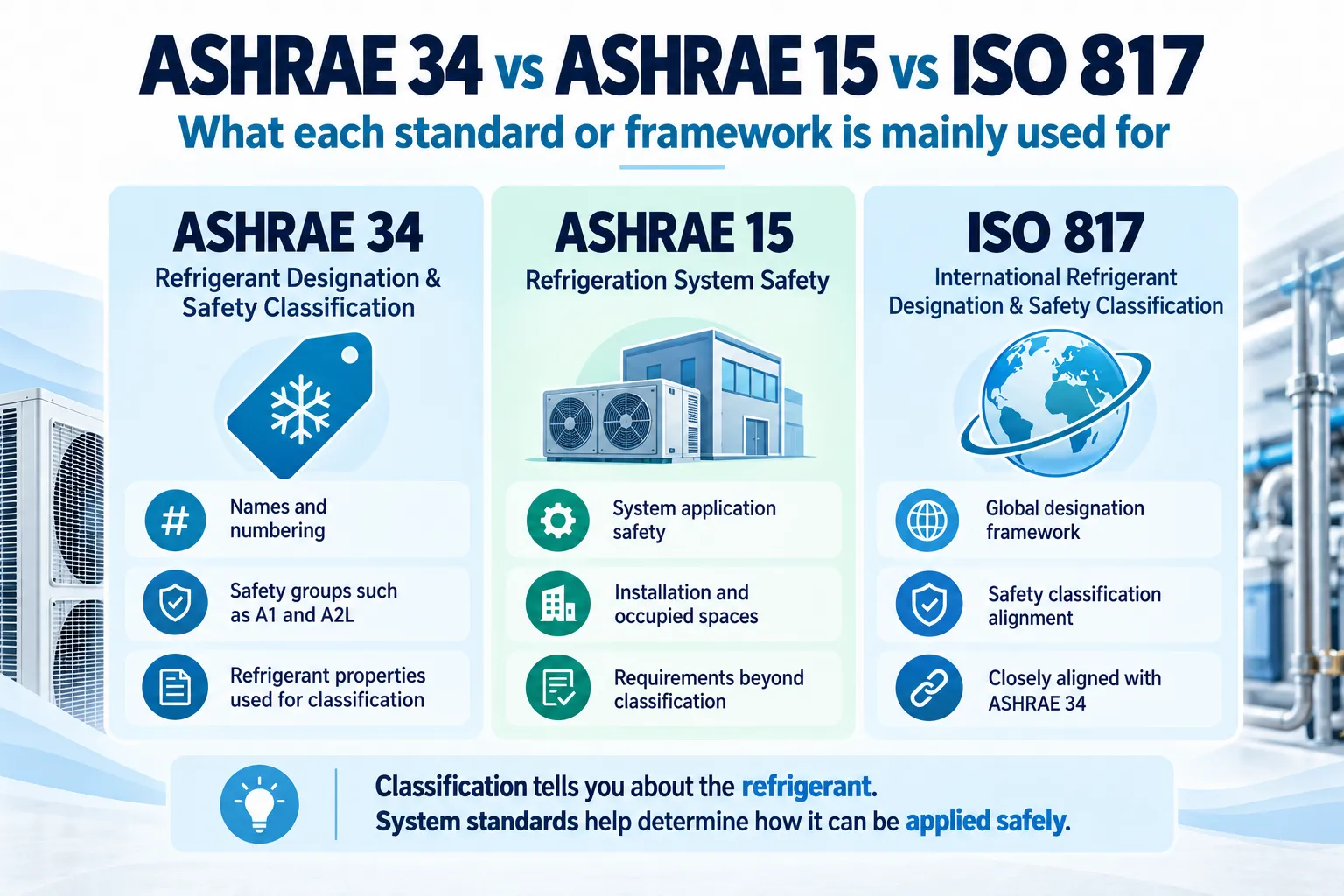
| Standard | Main Role |
|---|---|
| ASHRAE Standard 34 | Refrigerant designation, safety classification and refrigerant concentration information |
| ASHRAE Standard 15 | Safety requirements for refrigeration-system design, construction, installation and operation within its scope |
A simple way to remember the distinction is:
Standard 34 tells you about the refrigerant.
Standard 15 helps govern how refrigeration systems using refrigerants are safely applied within its scope.
The two standards are designed to work together.
Current Standard 15 also has defined scope exclusions and related standards. For example, ammonia systems and residential single-dwelling applications are handled through different applicable frameworks rather than assuming Standard 15 alone covers every refrigeration installation.
ASHRAE Standard 34 vs ISO 817
ISO 817:2024 — Refrigerants — Designation and safety classification provides an international framework for refrigerant designation and safety classification.
Like Standard 34, it considers:
- refrigerant designations;
- toxicity;
- flammability;
- safety classification; and
- refrigerant concentration information.
The two systems are closely aligned, and Standard 34-2024 includes revisions intended to improve further alignment with ISO 817.
They should not, however, simply be described as identical standards.
They are independently published standards within different standards organizations and may have differences in wording, administration and application context.
What Changed in ASHRAE Standard 34-2024?
The 2024 edition introduced several notable updates.
28 Refrigerants Added
ASHRAE added safety designations and data for additional refrigerants as the HVAC/R industry continues to develop lower-GWP alternatives and new blends.
Burning-Velocity Data Added
Burning-velocity information for flammable refrigerants was added to the relevant refrigerant tables.
This is especially relevant to 2L classification.
Greater Alignment with ISO 817
Several revisions were made to improve coordination with ISO 817, including terminology and application-related updates.
OEL and Toxicity Clarifications
The edition includes revisions associated with the definition of occupational exposure limit and toxicity-data requirements.
Refrigerant Numbering Updates
Standard 34 also revised portions of its refrigerant designation framework as the number of registered refrigerants and blends continues to grow.
Because Standard 34 is maintained through addenda, engineers working on compliance-sensitive projects should always verify the current standard and published addenda rather than relying only on an older summary table.
Common Misunderstandings About ASHRAE Refrigerant Classes
“A Means Non-Toxic”
Incorrect.
A means the refrigerant falls into the lower-toxicity group based on the Standard 34 OEL threshold.
“B Means the Refrigerant Cannot Be Used”
Incorrect.
R717 ammonia is B2L and remains one of the most important refrigerants in industrial refrigeration.
“A1 Means Completely Safe”
Incorrect.
A1 does not describe pressure, oxygen displacement, refrigerant charge, frostbite risk or every other system hazard.
“A2L Means Nonflammable”
Incorrect.
A2L refrigerants are flammable under the relevant classification conditions.
The 2L designation indicates lower flammability with an additional low-burning-velocity criterion.
“2L and 2 Are the Same”
Not exactly.
2L is a subclass of Class 2 that satisfies an additional maximum burning-velocity criterion.
“A3 Refrigerants Cannot Be Used Safely”
Incorrect.
R290 and R600a are widely used in purpose-designed systems.
Higher flammability changes the system-design requirements; it does not automatically prohibit use.
“Safety Class Determines Operating Pressure”
Incorrect.
Pressure is a thermodynamic property and is separate from the Standard 34 toxicity/flammability classification.
“Safety Class Determines Maximum Refrigerant Charge”
Incorrect.
Charge limits depend on the application, equipment, room and relevant standards or regulations.
“Refrigerants in the Same Safety Class Are Interchangeable”
Incorrect.
R410A and R744 are both A1 but are clearly not interchangeable.
Likewise, R32 and R454B are both A2L but have different compositions, pressures, thermodynamic behavior and equipment requirements.
How to Look Up a Refrigerant’s ASHRAE Classification
For a reliable classification check:
- Identify the exact refrigerant designation.
- Use current ASHRAE Standard 34 data or an authoritative reference derived from it.
- Check whether published addenda affect the refrigerant.
- Confirm the equipment manufacturer’s refrigerant designation.
- Use the appropriate system/product standard to evaluate actual use.
- Check local regulations for the specific application.
For quick browsing, the Refrigerants.net Refrigerant Database lists safety classes alongside refrigerant type, GWP and common applications.
Frequently Asked Questions
What is ASHRAE refrigerant classification?
ASHRAE refrigerant classification is a safety-group system defined by Standard 34. It combines a toxicity group, A or B, with a flammability class, 1, 2L, 2 or 3.
What does A1 mean for a refrigerant?
A1 means the refrigerant belongs to toxicity Class A and flammability Class 1. In simplified terms, it is in the lower-toxicity group and shows no flame propagation under the specified classification test.
What does A2L mean?
A2L means toxicity Class A combined with the Class 2L lower-flammability subclass.
2L refrigerants satisfy the Class 2 criteria and have a maximum burning velocity of 100 mm/s or less under the specified classification conditions.
What is the difference between A2 and A2L?
Both are toxicity Class A and both exhibit flame propagation.
A2L additionally meets the 2L low-burning-velocity criterion.
R32 is A2L.
R152a is A2.
What does A3 mean?
A3 means lower toxicity group combined with higher flammability.
R290 propane and R600a isobutane are common A3 refrigerants.
What does B2L mean?
B2L means higher toxicity group combined with the lower-flammability 2L subclass.
R717 ammonia is the most important example.
Is R32 A2L?
Yes. R32 is classified A2L.
Is R454B A2L?
Yes. R454B is an A2L refrigerant blend.
Is R1234yf A2L?
Yes. R1234yf is classified A2L.
Is R1234ze(E) A2L?
Yes. R1234ze(E) is classified A2L.
Is R290 A3?
Yes. R290 propane is classified A3.
Is R600a A3?
Yes. R600a isobutane is classified A3.
Is R744 CO₂ A1?
Yes. R744 is classified A1.
However, its A1 classification does not describe the high pressures associated with CO₂ refrigeration systems.
Is R717 ammonia B2L?
Yes. R717 ammonia is classified B2L.
Is A1 safer than A2L?
A1 represents a lower flammability category within the Standard 34 toxicity/flammability classification framework.
However, whole-system safety depends on additional factors such as pressure, refrigerant charge, installation, ventilation, equipment design and application.
Does A2L mean mildly flammable?
The industry sometimes uses “mildly flammable” conversationally, but lower flammability is the more precise terminology when explaining the Standard 34 classification.
A2L refrigerants are still flammable.
Does ASHRAE safety class determine refrigerant charge limits?
No.
Safety classification is one input. Actual charge limits depend on the applicable equipment standard, application, room conditions, installation and regulatory framework.
What is the difference between ASHRAE Standard 34 and Standard 15?
Standard 34 primarily covers refrigerant designation and safety classification.
Standard 15 addresses safe refrigeration-system design, construction, installation and operation within its defined scope.
Is ASHRAE classification the same as ISO 817?
ASHRAE Standard 34 and ISO 817 use closely aligned refrigerant designation and toxicity/flammability classification frameworks, but they are separate standards.
Final Takeaway
ASHRAE refrigerant classification becomes much easier to understand once the code is separated into two parts:
A or B = toxicity group
1, 2L, 2 or 3 = flammability class
That produces eight possible groups:
A1 · A2L · A2 · A3 · B1 · B2L · B2 · B3
The most important mistake to avoid is treating these codes as a complete ranking of refrigerants.
An ASHRAE safety class does not tell you:
- GWP;
- ODP;
- operating pressure;
- efficiency;
- equipment compatibility;
- allowable charge;
- retrofit suitability; or
- whether a refrigerant is legally permitted in every application.
It tells you something much more specific:
how the refrigerant is classified for toxicity and flammability under the Standard 34 framework.
Use that classification as the starting point for system design and risk assessment — not as the entire answer.
Continue with the Refrigerant Safety Guide for broader system-risk considerations, the A2L Refrigerants Guide for lower-flammability refrigerants, or browse the Refrigerant Database to compare classifications across individual refrigerants.
Reference basis: ANSI/ASHRAE Standard 34-2024 and current published addenda; 2025 ASHRAE Handbook refrigerant classification data; ISO 817:2024. Always verify the current standard, applicable system/product standards, equipment documentation and local regulations for compliance-sensitive decisions.
